Practical Guide
Getting Around Ireland
Cars, trains, buses, ferries, and what works for each route. Costs, schedules, and the realistic options for getting from any airport to where you actually want to go.

Cars, trains, buses, ferries, and what works for each route. Costs, schedules, and the realistic options for getting from any airport to where you actually want to go.
The short version: a car opens the whole country, trains and buses connect the cities, and rural Ireland is car-dependent.
A rental car gives you full access. Every coastal road, every village, every castle ruin down a single-track lane. Most road trip routes assume you have one.
Trains run a clean spoke pattern out of Dublin to Cork, Belfast, Galway, Killarney, and Sligo. Fast, comfortable, and a fair price if you book a few days ahead. They do not go everywhere though. Connemara, the Beara Peninsula, the Ring of Kerry coastline, most of Donegal. No rail.
Buses pick up the slack. Bus Eireann reaches small towns the train skips, and private operators run cheap express services on the busy routes. Slower than the train but half the cost.
Uber works only in Dublin, and even there it just calls a regular taxi. Free Now is the dominant taxi app across Cork, Galway, Limerick, and the rest of the cities. Outside cities, do not assume a taxi is one tap away.
A quick scan of what each one is actually good for.
Most flexible, reaches everywhere.
Fastest between major cities.
Cheapest, reaches towns trains skip.
Rarely worth it on an island this size.
Bring your own car from UK or France.
Drive + sleep in one vehicle.
A car removes every “we can not get there from here” problem in Ireland.
A rental car is the single biggest unlock for an Ireland trip. The places most people show up to see, the Cliffs of Moher, the Ring of Kerry, the Wild Atlantic Way, are easier (and often only realistic) with your own car.
Manual transmission is standard. Automatics exist but cost more and book out fast in summer, reserve early. Pickup at Dublin, Shannon, Cork, Knock, and Belfast airports is straightforward.
You need to be 25 or older with most rental companies (some allow 21+ with a young-driver surcharge). Bring your home licence, an International Driving Permit if you live outside the EU, and a credit card in the main driver name.
Insurance is the trap. Basic CDW is included but leaves a large excess (often around €1,500–€3,000). Super CDW removes the excess and runs €15–€25 per day. Most US credit card rental insurance does not cover Ireland, double-check before you fly. Roads outside cities are narrow with hedges right up to the lane. Drive slow.
Best for: Reaching coasts, rural villages, and anywhere off the rail line.
What each one costs, where it goes, and when to use it.
Fast spoke routes out of Dublin to every major city. Slow or absent everywhere else.
Book at irishrail.ie. Fares jump if you walk up the same day, so book a few days ahead. Trains are comfortable, on time, and have a quiet coach.
The Leap Card is not useful for inter-city travel. It works on Dublin commuter rail, DART, and city buses. For inter-city, buy your specific journey ticket online.
Trains beat buses for long routes where comfort matters, Dublin to Cork or Belfast for example. They lose to buses (or cars) wherever the rail does not go: Connemara, Donegal, the Beara and Iveragh peninsulas, most of the Wild Atlantic Way.
| Route | Time | Sample Fare | Frequency |
|---|---|---|---|
| Dublin – Cork | 2h 30m | €30–€70 | ~hourly |
| Dublin – Belfast | 2h 15m | €20–€40 | 8 per day |
| Dublin – Galway | 2h 30m | €25–€45 | ~9 per day |
| Dublin – Killarney | 3h 15m | €35–€75 | 6 per day |
| Dublin – Sligo | 3h | €25–€45 | 8 per day |
Fares quoted are typical advance-purchase singles. Walk-up fares run higher.
Cheaper than trains, slower, and they reach towns the train skips.
Bus Éireann is the national operator and covers basically everywhere with a town in it. Private coaches like Aircoach, Citylink, GoBus, and Dublin Coach run frequent express services on the busy corridors, often beating Bus Éireann on both price and comfort.
Major corridors run every 30 minutes or so during the day. Smaller rural routes drop to a handful per day, sometimes one. Check timetables before you commit, especially on Sundays.
| Operator | Routes | Sample Fare | Notes |
|---|---|---|---|
| Bus Éireann | National network | €8–€25 | Reaches small towns |
| Aircoach | Dublin–Cork, Belfast, Galway | €10–€20 | Premium coaches, hourly |
| Citylink | Galway, Limerick, Cork | €10–€20 | Reliable, frequent |
| GoBus | Dublin–Galway, Cork | €10–€20 | Express, free WiFi |
| Dublin Coach | Dublin–Limerick, Tralee | €10–€25 | Onboard toilets |
Dublin to Galway on a private coach is usually €15–€25 vs €25–€45 on the train.
The island is small. Flying inside Ireland is rarely the right call.
Aer Lingus and Ryanair run a small number of domestic routes, mainly Dublin to Kerry and Dublin to Donegal. By the time you factor in airport transit on both ends, security, and waiting at the gate, the train or a car normally wins.
The exception: if you fly into Dublin and only want to spend time on the Wild Atlantic Way in Kerry or Donegal, a domestic hop can save a real half-day of driving. Fares run €40–€120 each way.
If you are renting a car anyway, drive. The scenery between Dublin and the coast is the trip.
The only way to bring your own car from Britain or France.
Stena Line and Irish Ferries run the main crossings from Britain. P&O and others cover the Northern Ireland routes. Crossings range from 2 hours (Dublin–Holyhead fast craft) to 18 hours (Cork–Roscoff overnight).
Ferry usually beats flying when you want your own car, are travelling with more than two people and a lot of luggage, or are bringing a dog. For a foot passenger flying solo, a Ryanair flight is almost always cheaper and faster.
| Route | Operator | Duration | Notes |
|---|---|---|---|
| Dublin – Holyhead (Wales) | Stena, Irish Ferries | 2h–3h 15m | Most frequent UK crossing |
| Rosslare – Pembroke (Wales) | Irish Ferries | 4h | Quieter, south-east entry |
| Belfast – Cairnryan (Scotland) | Stena | 2h 15m | Fast, frequent |
| Cork – Roscoff (France) | Brittany Ferries | 14h–18h | Seasonal, overnight |
| Rosslare – Cherbourg (France) | Irish Ferries | 17h–19h | Year-round, overnight cabin |
Bringing a car? Book early. Foot passenger only? A flight is usually cheaper.
A campervan turns the loop itself into the lodging plan.
A campervan combines transport and lodging into one bill. For 7+ day trips along the Wild Atlantic Way or a Ring of Kerry loop, the maths often works out cheaper than rental car plus B&Bs, especially in July and August when accommodation prices climb hard.
Park overnight at a registered campsite (€20–€35 a night with hookups), an Aire (free or low-cost designated stops), or a pub or farm that offers “campsite” parking. Wild camping in a campervan is technically not legal in most of Ireland, but you will find informal coastal spots used by everyone. Be discreet and leave nothing behind.
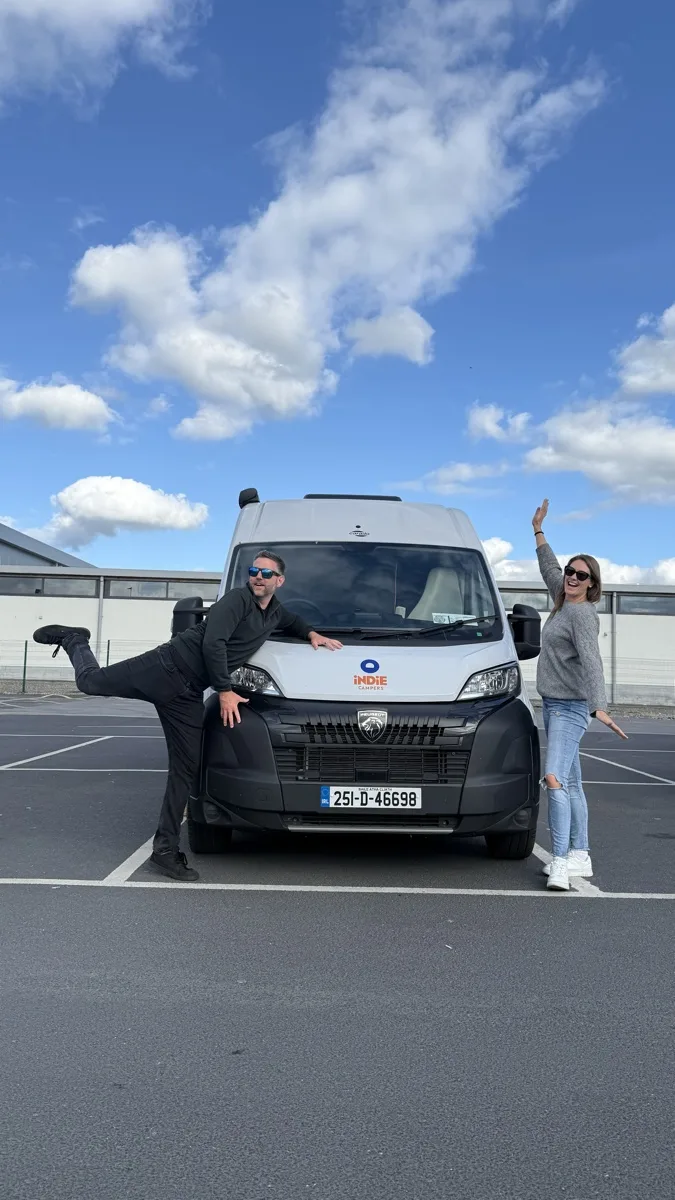
Bunk Campers, Indie Campers, and Camperline are the main rental brands. Manual is standard, automatics cost more. Most companies require drivers 25 or older with two years of licence experience.
Best for: 7+ day Atlantic loops where lodging would otherwise stack up.
How to actually move once you are in town or on the trail.
Uber exists in Dublin but it just hails a regular taxi. Free Now is the actual app you want.
Uber in Ireland is “Uber Taxi” mode only. There is no UberX. Open the app in Dublin and it dispatches a licensed black taxi at the standard meter rate, the same car you would have flagged on the street. Outside Dublin, Uber does not operate at all.
Free Now (formerly Hailo, formerly mytaxi) is the dominant taxi app in Ireland. It works in Dublin, Cork, Galway, Limerick, Belfast, and most larger towns. Cars typically arrive in 5 to 15 minutes in cities. Rural areas, do not assume a taxi is on tap, book ahead by phone if you can.
Fares are metered. A short city ride runs €8–€15. Dublin Airport to the city centre is typically €25–€35 depending on traffic. Tipping is not expected but rounding up is appreciated.
Ireland has a growing network of traffic-free greenways. They are excellent.
The Great Western Greenway runs 42 km along an old railway line from Achill to Westport in County Mayo. Mostly flat, scenic, and family friendly. The Waterford Greenway is similar at 46 km between Waterford city and Dungarvan. Both are paved, well-signed, and have bike rentals at the endpoints.
Dublinbikes is the city bike-share scheme in Dublin. Buy a 3-day pass for €5 at any station. First 30 minutes free, then €0.50 to €5 per hour. Covers most of the city centre and Phoenix Park.
Cycling between cities is feasible on the quieter R-roads but bring patience and a high-vis jacket. Irish drivers tolerate cyclists rather than welcome them. The greenways are where cycling in Ireland actually shines.
Bus, train, taxi, or rental car at every major Irish airport, with prices and travel times.
Ireland’s main entry point. Airlink Express is the simple answer for almost everyone.
| Option | Cost | Time | Notes |
|---|---|---|---|
| Airlink Express (bus 747/757) | €7 | ~30 min | Direct to city centre. Frequent. |
| Aircoach | €10–€18 | 30–40 min | Onward to Cork, Belfast, Galway too |
| Dublin Bus 16 | €2.30 | ~60 min | Cheap but slow. Many stops. |
| Taxi | €25–€35 | 20–35 min | Free Now app works at airport |
| Direct train | — | — | No direct rail. Avoid. |
Most travellers take the Airlink Express. It is fast, simple, and €7. Link out to our full Dublin Airport to city centre guide below.
The main west-coast entry. Most arrivals rent a car here for the Wild Atlantic Way.
| Option | Cost | Time | Notes |
|---|---|---|---|
| Bus Éireann to Limerick | €10 | ~45 min | Then onward train or bus |
| Taxi to Limerick | €40–€50 | ~30 min | Quicker but pricier |
| Car rental | Daily | On arrival | Most popular option for SNN |
If your trip is the Wild Atlantic Way, pick up your rental car here and skip Limerick.
Small, frequent, and the bus into Cork city is cheap and easy.
| Option | Cost | Time | Notes |
|---|---|---|---|
| Bus Éireann 226 | €4 | ~25 min | Every 20–30 min to Cork city |
| Taxi | €20–€30 | ~20 min | Free Now app available |
| Car rental | Daily | On arrival | For onward Kerry or West Cork |
No train. Public transport is limited. Most people rent a car or book a transfer.
| Option | Cost | Time | Notes |
|---|---|---|---|
| Bus Éireann to Charlestown | €5 | ~15 min | Then onward bus to Sligo, Galway |
| Pre-booked private transfer | €30–€80 | Direct | Common for tour groups |
| Car rental | Daily | On arrival | Most flexible. Rural area. |
Onward bus connections from Charlestown are slow. If you have luggage and a tight schedule, rent a car.
Two airports. Airport Express 300 to Belfast city. Translink trains south to Dublin.
| Option | Cost | Time | Notes |
|---|---|---|---|
| Airport Express 300 (from BFS) | £8.50 | ~40 min | To Belfast city centre |
| Airport Express 600 (from BHD) | £2.50 | ~15 min | BHD is closer to Belfast |
| Translink train to Dublin | £20–£35 | ~2h 15m | From Belfast Lanyon Place |
| Taxi to Belfast city (from BFS) | £25–£35 | ~25 min | No Uber in Belfast |
Belfast uses pounds sterling, not euros. The train south to Dublin crosses the border without stopping.
Six guides that cover the questions every Ireland trip starts with.
Most Ireland trips end up using two or three transport modes. Pick the right one for each leg and the whole trip flows.
Quick rules of thumb: city-to-city, take the train. Coast and countryside, rent a car. Dublin-only weekend, taxi and walk. Wild Atlantic Way for 7+ days, consider a campervan. Inbound from the UK with a car, book the ferry.
Whatever combination you land on, lock in airport transfers and the rental car (if you need one) before you fly. Both run out in summer.
5 routes, 32 counties, and the exact bases and stops we’d book ourselves. One free 24-page PDF, in your inbox in under a minute.