A week of golf in Ireland runs roughly 3,500 to 8,000 US dollars per person, and almost all of that spread comes down to two decisions: which courses you play, and where you sleep at night. The cost of a golf trip to Ireland comes down to those two calls, and everything else is rounding.
The problem with most cost guides is they give you a vague range and leave you to guess. We’re not going to do that. Below is a real line-by-line breakdown, green fees at the marquee links, the value courses that cost a quarter of the price, hotels, car hire, caddies, flights, and three sample weekly budgets you can actually plan against.
Quick Answer:
The cost of a golf trip to Ireland runs about 3,500 to 8,000 US dollars per person for a week with flights, and course and hotel choice drives almost the whole spread. A budget week of value links and guesthouses lands near 3,500, a mid-range week around 5,500, and a luxury week playing the marquee names starts around 8,000.
More Ireland Golf Course Guides
- Portmarnock Golf Club Review: A Guide To The Course
- Golfing At Holywood Golf Course: A Complete Guide
- Best Links Golf Courses in Ireland: Top 12 Ranked
What Shapes the Cost of a Golf Trip to Ireland
Five things move the number, and they don’t move it equally. Green fees and accommodation eat the biggest share by a wide margin. Transport, timing, and group size handle the rest.
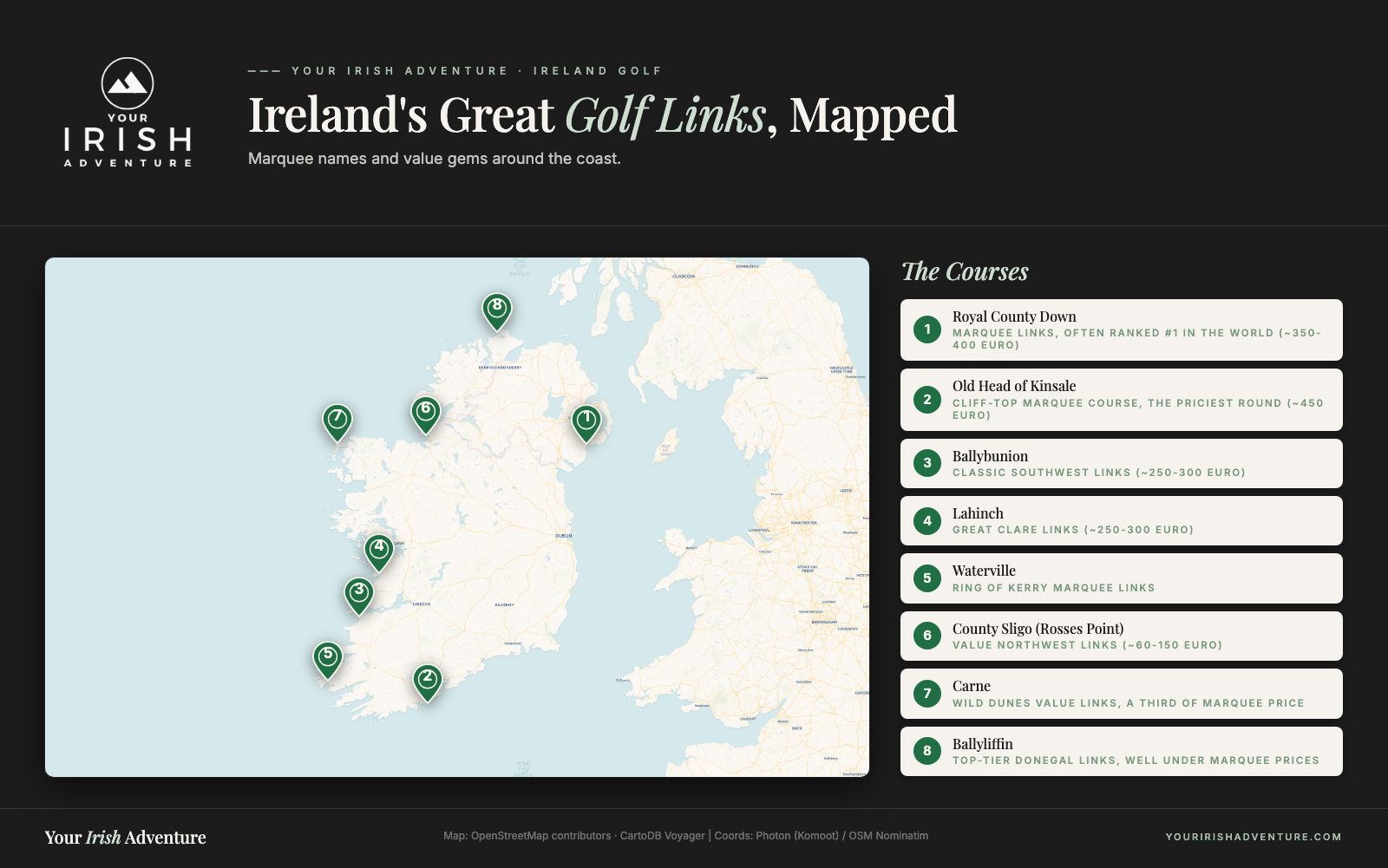
Green fees are the wild card. You can pay 60 euro for a world-class links in the northwest or 450 euro at Old Head. Same country, same standard of golf, seven times the price. Which courses you list decides more than any other choice.
Accommodation is the other heavy line. A guesthouse near the course runs about 80 euro a night. A room at a five-star golf resort runs 400 euro or more. Over seven nights that gap alone is over 2,000 euro per room.
The reason these two lines dominate is simple. You’ll play a round a day and sleep every night, so any change to the per-round or per-night price multiplies across the whole week. A 100-euro swing on green fees is a 700-euro swing on the trip.
Transport is smaller but real: a self-drive rental for the week, or a private driver-guide if you’d rather not deal with narrow roads after a round. Timing swings both green fees and hotel rates by season.
And group size matters because a rental house and a hired van both split cleanly across four golfers, which is why groups of four are the norm.
Two costs sit outside those five and stay fixed no matter what: flights, roughly 600 to 1,200 dollars return from the US, and the on-course extras like caddies and buggies. They matter, but they don’t swing the trip the way courses and hotels do.
Get those five right and you control the trip. Ignore them and the bill controls you. The rest of this breakdown takes each line in turn, with real numbers you can plan against.
How Much Does a Golf Trip to Ireland Cost Overall
For a week of Irish golf, plan on 3,500 to 8,000 US dollars per person, flights included. That’s a wide gate, and it’s wide for a reason: the same seven days can be a budget trip or a luxury one depending on almost nothing except course and hotel choice.
At the bottom end, around 3,500 dollars, you’re playing value links at 60 to 120 euro a round, staying in guesthouses, splitting a rental car, and flying economy booked well ahead.
In the middle, around 5,500 dollars, you mix a couple of marquee rounds in with cheaper courses, stay in good three and four-star hotels, and take a caddie once or twice for the experience.
At the top, 8,000 dollars and up, you’re playing the famous names back to back at 250 to 450 euro each, sleeping at resorts like Adare Manor, riding with a private driver, and taking a caddie every round.
To put rough shape on it, a mid-range week breaks down to about 900 dollars on flights, 1,100 on green fees, 1,300 on hotels, 400 on the shared car and fuel, and the rest on food, caddies, and the clubhouse. Shift any one of those and the total moves, which is exactly why the range is so wide.
Those figures are per person for a group of four. Travel solo and everything that splits, the car, the house, the driver, gets more expensive per head. This is a trip that rewards a foursome.
One more thing the headline number hides: food and drink. Ireland isn’t cheap for either. A pub dinner runs 20 to 30 euro, a pint is around 6 to 7, and the clubhouse round after golf adds up fast over a week. Budget 60 to 80 euro a day per person for meals and you won’t be caught short.
Green Fees at Ireland’s Top Courses
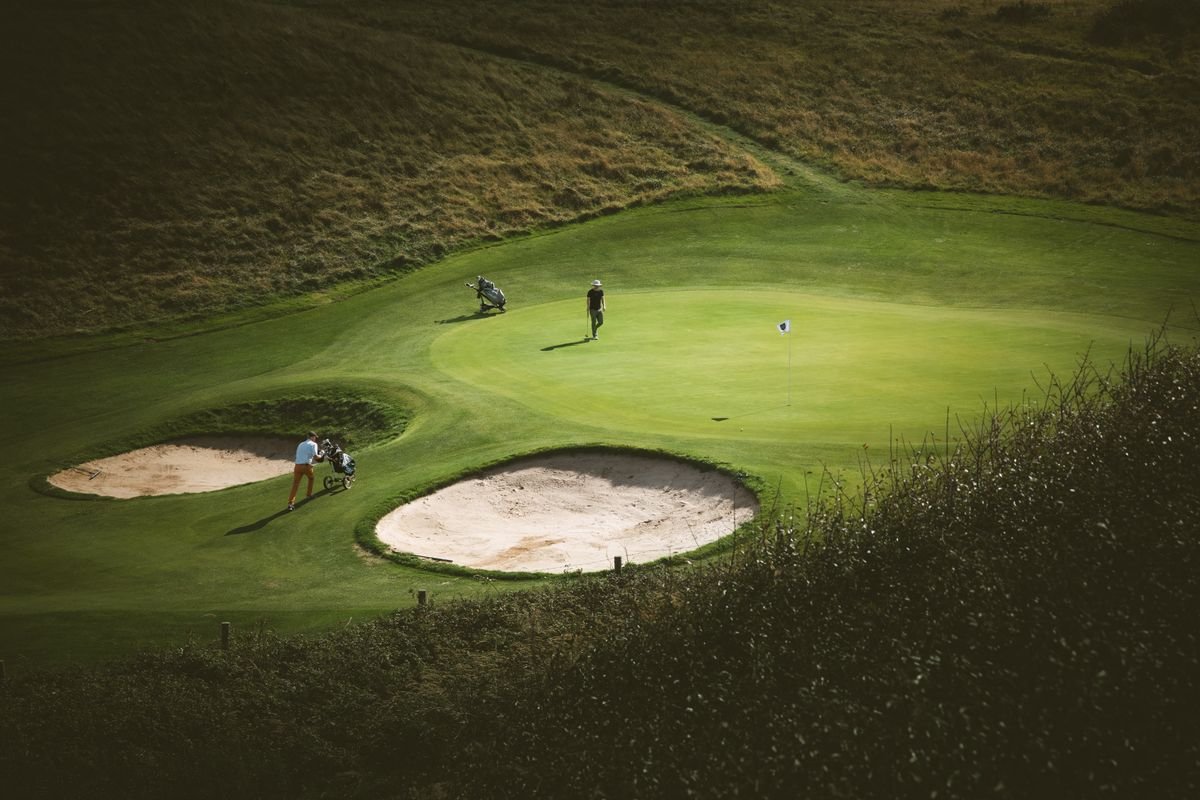
Green fees are where the money goes and where the biggest decisions get made. Ireland has more world-class links than almost anywhere on earth, and they are not all priced the same. The famous ones charge a premium for the name. The ones an hour further from the airport charge a fraction of it for golf that’s every bit as good.
Here’s the math. If you play seven marquee rounds, your green fees alone clear 2,000 euro. Play seven value links and the same week of golf costs you around 700. A lot of golfers who know Ireland do neither, they mix a couple of bucket-list courses with cheaper rounds and get the best of both.
The Marquee Links Courses
These are the names that fill golf calendars. Old Head of Kinsale, perched on a cliff over the Atlantic, sits at the very top, around 450 euro in peak season. Royal County Down in the north is regularly ranked the best course in the world and charges in the same bracket, roughly 350 to 400 euro.
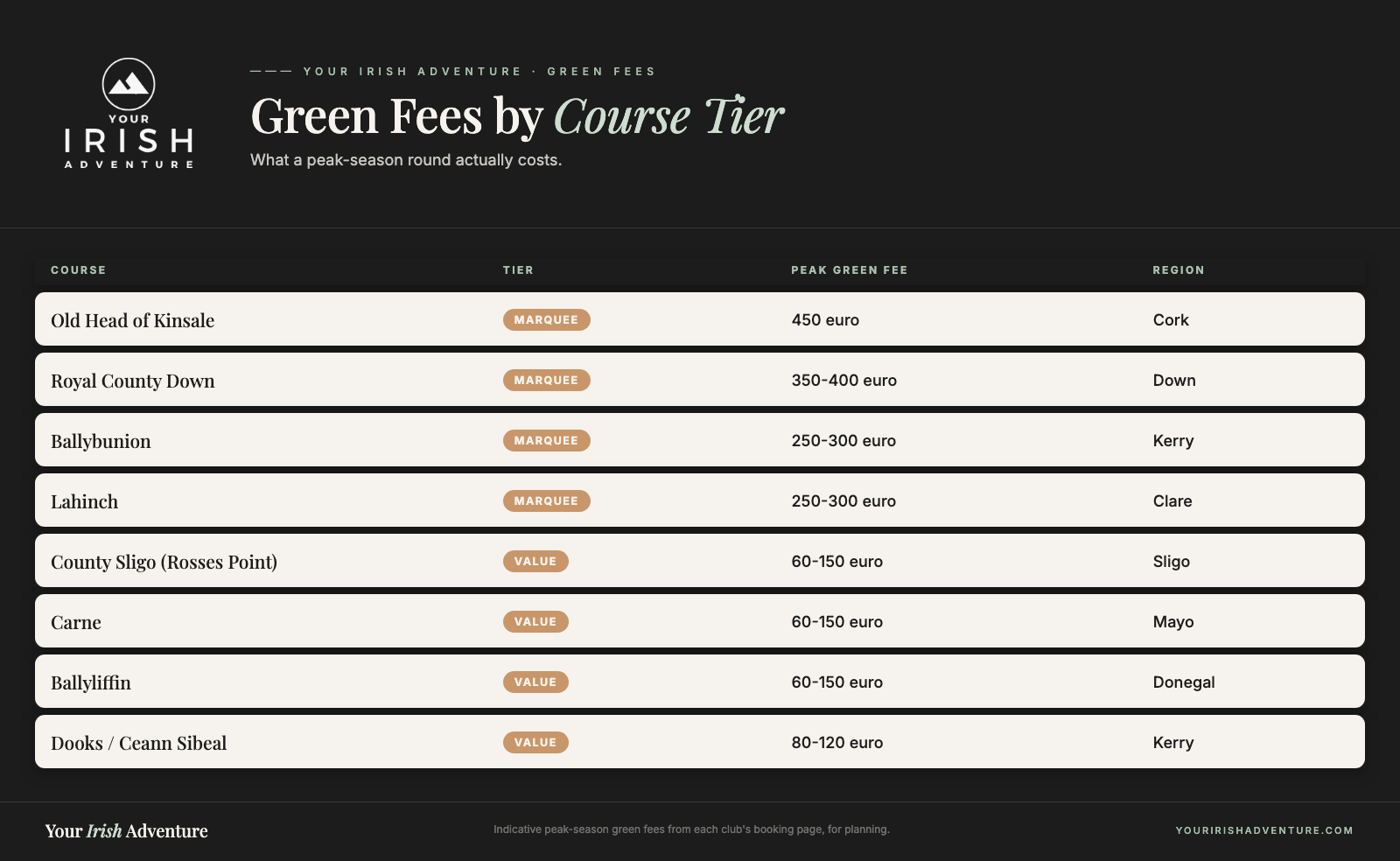
Ballybunion and Lahinch, two of the great southwest links, run about 250 to 300 euro a round in summer. Portmarnock, Waterville, and Tralee land in a similar range. These are once-in-a-lifetime rounds, and the price reflects it.
Book these early, months ahead for the summer peak, and expect the tee sheet to fill fast. A tip if you’re watching cost: many charge less in the shoulder season and less again for an afternoon tee time. Same course, smaller bill.
A word on what the fee gets you. At the marquee links there are often add-ons, a mandatory caddie at a few of them, a stiff cancellation policy, and dress codes that are stricter than most American courses. Read the booking terms before you commit, because a surprise caddie fee can add 90 euro to a round you thought you’d priced.
Value Courses in the Northwest and Beyond
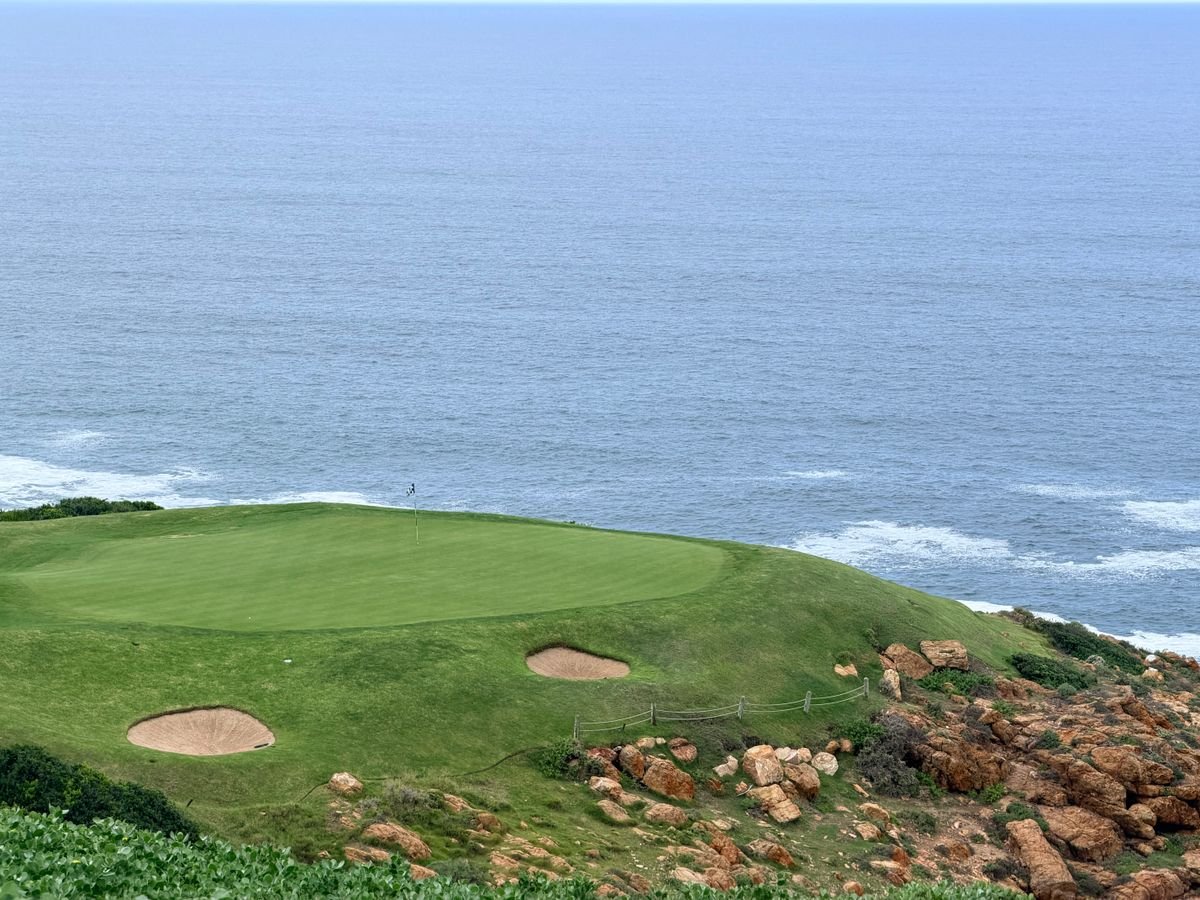
This is the part that changes the whole trip. The northwest of Ireland is stacked with links courses that would charge 300 euro if they were near Dublin and instead charge 60 to 150.
Enniscrone, Carne in County Mayo, Donegal at Murvagh, and County Sligo at Rosses Point are all serious links golf for a third of the marquee price. Carne in particular is one of the wildest, most dramatic sets of dunes in the country, and a round there costs less than one afternoon at Old Head.
It’s not only the northwest. Ballyliffin up in Donegal, Rosapenna nearby, and Portsalon are all top-tier links well under the marquee prices. Down south, courses like Dooks and Ceann Sibeal give you links golf on the Kerry coast for around 80 to 120 euro.
Play a week built mostly around these and your golf could come in under 800 euro total. The catch is the drive, they’re further from the main airports, so they pair best with a road trip rather than a fly-in, fly-out itinerary.
Accommodation: Where You Stay and What It Costs

Accommodation is usually the single biggest line on a golf trip, bigger than flights, often bigger than green fees. And it’s the line where you have the most control, because the range in Ireland is enormous.
At the bottom, a bed-and-breakfast or guesthouse near the course runs about 80 to 120 euro a night for a double, breakfast included. Irish B&Bs are a real value play. You get a proper cooked breakfast, a host who usually plays or knows someone who does, and a bill a quarter the size of a resort.
In the middle, a good three or four-star hotel runs 150 to 250 euro a night. This is where most trips land, comfortable, central to a cluster of courses, with a bar to sit in after the round.
At the top sit the resort names. Adare Manor, Trump Doonbeg, the K Club, Ashford Castle. Rooms here start around 400 euro and climb well past it in summer. You’re paying for a course on the doorstep, a spa, and a level of service that turns the trip into an event.
There’s a fourth option that quietly beats all of them on price for a group: rent a house. A four-bedroom self-catering place near a golf town can run 200 to 350 euro a night for the whole group, which is 50 to 90 euro a head. Split four ways with a kitchen and a living room to sit around, it’s hard to beat.
Location matters as much as price. Staying in a golf-town base like Killarney, Lahinch, or Rosapenna puts a cluster of courses within a short drive and saves you packing up every morning. Pick one or two bases for the week rather than a new hotel every night, and you cut both the driving and the hassle.
One trade-off worth naming: the cheapest B&Bs book out first in peak season, especially near the famous courses. If you want the value beds, reserve them the same day you lock your tee times. Leave it late and you’re pushed up into the pricier hotels by default, so it pays to check availability on Booking.com for your dates as soon as the trip is set.
Where to Stay in Killarney
Killarney is the single best base for a Kerry golf trip. Ballybunion, Tralee, Waterville, and Dooks all sit within an easy drive, the town itself is packed with restaurants and pubs for after the round, and it books up fast in summer. Here are three places worth locking in, one for each budget, all a short walk from the centre.
Killarney Lodge
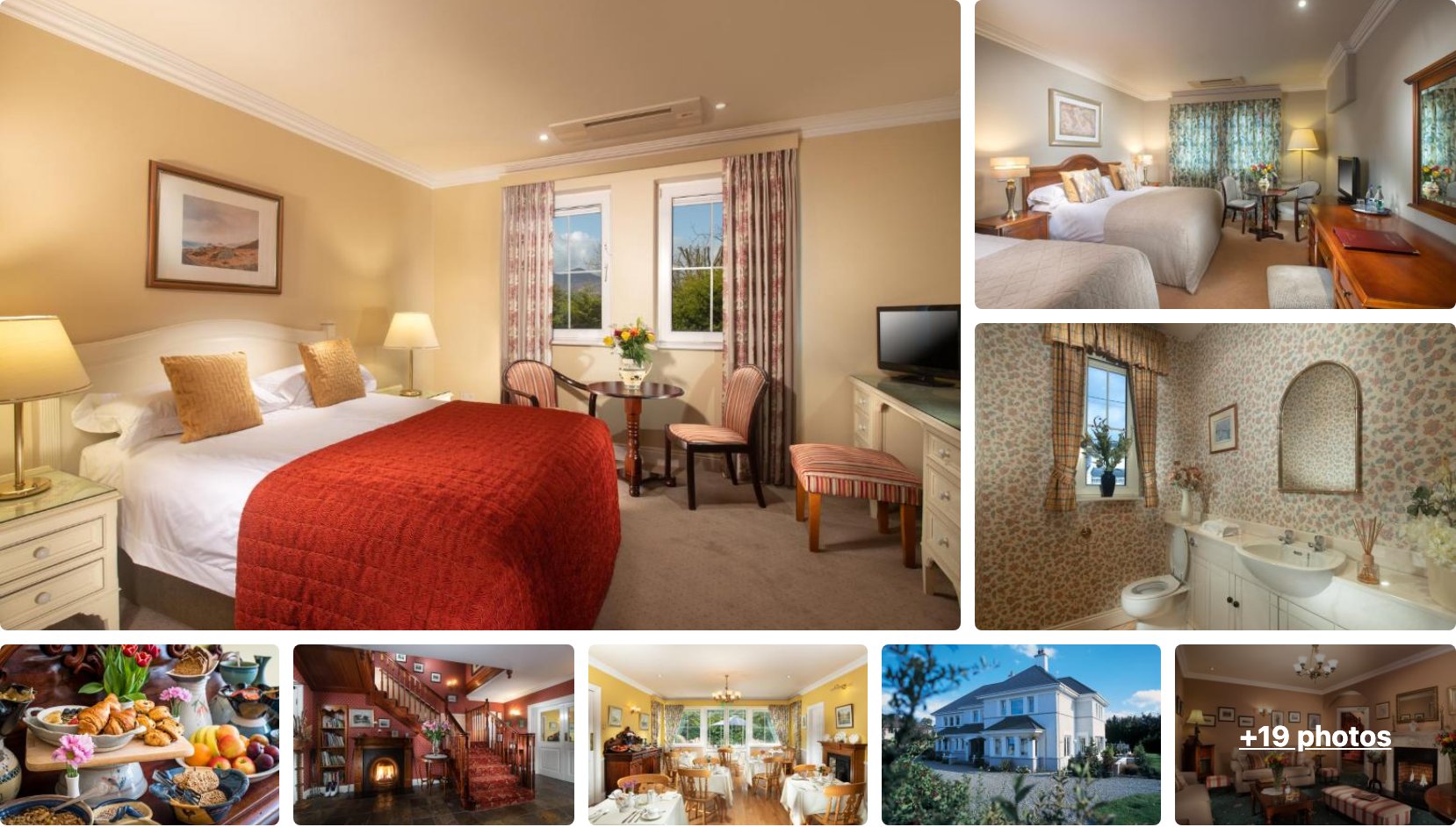
Killarney Lodge is a guesthouse a four-minute walk from the town centre, with a 9.6 guest score across more than 1,000 reviews, which is about as safe a bet as you’ll find here. Rooms are large, the cooked breakfast is included, and there’s private parking for the rental car.
👉 View Killarney Lodge Availability and Pricing
The Killarney Park
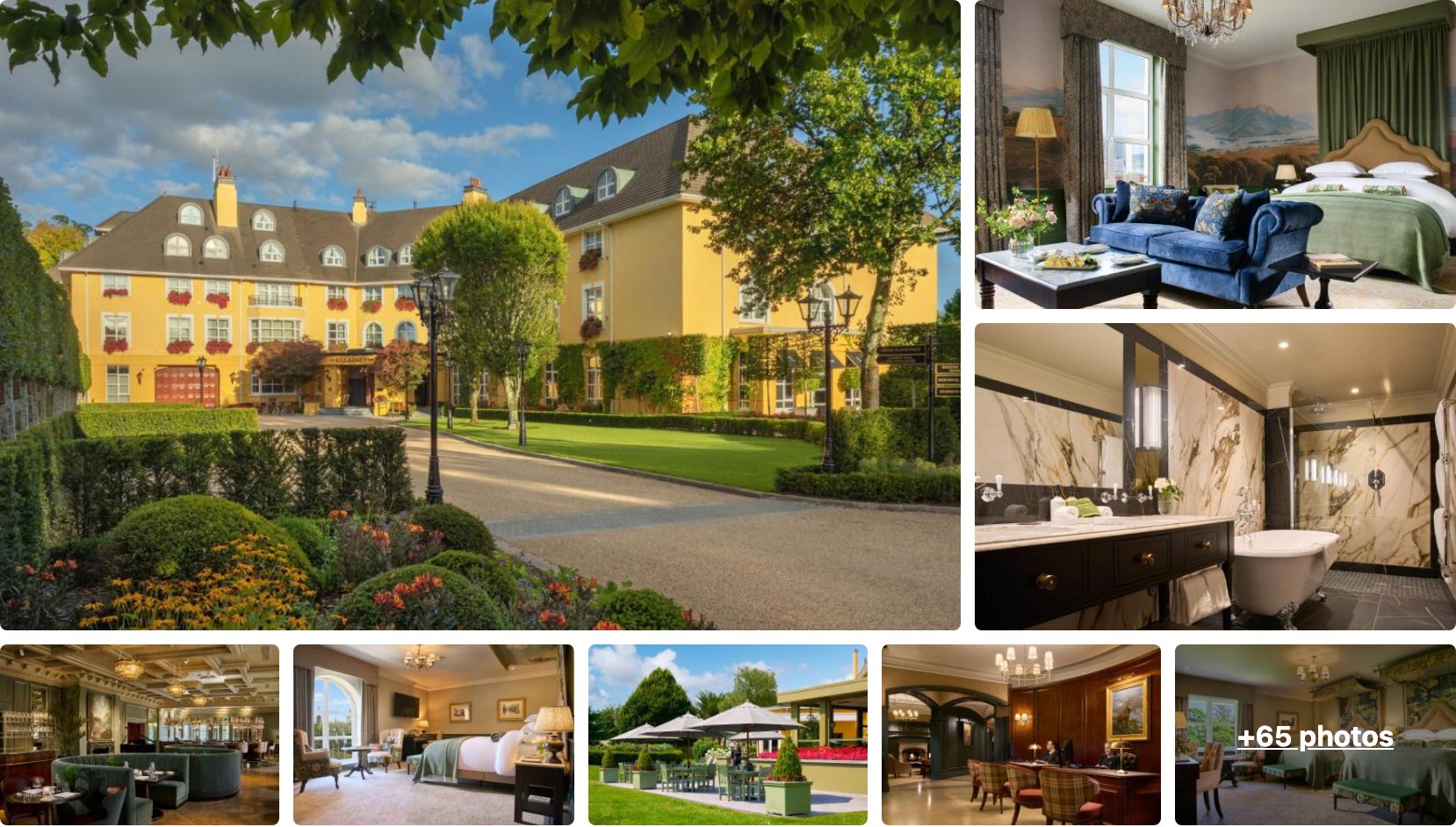
The Killarney Park is the town’s five-star, a 9.8 guest score and 200 metres from the centre, and it’s the splurge pick if you want the trip to feel like an event. There’s a spa and pool to soak the round out of your legs, and the service is the reason it scores as high as it does.
👉 View The Killarney Park Availability and Pricing
Algret House B&B
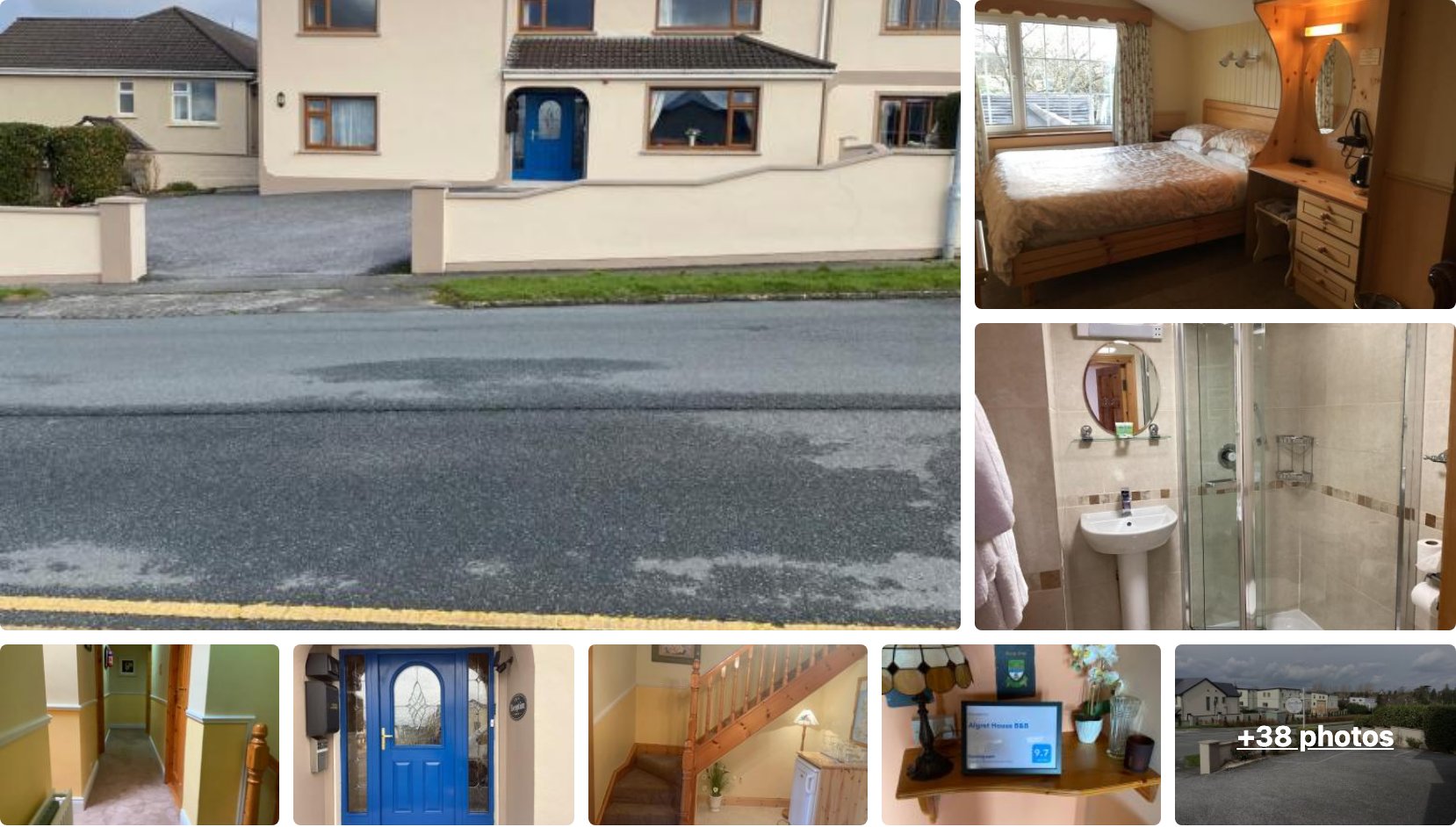
Algret House B&B is the value play, a 9.7 guest score across nearly 700 reviews at a fraction of the hotel rate. It’s a family-run B&B a ten-minute walk from town, breakfast included, and the kind of place where the host will point you at the best local courses. Book it early, beds like this go first.
👉 View Algret House B&B Availability and Pricing
Ranking Ireland’s Best Golf Courses
- 10 Best Golf Courses in Ireland
- 7 Best Northern Ireland Golf Courses
- Reasons To Visit Newcastle, County Down This Summer
Car Hire and Getting Around
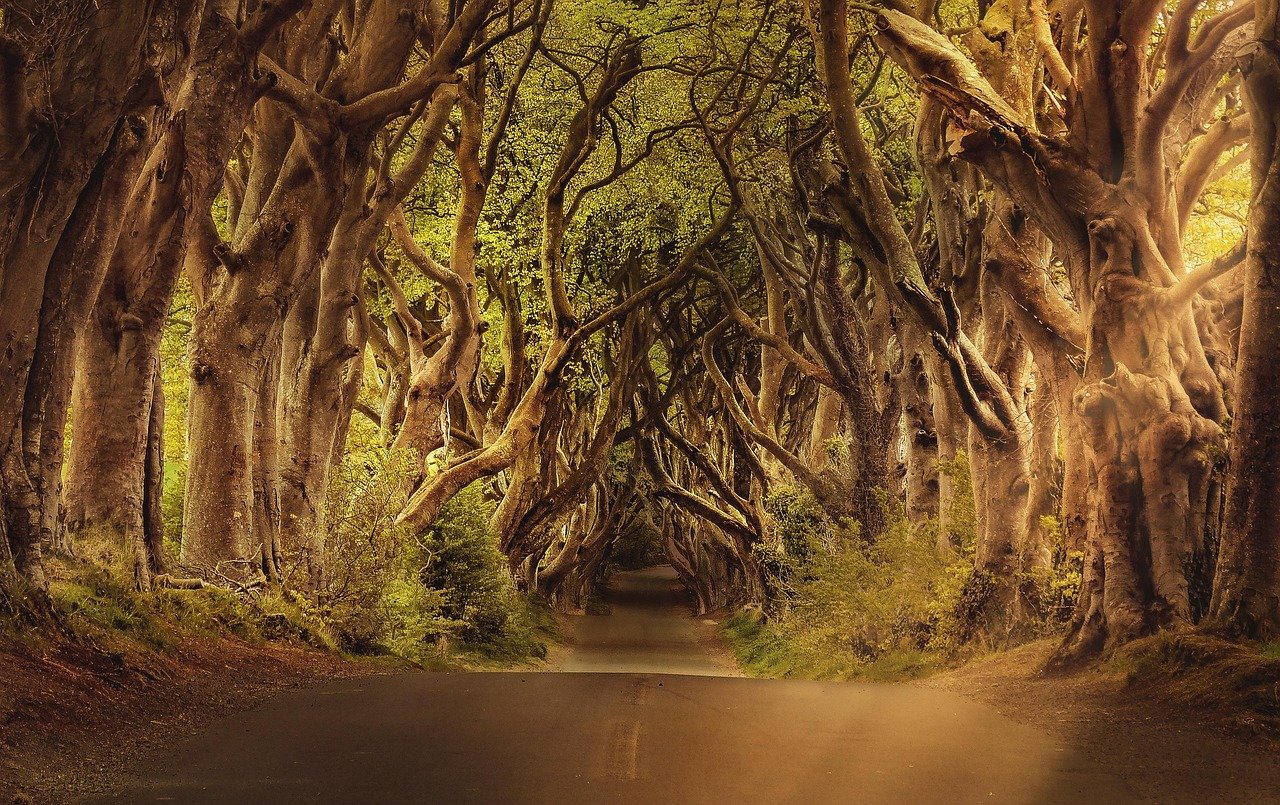
You need a car in Ireland. The best courses are spread along the coasts, often down narrow roads with no public transport for miles. There’s no version of this trip that works on trains and taxis.
We drove the length of Ireland on our last trip, from Dublin down to the southwest and up the Atlantic coast, and the roads are the thing first-timers underestimate. They’re narrow, hedged in tight, and slower than the map suggests.
Plan on more time between courses than you’d think, and enjoy the drive, because the scenery between the golf is half the reason to come. The coast roads through Kerry and Donegal are worth slowing down for.
A self-drive rental runs roughly 300 to 600 euro for the week, depending on season, car size, and how far ahead you book. It’s worth a minute to compare car hire deals on Discover Cars before you commit, since the same car swings a fair bit by supplier. Add fuel, and gas is more expensive than most Americans expect, plus the odd toll on the motorways around Dublin. Budget another 100 to 150 euro for fuel over a week of driving between courses.
Two things to know before you book. First, get automatic if you can’t drive a manual, they’re standard here and the automatics book out fast, so reserve early.
Second, watch the rental car insurance excess, Ireland is notorious for it. Check whether your credit card or a standalone policy covers the collision waiver before you pay the counter rate.
The other option is a private driver-guide, and for a lot of golf groups it’s worth every penny. Expect 350 to 500 euro per day for the whole group in a comfortable van, which splits to around 90 to 125 euro each.
Nobody has to drive tired roads after 18 holes and a couple of pints, and the driver knows every course and pub on the route. Pricey, but it turns the driving from a chore into part of the trip.
Caddies, Buggies and On-Course Extras
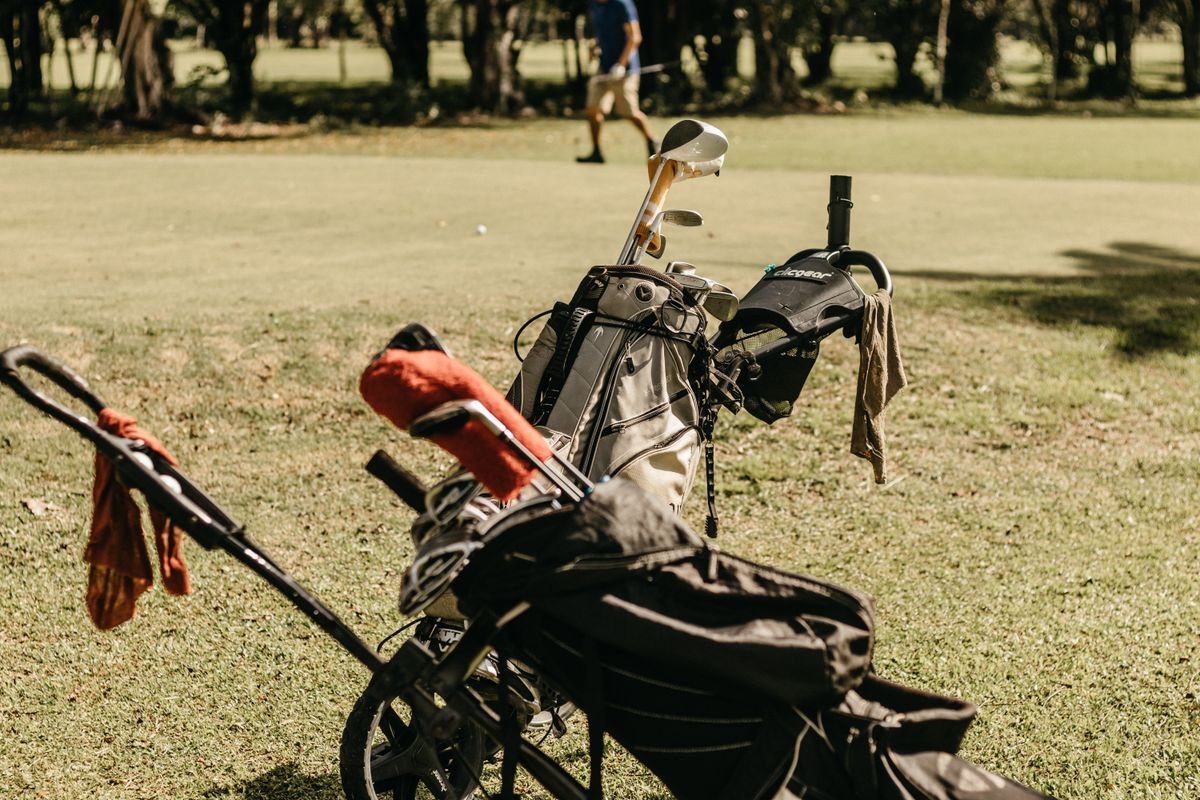
These are the extras that don’t show up in the headline price and quietly add up, so factor them in before you go.
A caddie costs about 50 to 70 euro for the round, plus a tip of 20 to 40 euro on top. On the great links a caddie is more than a bag carrier. They read the wind, know every blind tee shot, and tell you exactly where not to hit it, which on a course you’ve never seen is worth the money at least once.
Buggies are a different story. Many traditional links either don’t allow them or restrict them, and even where they’re offered they run about 40 to 50 euro and often need a medical reason. Irish links golf is a walking game, so plan to walk and pack for it.
Then there’s the small stuff: a pull cart at 10 to 15 euro, club rental at 40 to 60 euro if you don’t want to fly your own over, and the clubhouse bar afterward, which is not cheap and not optional. Set aside a bit for each and nothing surprises you.
Across a week, these extras add up quietly. A caddie every round with tips runs 500 to 700 euro over seven days. Take one every round only if you value it that much, or split the difference and hire a caddie for the two or three courses where local knowledge actually saves you shots.
Flights to Ireland
Return flights from the US typically run 600 to 1,200 dollars, and where you land in that range depends almost entirely on season and how far ahead you book.
Book in the depths of winter for a shoulder-season trip and you’ll find fares near the bottom of that range from the East Coast. Book late for a peak-summer week and you’ll be at the top, or past it. The single biggest lever on airfare is lead time, so lock it in early.
Where you fly into matters for a golf trip. Dublin has the most flights and the best fares, and works well if you’re playing the east and heading north to County Down.
Shannon, on the west coast, drops you far closer to the southwest links, Ballybunion, Lahinch, and Doonbeg, and often saves you a three-hour drive on day one. It’s worth paying a little more to fly into Shannon if the southwest is your golf.
Belfast is the third option, and it’s the smart landing spot if Royal County Down and Royal Portrush are on your list. Fares from the US can be higher than Dublin, but you save a long drive north and start your trip beside two of the best courses on the island.
One more thing golfers forget: check your airline’s rules and fees for flying golf clubs. Most treat a bag as standard checked luggage, but a few charge extra, and it’s cheaper to know before you get to the counter.
Planning the Rest of Your Ireland Trip
- The Definitive Guide To Driving in Ireland For Tourists
- A Photographer’s Definitive Ireland Road Trip
- Wild Atlantic Way Itinerary – Ireland’s Most Epic Road Trip
Guided Tours and Golf Packages vs Doing It Yourself
This is the big fork in the road, and it decides both your cost and how much work the trip is before you ever leave home.
A golf package or tour operator bundles it all: tee times at the courses you want, hotels, a driver, and a schedule that fits. You pay one price and someone else handles the logistics. If you’d rather someone else drive the scenic legs between rounds, you can also book a guided tour of the southwest on GetYourGuide and fold it around your tee times.
The upside is real. They hold blocks of tee times at the marquee courses that are hard to book on your own, and they smooth over every detail. The downside is you pay a premium for it, usually 20 to 40 percent over doing it yourself.
Doing it yourself saves that premium and gives you full control. You pick every course, every hotel, and every stop. But it’s real work. Booking a tee time at Royal County Down or Old Head in peak season is not a five-minute job, and if you leave it late the good slots are gone.
There’s a middle path a lot of groups miss. You can book your own hotels and car, then use a tee-time booking service just for the two or three marquee courses that are hard to get. You pay a small booking fee on those rounds and skip the full-package markup on everything else.
Here’s the call. If you’re experienced planners who like the process and can book six months out, do it yourself and put the savings toward another round. If you’re short on time or just want the famous courses locked in, a package is worth the premium. Neither is wrong.
When You Go and How It Changes the Price
Timing swings the whole bill, sometimes by thousands, and it’s the easiest lever to pull if your dates are flexible.
Peak season is June through August. Green fees hit their highest, hotels charge their most, and the marquee courses book out first. The trade-off is the longest days, you can play 36 holes and still have light for a pint, and the best odds of a dry week. If you want summer certainty, you pay for it.
Those long summer evenings are a real perk in Ireland. In June it stays light past 10pm in the west, which means you can squeeze in a late nine after a full round, or tee off early and beat the day’s crowds. That extra daylight is part of what the peak price buys.
The value play is the shoulder season, May and September. Green fees drop, sometimes by a third, hotel rates ease, and the courses are quieter. The weather is a gamble either way in Ireland, so the shoulder months give up little on that front while cutting real money off the cost. May and September are the smart pick.
Then there’s the off-season, roughly November through March. Cheapest of all, but the days are short, the weather turns properly wet and windy, and some courses cut back their hours. Links golf in an Atlantic gale has its fans, and if that’s you, you’ll have the place to yourself and a small bill to match.
Whatever month you pick, pack for rain and wind. Irish weather turns on a dime, and we’ve had blue sky and a downpour in the same afternoon on the west coast. Good waterproofs and a warm layer matter more than the calendar, because you’ll play through a shower no matter when you go.
Sample Budgets for a Week of Irish Golf

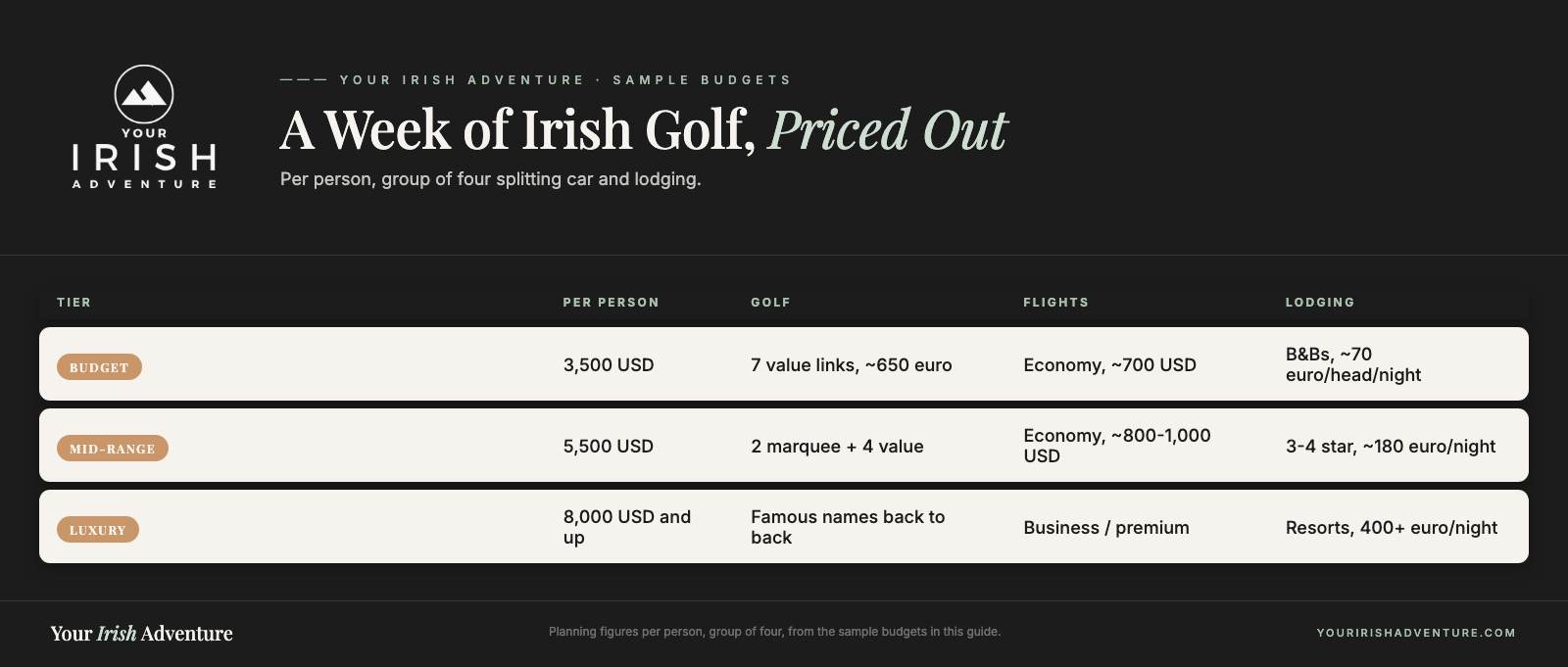
Numbers in the abstract only get you so far, so here is the cost of a golf trip to Ireland priced out three ways, per person, all based on a group of four splitting the car and lodging. These are planning figures, not quotes, but they’ll get you close.
The Budget Week, About 3,500 Dollars
Fly economy booked well ahead at around 700 dollars. Play seven value links in the northwest and west at 60 to 120 euro a round, roughly 650 euro of golf. Stay in B&Bs and a self-catering house at about 70 euro a head per night, and split a rental car four ways.
Walk every round, no caddies. It’s a full week of world-class links golf on a real budget, and the golf is no worse for it.
The Mid-Range Week, About 5,500 Dollars
Fly economy at 800 to 1,000 dollars. Play two marquee courses like Lahinch and Ballybunion at around 275 euro each, plus four value links to fill the week. Stay in good three and four-star hotels at 180 euro a night, take a caddie for the two big rounds, and keep the rental car.
This is the trip most golfers book, the famous names without the resort markup.
The Luxury Week, 8,000 Dollars and Up
Fly business or premium economy. Play the famous names back to back, Old Head, Royal County Down, Ballybunion, and Waterville, at 250 to 450 euro a round. Sleep at Adare Manor and other resorts at 400-plus a night.
Take a private driver-guide the whole week and a caddie every round. This is the no-compromise version, and if a golf trip to Ireland is a bucket-list one for you, it earns the spend.
Money-Saving Tips for an Ireland Golf Trip
You don’t have to spend 8,000 dollars to have the trip of a lifetime here. A few smart moves cut the bill hard without touching the quality of the golf.
Play the Value Links
This is the biggest lever by far. Courses like Carne, Enniscrone, Donegal, and County Sligo give you dramatic links golf at 60 to 150 euro instead of 300-plus. Build your week around these and mix in one or two marquee rounds, not seven. Your golf will barely notice, and your card will.
Travel in the Shoulder Season
May and September cut green fees, hotel rates, and airfare at once, sometimes by a third across the board. The weather is a coin flip in summer too, so you’re giving up very little for a real saving.
Book Direct and Book Early

Book tee times straight with the course rather than through a middleman and you often skip a markup. Book early and you get the cheaper morning or afternoon rates before they’re gone. Lead time saves money on flights, cars, and green fees alike.
Split a House With the Group
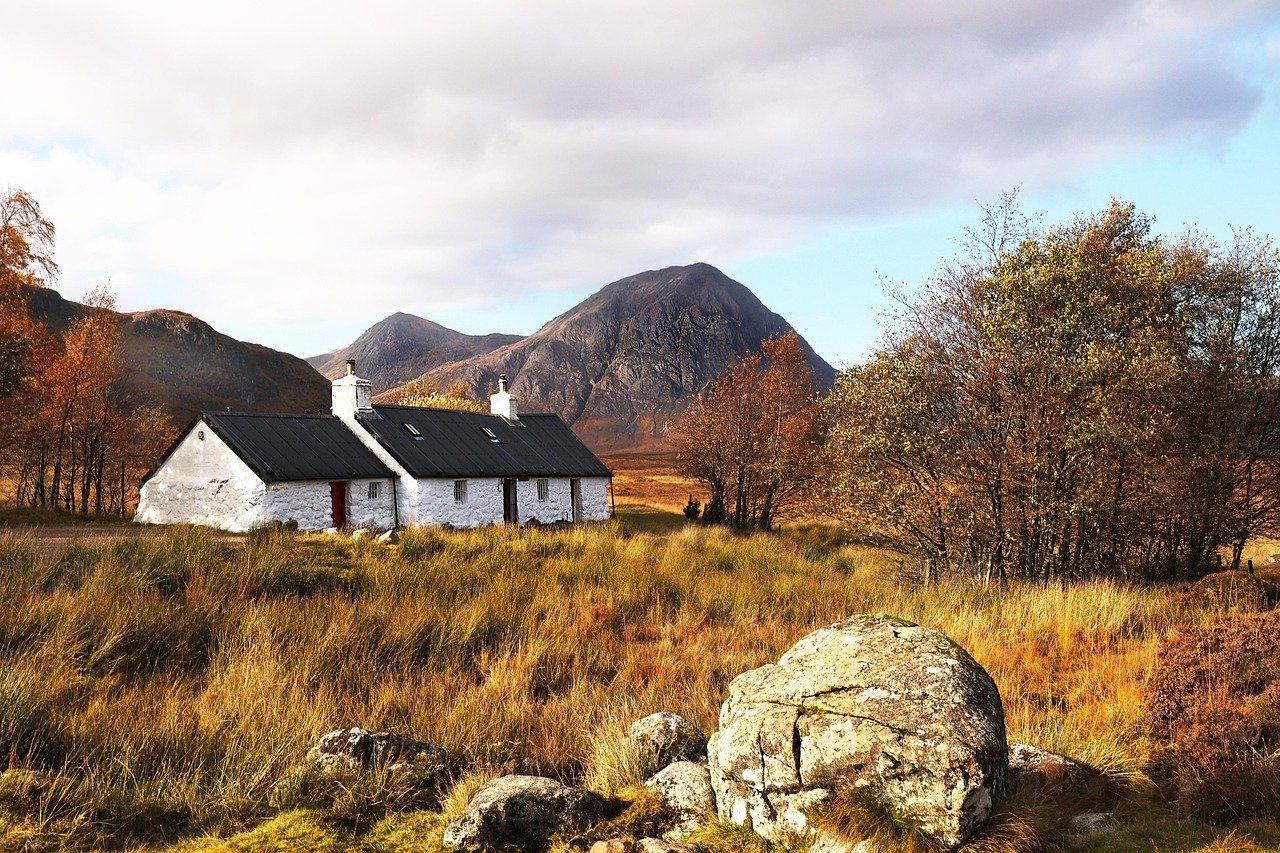
A rental house four ways beats four hotel rooms almost every time. You get a kitchen for breakfast, a place to sit around after the round, and a per-head cost of 50 to 90 euro a night instead of 150-plus. The same logic makes the rental car and the driver cheaper per person, which is the whole case for traveling as a four.
Skip the Caddie on the Rounds That Don’t Need One

A caddie is worth it on a hard, blind links you’ve never played. On a straightforward course, or a second round of the same one, walk it yourself with a yardage book. Cutting caddies from three or four of your seven rounds saves 300 euro or more without hurting your golf.
Fly Into the Right Airport
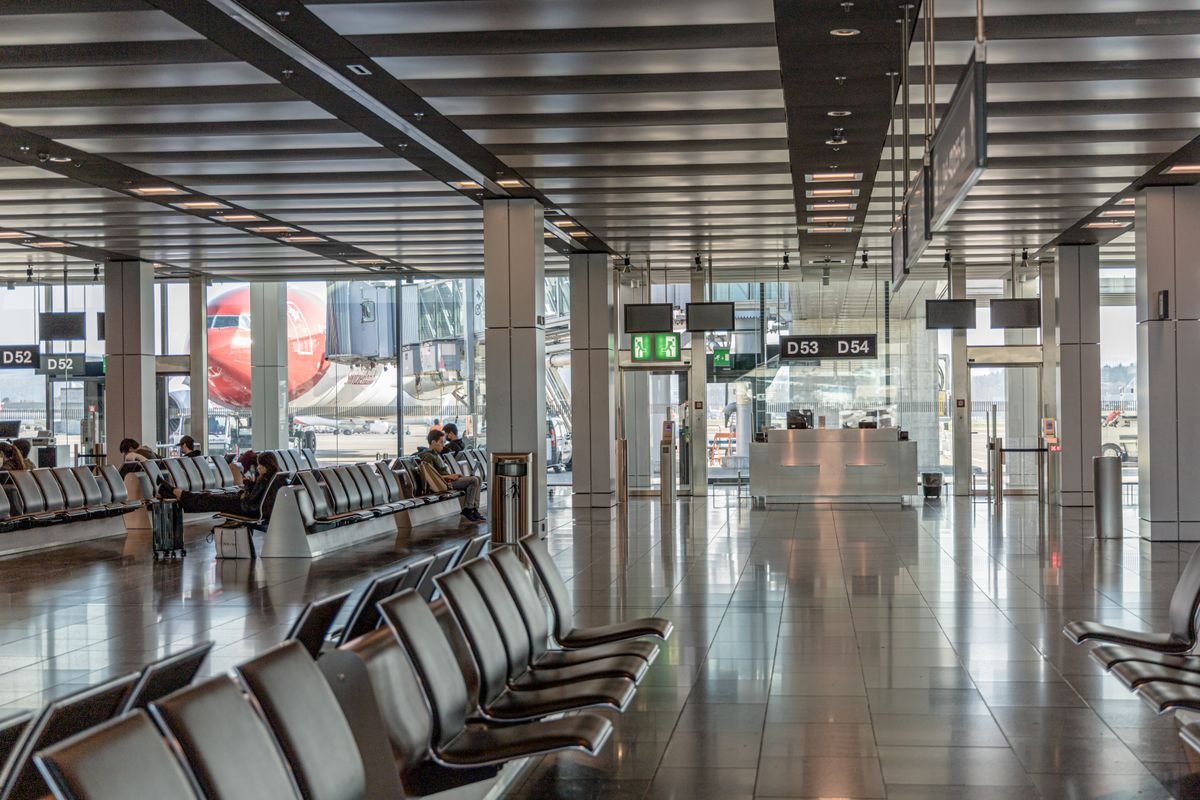
Landing at the airport nearest your golf saves a long drive and a night’s hotel on each end. Shannon for the southwest, Belfast for the north, Dublin for the east. The cheapest fare isn’t a saving if it costs you three hours of driving and a wasted afternoon.
Where to Stay Near the Courses
- Where to Stay in Lahinch: Best Hotels, Lodges & B&Bs
- Where to Stay in County Cork: Cork City vs West Cork
- Where to Stay in Belfast: Best Areas & Hotels
Best Tours in Ireland to Book Around Your Golf
Golf is only half a trip. On a rest day, or the afternoon after an early round, these are the bookable tours worth folding in, and each one sits close to a cluster of the courses in this guide.
From Doolin: Cliffs of Moher Boat Tour
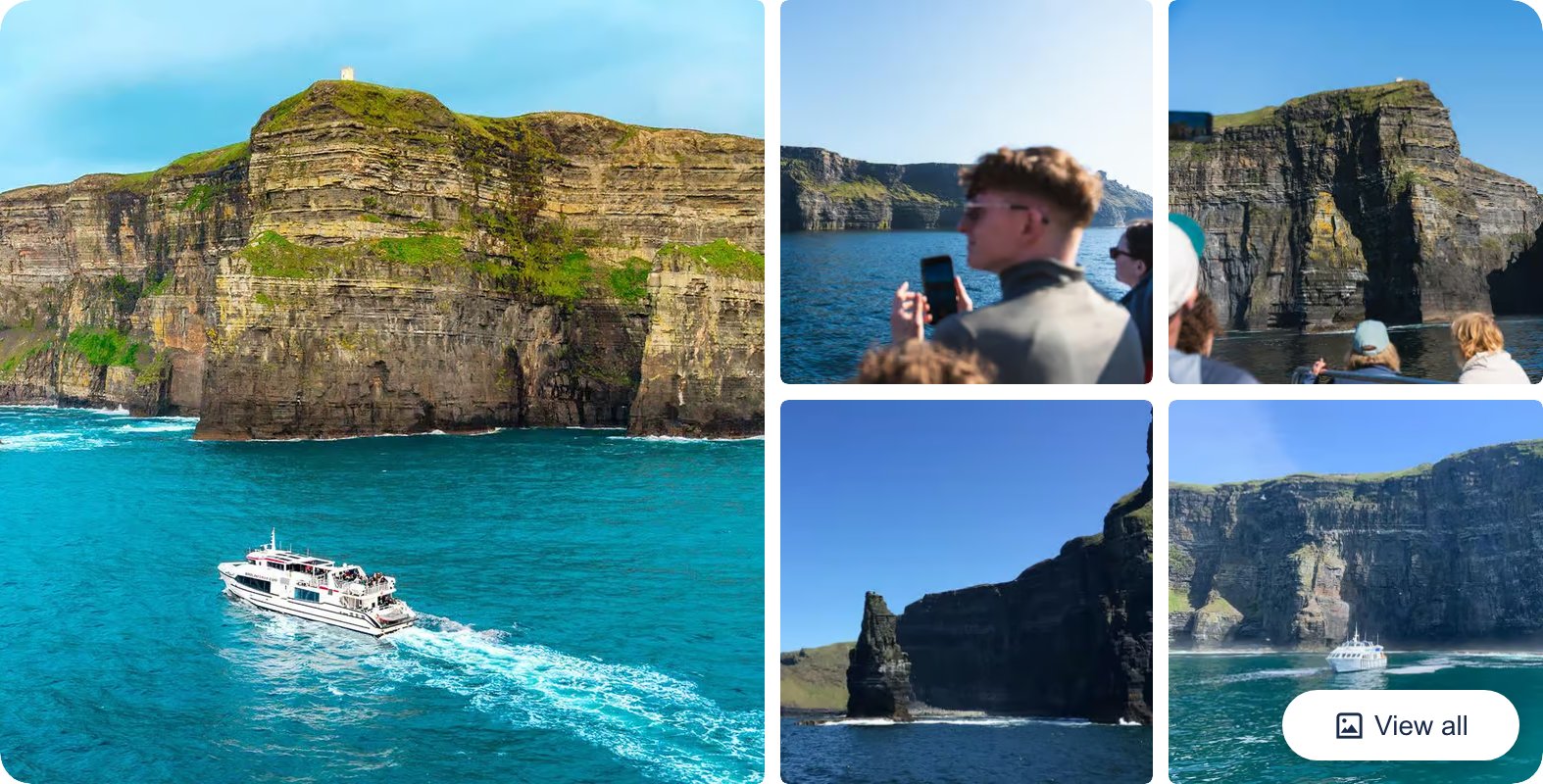
This hour-long cruise leaves Doolin pier and runs along the foot of the Cliffs of Moher, so you see the full 700-foot wall from the water instead of the usual view from the top. It’s an easy half-day if you’re playing Lahinch or Doonbeg, both a short drive away.
👉 Check From Doolin: Cliffs of Moher Boat Tour Availability and Reviews
County Cork: Whale & Dolphin Watching Boat Trip
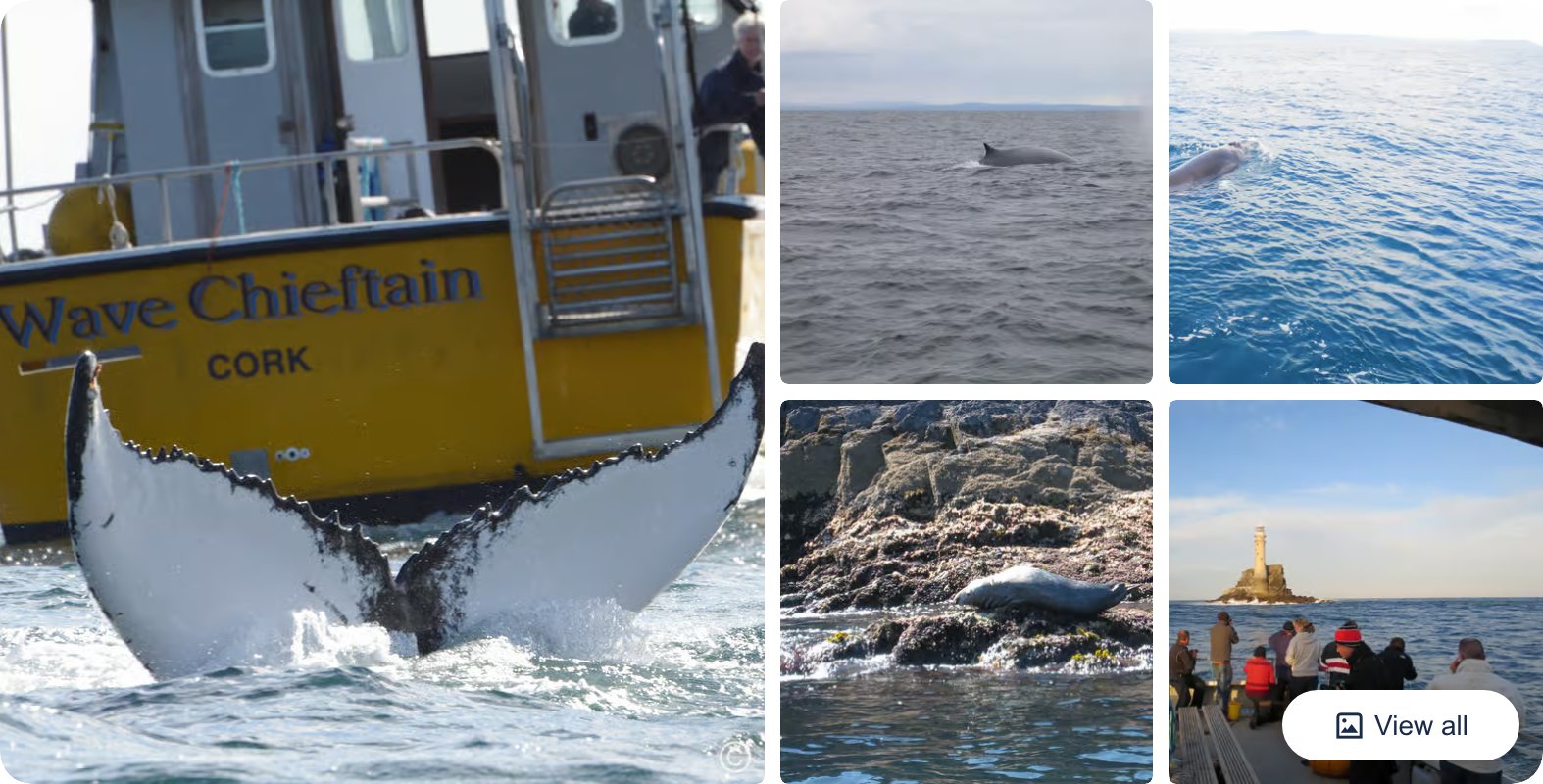
This trip runs out of West Cork and spends three to four hours offshore looking for minke whales, fin whales, and dolphins, passing the Fastnet lighthouse on the way. A good rest-day option if your golf has you down around Old Head and Kinsale.
👉 See what’s included on the County Cork Whale & Dolphin Watching Boat Trip
In short
- A week of Irish golf costs roughly 3,500 to 8,000 dollars per person, flights included.
- Green fees and accommodation drive almost the entire price spread.
- Marquee links like Old Head and Royal County Down run 250 to 450 euro a round; value courses run 60 to 150 euro.
- Return flights from the US run about 600 to 1,200 dollars; a self-drive rental is 300 to 600 euro a week.
- Travel in May or September to cut green fees, hotels and flights without losing much on weather.
Frequently Asked Questions
How much does a golf trip to Ireland cost in total?
Plan on 3,500 to 8,000 US dollars per person for a week, flights included. A budget week of value links and guesthouses lands near 3,500, a mid-range week with a couple of marquee courses runs about 5,500, and a luxury week at resort hotels playing the famous names starts around 8,000.
What’s the cheapest way to play golf in Ireland?
Play the value links in the northwest and west, courses like Carne, Enniscrone, and County Sligo at 60 to 150 euro a round. Stay in B&Bs or split a rental house, travel in May or September, and walk instead of taking caddies. A week done this way comes in around 3,500 dollars all in.
Do you tip caddies in Ireland, and how much?
Yes. The caddie fee is usually 50 to 70 euro for the round, and you tip 20 to 40 euro on top, more if they were great and the course was hard. Bring cash for it, most caddies are paid directly rather than through the clubhouse.
Are golf packages worth the money?
They can be. A package costs roughly 20 to 40 percent more than doing it yourself, but it locks in hard-to-get tee times, handles the driving, and removes all the planning. If you’re short on time or want the marquee courses guaranteed, it’s worth the premium. If you like planning and book early, do it yourself and save.
When is the best-value time to go?
May and September. The shoulder season cuts green fees, hotels, and flights, sometimes by a third, while the weather is nearly as good a bet as summer and the courses are quieter. For most golfers it’s the smartest window of the year.
How far ahead should I book the top courses?
Six to twelve months for the marquee links in peak season. Old Head, Royal County Down, Ballybunion, and the other famous names fill their prime summer tee times early. Book those first, then build the rest of the trip, the flights, hotels, and value courses, around the times you’ve secured.
Do I need to bring my own clubs?
No, but most golfers do. Flying your clubs usually costs the same as a checked bag, while renting a set at the course runs 40 to 60 euro a round, which adds up fast over a week. Bring your own unless you’re only playing a round or two.
Is a Golf Trip to Ireland Worth the Cost
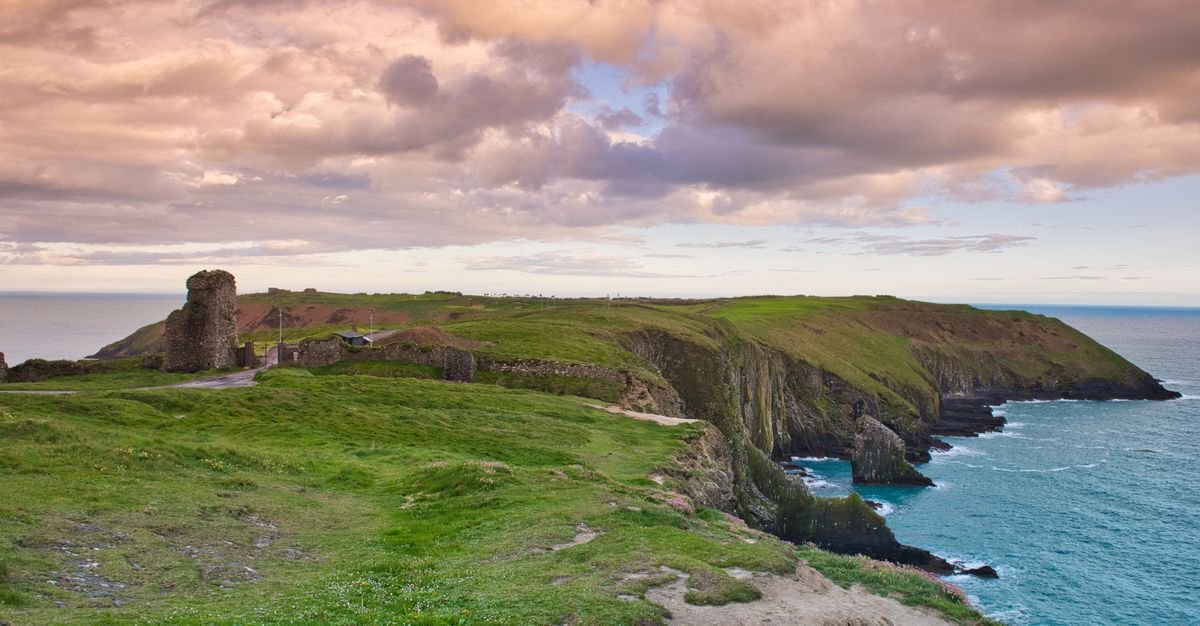
Yes, and it’s not close. There is no other place on earth with this many world-class links packed into a country you can drive across in a few hours, and courses like Old Head and Royal County Down are once-in-a-lifetime rounds that live up to every bit of their reputation.
The trick is matching the spend to what you value, because the cost of a golf trip to Ireland bends entirely to your choices. Plan it well, mix a couple of marquee courses with the cheaper links, travel in the shoulder season, and split the car and lodging four ways, and you get the trip of a lifetime without the luxury bill.
Whether you go budget or all-out, Irish golf earns its price. Set your number, build the week around it, and book the marquee tee times early. Do that and the only surprise left is how good the golf actually is.
Like it? Pin it!
Save this guide for later