
The best ruined castles in Ireland are the ones nobody is standing in front of. Ireland has thousands of them, from clifftop shells on the Causeway Coast to ivy-wrapped towers you can walk to in ten minutes from Galway city.
We spent about two weeks driving the country on our last trip, and a rental car is really the only way to string these ruins together, since most sit down back roads with no bus anywhere near. If you’re planning the same, compare car hire deals on Discover Cars before you go. The ruins we stumbled onto by accident often beat the ones with a ticket booth and a parking lot.
This is the list, from the famous ones like Dunluce and the Rock of Cashel to the ones we’d send you to instead. For each one you’ll get where it is, why it fell into ruin, and how to reach it without breaking an ankle.
Quick Answer:
The best ruined castles in Ireland include Dunluce on the Causeway Coast, the free hilltop Rock of Dunamase in Laois, ivy-covered Ballycarbery in Kerry, and the huge Anglo-Norman keep at Trim. Some are managed sites with an entry fee, but many are free, open, and yours to wander alone.
More Irish Castle Guides
- The Best Castles in Ireland
- The Best Medieval Castles in Ireland
- 5 Top Castles To Visit in Cork (+Castle Accommodation)
- The Most Haunted Places In Ireland
Why Ireland Has So Many Ruined Castles
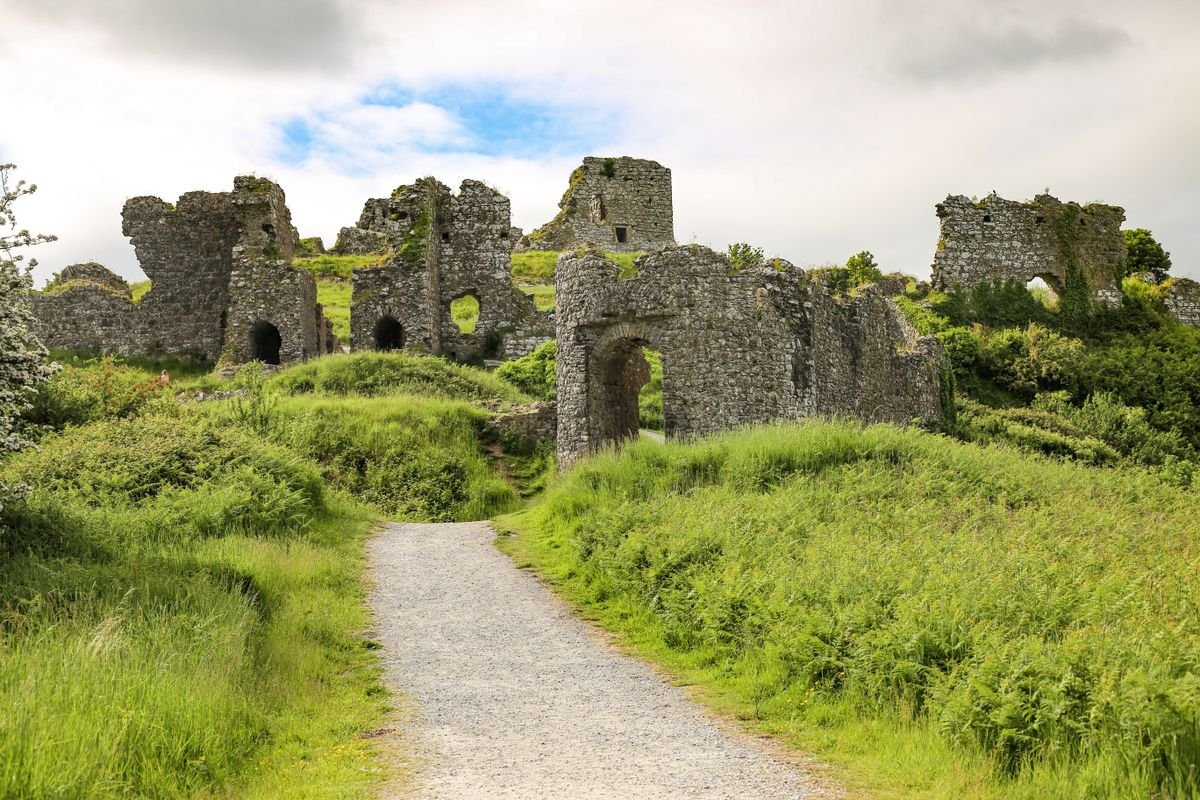
There are thousands of castle ruins scattered across Ireland, and the reason comes down to eight centuries of people building strongholds and other people knocking them down. The Anglo-Normans arrived in the late 1100s and started throwing up forts, then stone keeps like Trim, to hold the land they’d taken.
The bigger reason is the tower house. From the 1400s onward, Gaelic and Anglo-Irish lords built these tall, narrow, fortified homes by the thousand. That’s why so many ruins look alike, and why they’re everywhere.
Then came the wars. Cromwell’s campaign in the 1650s deliberately slighted castles across the country, blowing gaps in walls so they could never be defended again.
Others were simply abandoned when a wealthier owner moved into a comfortable country house and left the drafty old tower to the ivy. Conquest, clan warfare, and slow abandonment did the rest, and the ruins are what’s left standing.
How to Visit Ruined Castles Safely and Respectfully
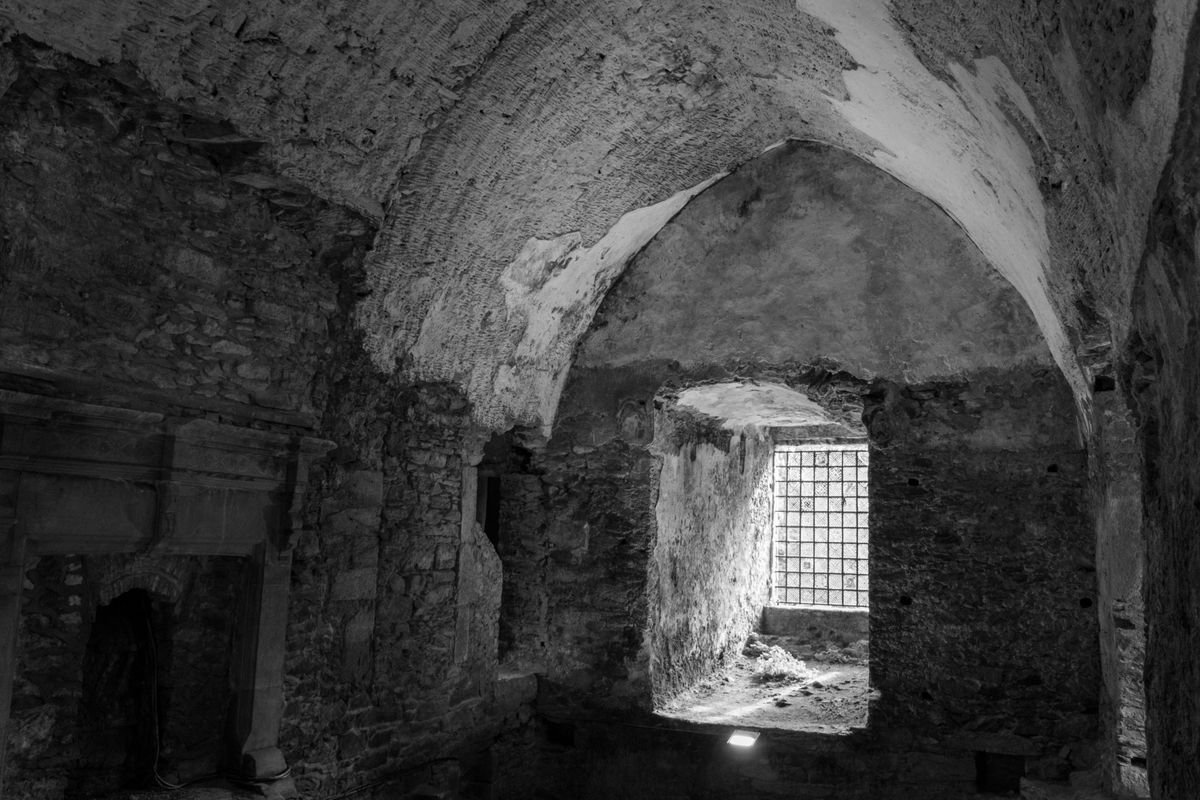
Most of these ruins are not managed sites. There’s no railing, no warden, and no one checking whether the wall above you is about to drop a stone. Treat every ruin as unstable, because a lot of them are.
Don’t climb the walls, don’t stand under overhanging masonry, and keep well back from any edge. That goes double for the clifftop ones like Kinbane and Dunluce, where a gust and wet grass are a bad combination.
A good number sit on private farmland. Ballycarbery is the classic example, reached across a field, and access there has changed over the years. Check locally before you cross anyone’s land, and never assume you’re welcome. If a gate is closed, leave it closed.
Wear shoes with grip. The ground around ruins is uneven, muddy, and often slick with moss, and I’ve slid around plenty of Irish fields in the wrong footwear. For the coastal ones, check the tide before you walk out.
Take your trash back out with you, and don’t carve, stack, or pocket anything. These places have lasted 500 years. Leave them that way for the next person.
The Best Ruined Castles in Ireland
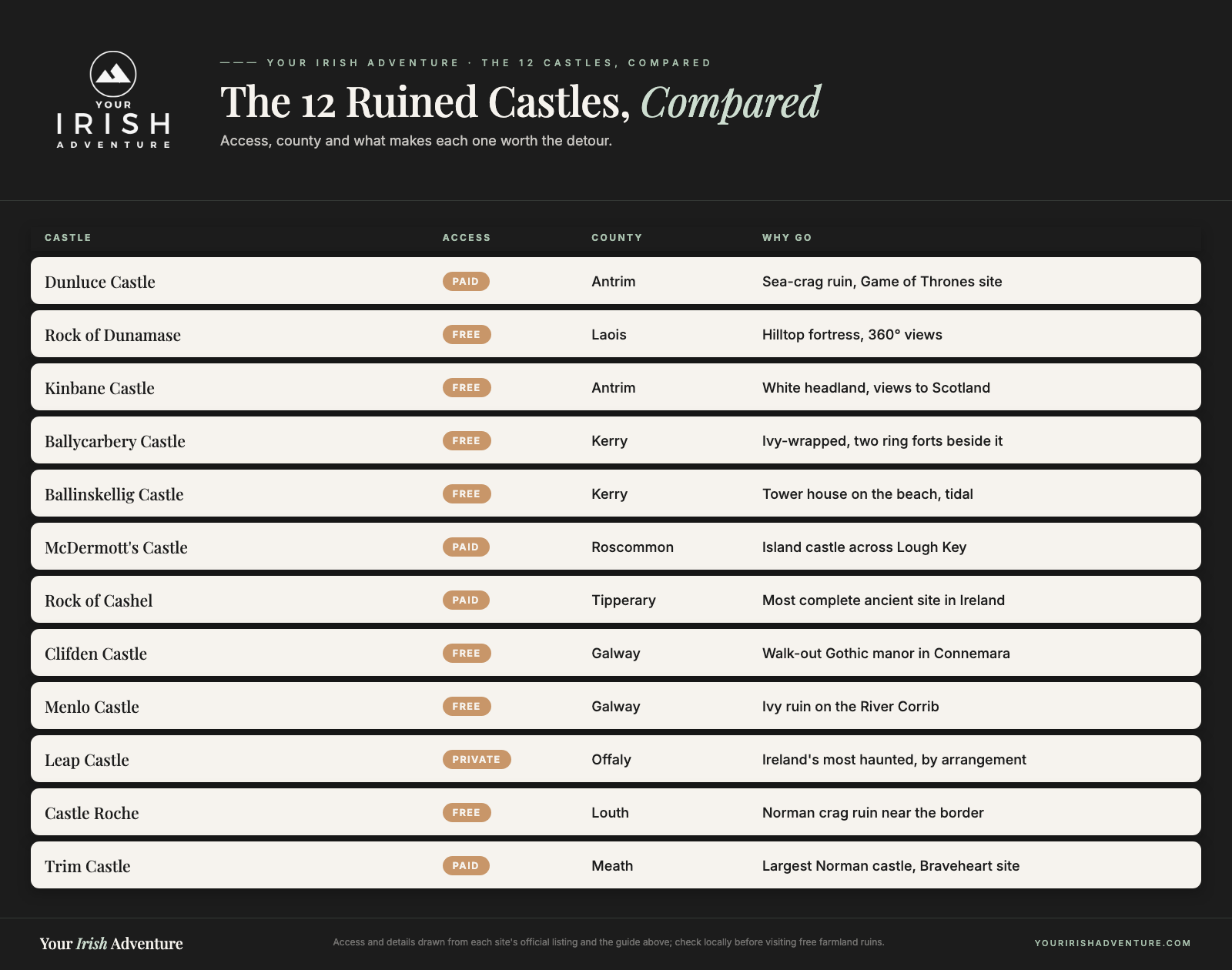
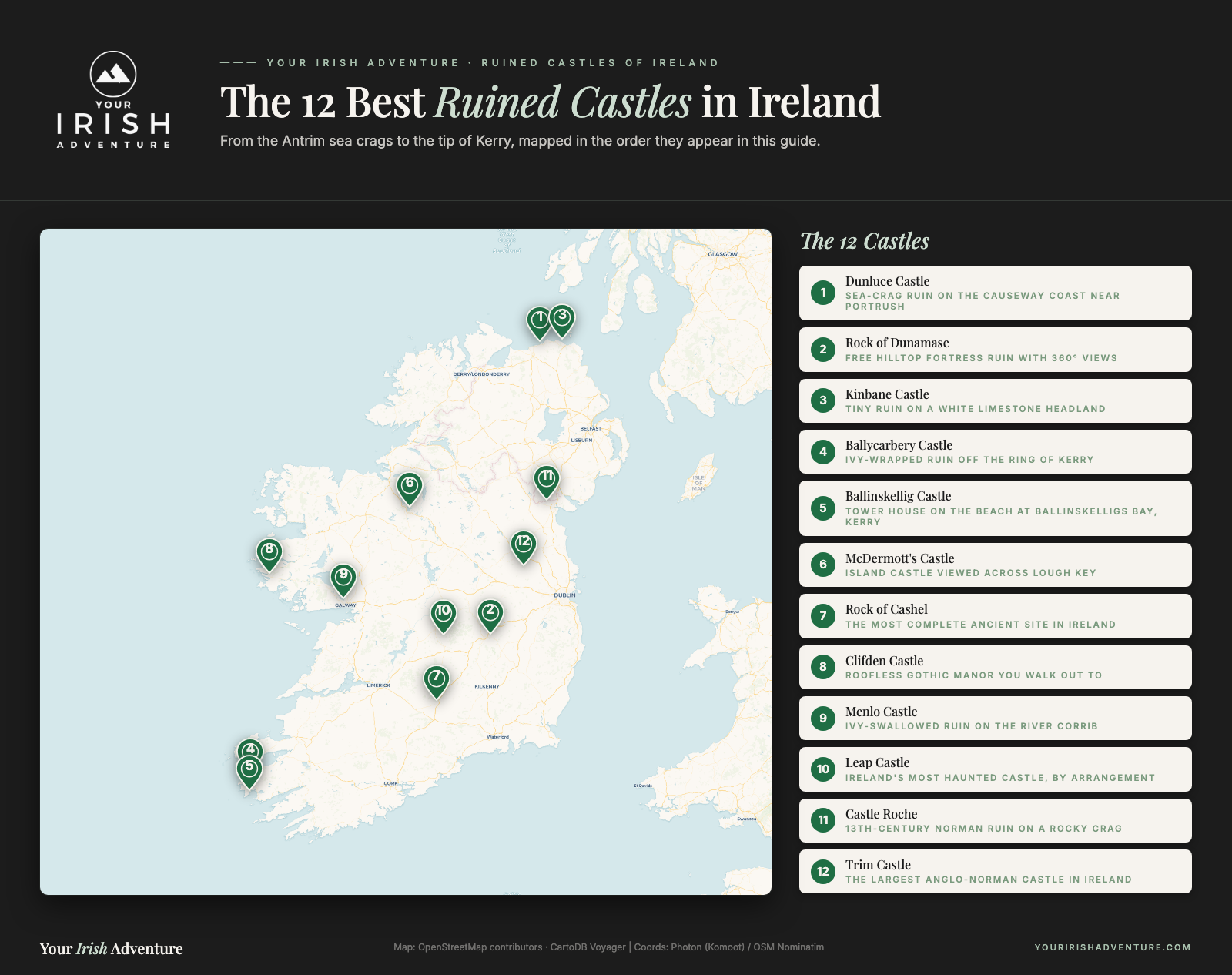
These twelve are spread across every corner of the island, from the far north of Antrim to the tip of the Kerry coast, with a couple in the middle you’ll probably drive straight past. Some are famous and busy, some you’ll have to yourself. I’ve put the standouts first and mixed in a few we walked to ourselves through Connemara and Galway.
Dunluce Castle
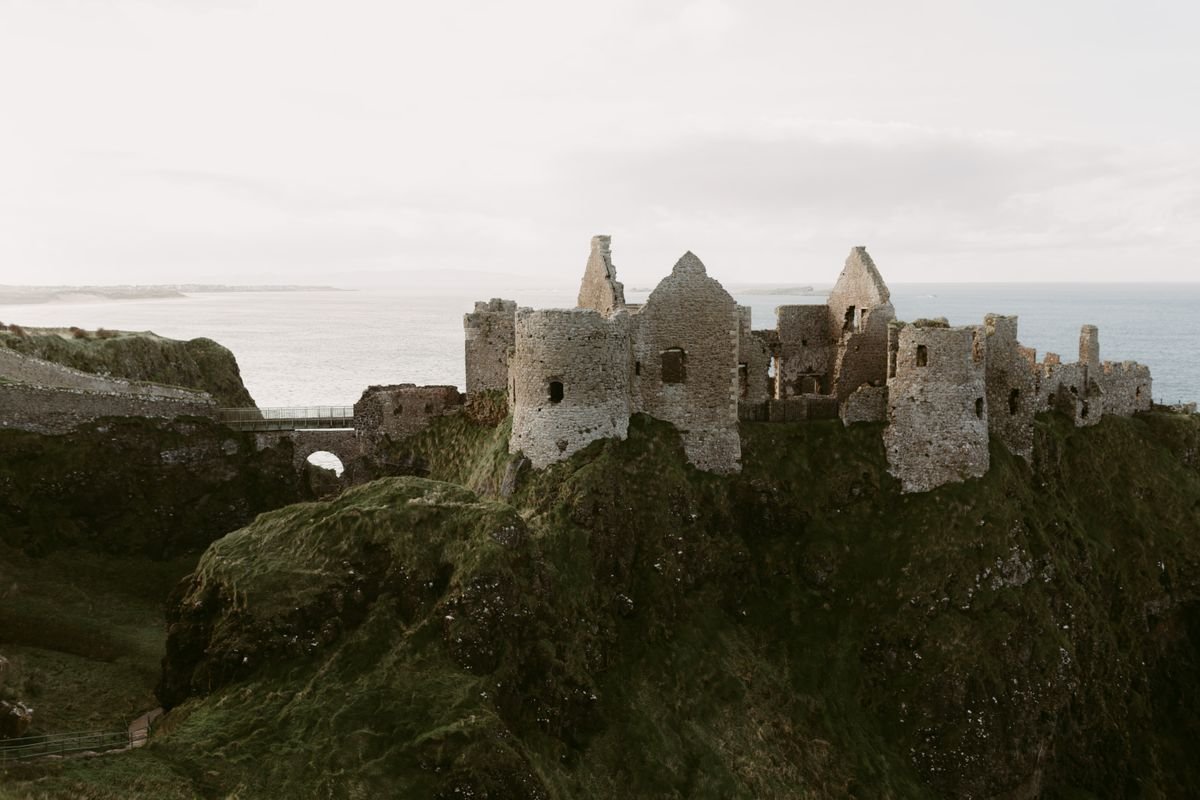
Dunluce sits on a basalt crag jutting out over the sea on the Causeway Coast in County Antrim, and it’s the most photographed castle ruin in Northern Ireland for good reason. The version you see now is mostly 16th and 17th century, built up by the MacDonnell clan on the site of an earlier Norman castle.
The story everyone tells is that part of the kitchen collapsed into the sea one night in 1639, taking staff with it, and the family moved out not long after. Either way, it was abandoned and left to the weather.
You’ll cross a bridge onto the outcrop and walk through roofless halls with the Atlantic on three sides. Fans will recognize it as a Game of Thrones filming location. It’s a paid, managed site with a visitor center, and the cliff edges are real, so keep kids close. If you’re not driving the coast yourself, you can book a Causeway Coast day tour from Belfast on GetYourGuide that pairs Dunluce with the Giant’s Causeway.
Where to Stay near Dunluce Castle (Portrush)
Rock of Dunamase
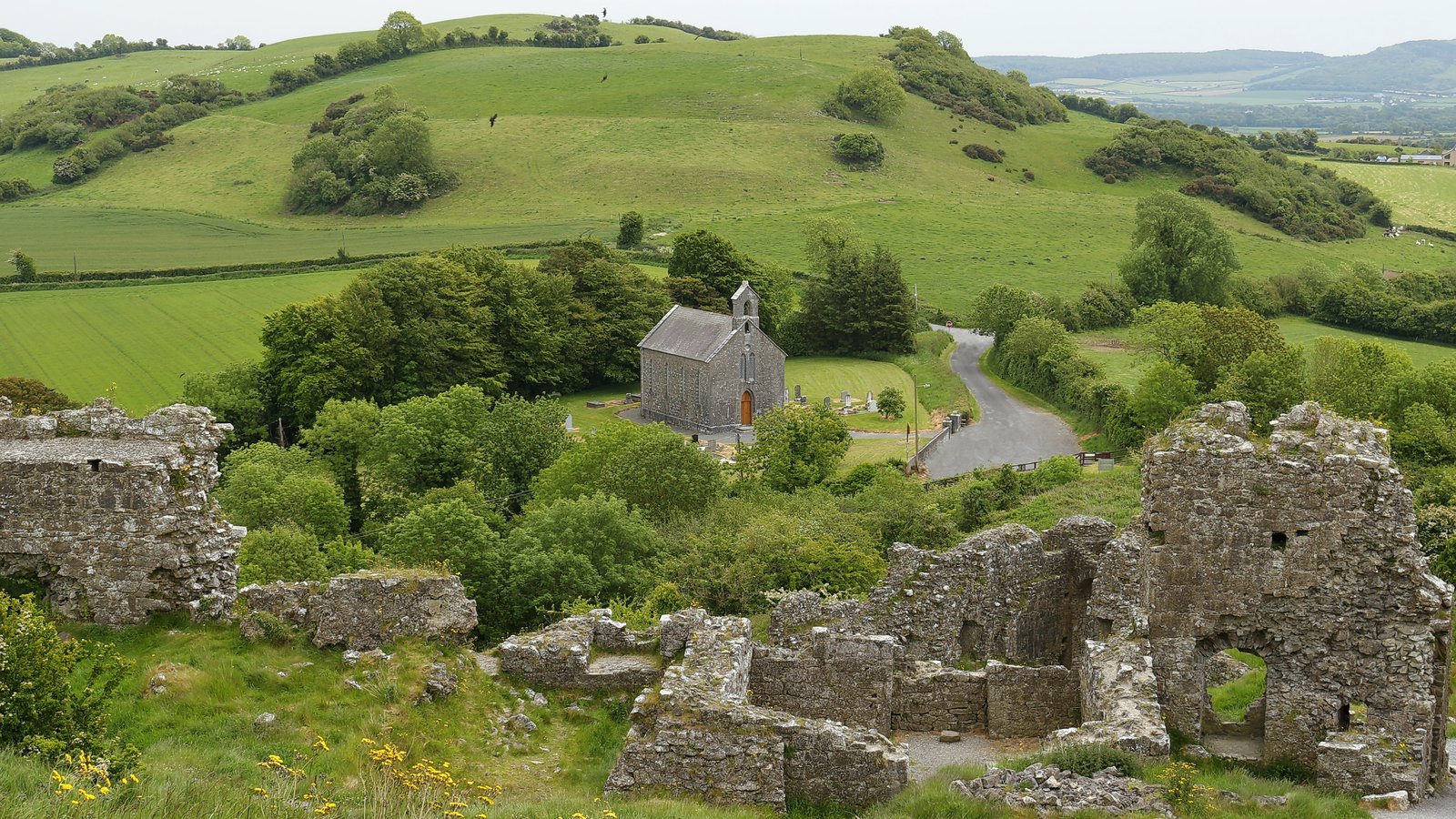
The Rock of Dunamase is a ruined fortress on a limestone outcrop in County Laois, about an hour southwest of Dublin. It’s one of the easiest big ruins to reach if you’re driving west. It started as an early Christian settlement, became an Anglo-Norman stronghold after the 1170s, and passed to the powerful Marshal family through marriage.
Cromwellian forces wrecked it in the 1650s, which is why what’s left is broken walls and gateways rather than a standing keep. The payoff is the climb. From the top you get a full 360 across the Laois plains, and on a clear day you can see for miles.
It’s free, open, and unstaffed, so watch your footing on the loose stone and the steep drops. Plan on 30 to 45 minutes to walk up and around.
Kinbane Castle
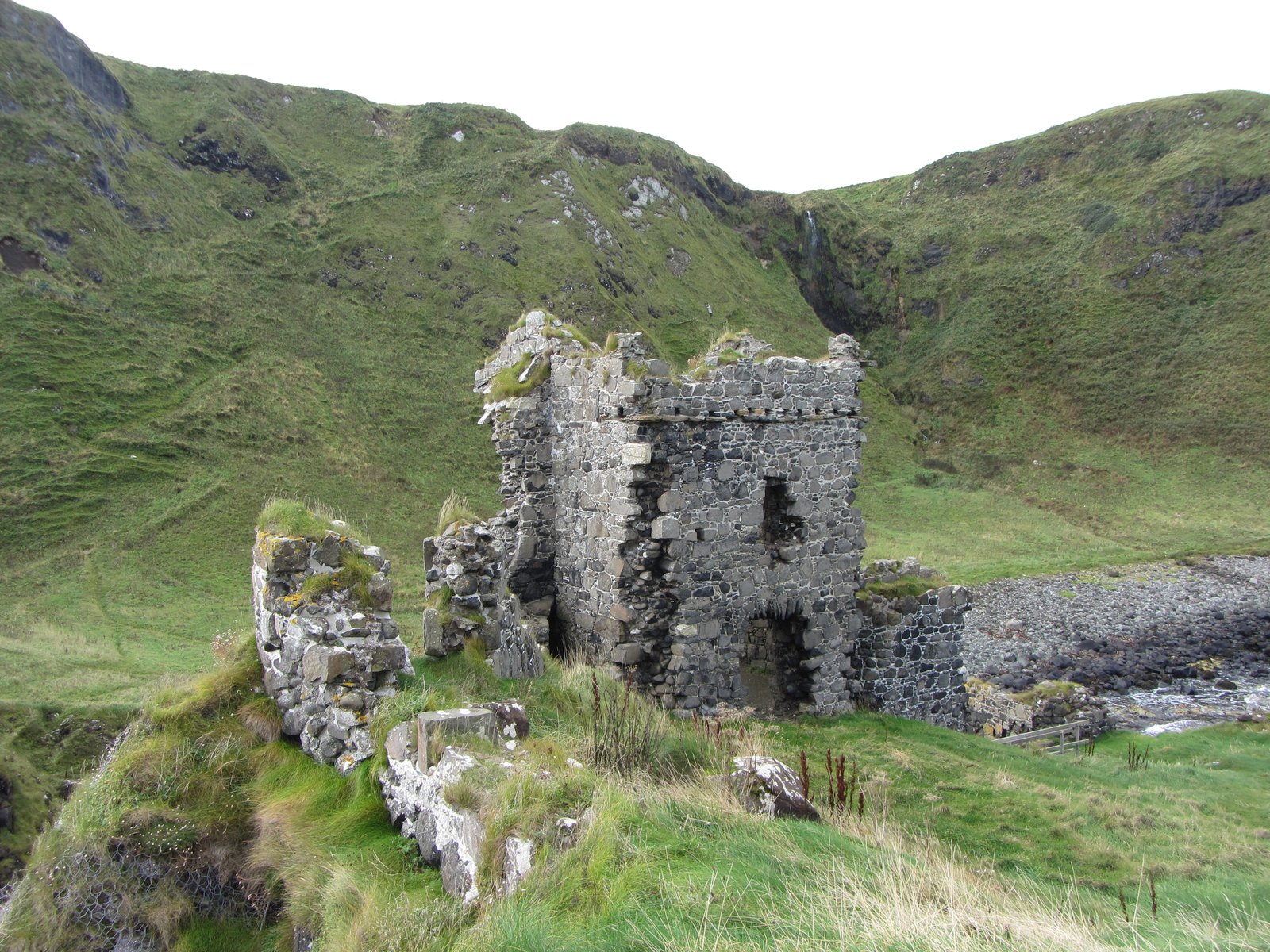
Kinbane is a small ruin on a long white limestone headland near Ballycastle in County Antrim, just off the Causeway Coastal Route. It was built around 1547 by Colla MacDonnell, brother of the more famous Sorley Boy MacDonnell, and it saw its share of fighting before it was left to fall apart.
There isn’t a huge amount of castle left, but that’s not why you come. You come for the setting, a fang of rock sticking into the sea with Rathlin Island and, on a clear day, Scotland across the water.
Getting down means a steep flight of steps that can be slick, so take your time and wear proper shoes. It’s free and far quieter than nearby Dunluce, which is half the appeal.
Ballycarbery Castle
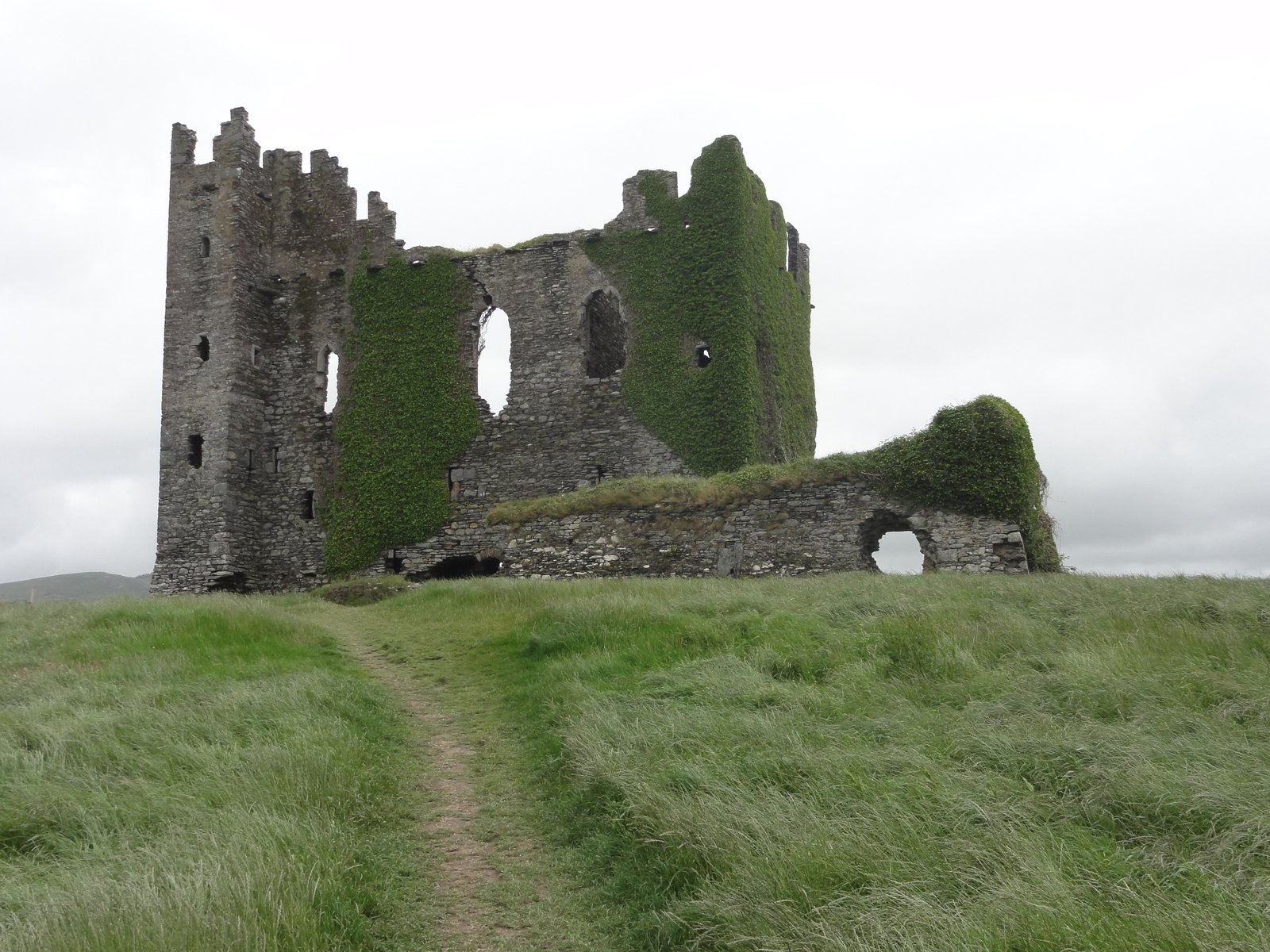
Ballycarbery sits near Cahersiveen on the Iveragh Peninsula in County Kerry, just off the Ring of Kerry, and it’s the ivy-covered ruin you’ve seen on postcards. The current stronghold dates to the 16th century and was linked to the McCarthy Mór family and later the O’Connells. Cromwellian artillery is blamed for the state it’s in now.
The whole front is wrapped in green, with grass growing out of the walls, which makes it one of the most photogenic ruins in the country. Right beside it are two ancient stone ring forts, Cahergall and Leacanabuaile, so you get three ancient sites in one stop.
One honest warning: it stands on private farmland, and access has been restricted at times, so check locally and don’t assume you can walk right up.
Ballinskellig Castle
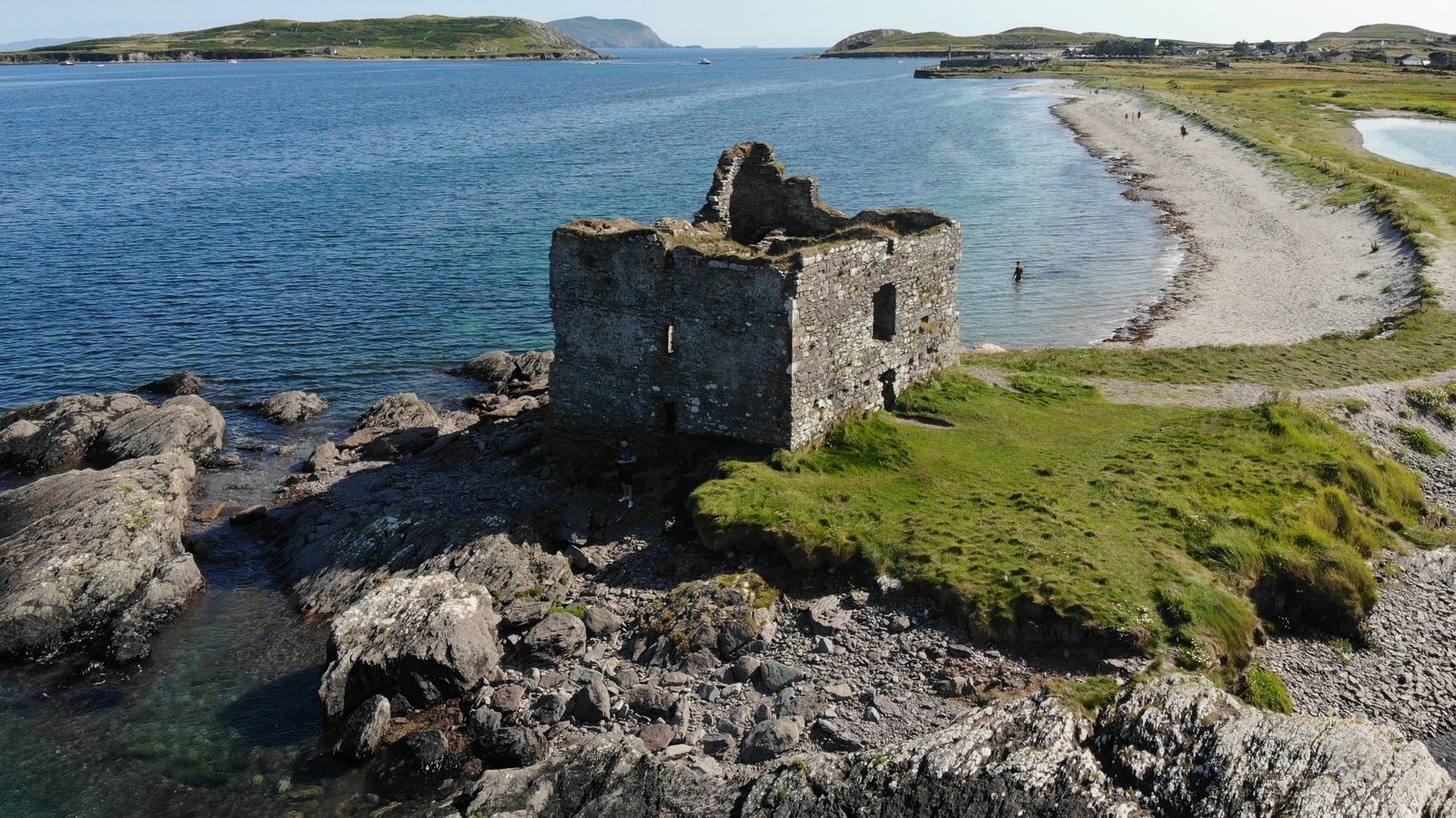
Ballinskellig Castle, sometimes spelled Ballinskelligs, is a tower-house ruin right on the beach at Ballinskelligs Bay in County Kerry, out on the western tip of the Ring of Kerry. It was a McCarthy tower house, set to watch over the bay and the sea approaches, and the sea is now slowly taking it back.
What makes it worth the detour is exactly that position. The ruin stands on a spit of sand with the water lapping close, and just along the shore are the remains of Ballinskelligs Abbey, an old Augustinian priory.
Come at low tide so you can walk out to it properly, and check the tide times before you set off, because the approach floods. It’s free and open, and you’ll often have the beach to yourself.
McDermott’s Castle
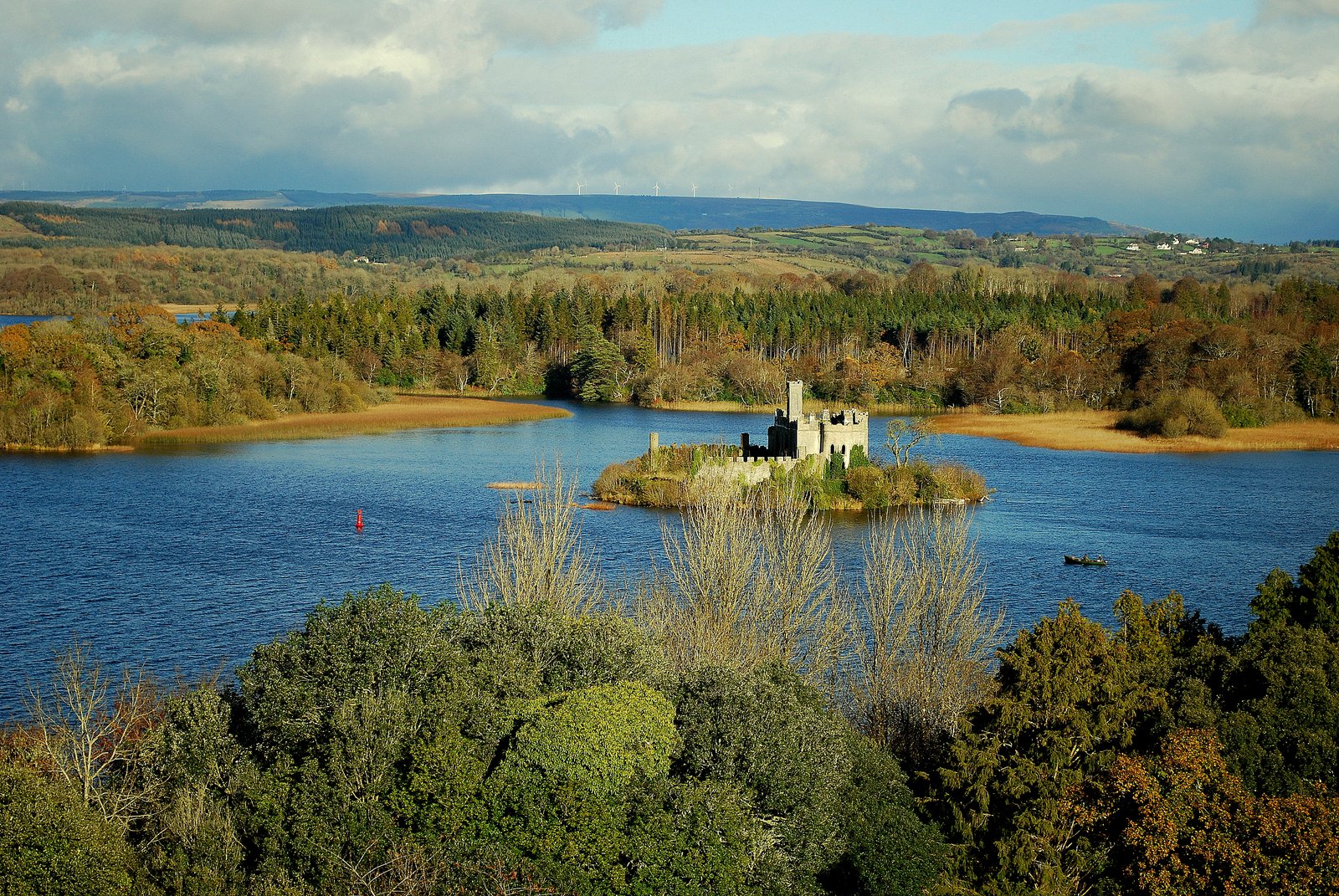
McDermott’s Castle sits on a tiny wooded island called Castle Island in Lough Key, in County Roscommon. The McDermott clan held this stretch of country for centuries. There’s been a stronghold here in some form since medieval times, though much of what stands today is a later, romantic rebuild that fell into ruin in its own right.
The magic here is that you view it from across the water. From the shore of Lough Key Forest Park you look out at a small castle sitting alone on its own island, ringed by trees, and it’s the kind of view that doesn’t look real.
You can reach the island by kayak or on a boat trip when they’re running, but the shore view is the one everyone comes for. The forest park has parking, trails, and a set entry fee.
More Ireland Road Trip Itineraries
- A Photographer’s Definitive Ireland Road Trip
- Wild Atlantic Way Itinerary – Ireland’s Most Epic Road Trip
- 9 Best Places On The Wild Atlantic Way Route
Rock of Cashel
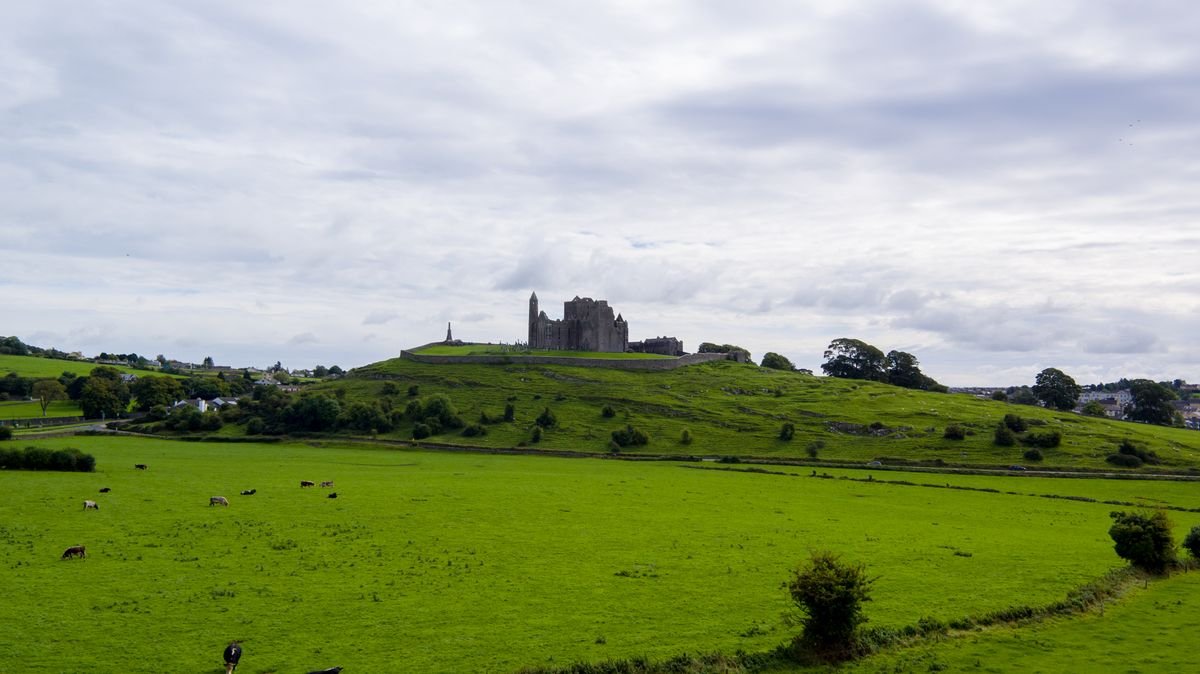
The Rock of Cashel in County Tipperary is the big one. It’s an ecclesiastical site rather than a castle, but nobody driving up to it argues the point. A cluster of medieval buildings, a round tower, a Gothic cathedral, a Romanesque chapel, and a high cross, all sit on a limestone rock rising out of the Tipperary plain.
It was the seat of the kings of Munster before it was handed to the church in the 12th century. The cathedral was left roofless in the 1700s and the complex slid from active use into preserved ruin.
This is one of the most complete ancient sites in Ireland, a paid, managed attraction with guided tours worth taking. Give it a couple of hours, and go early to beat the tour buses.
Where to Stay near the Rock of Cashel (Cashel)
Clifden Castle
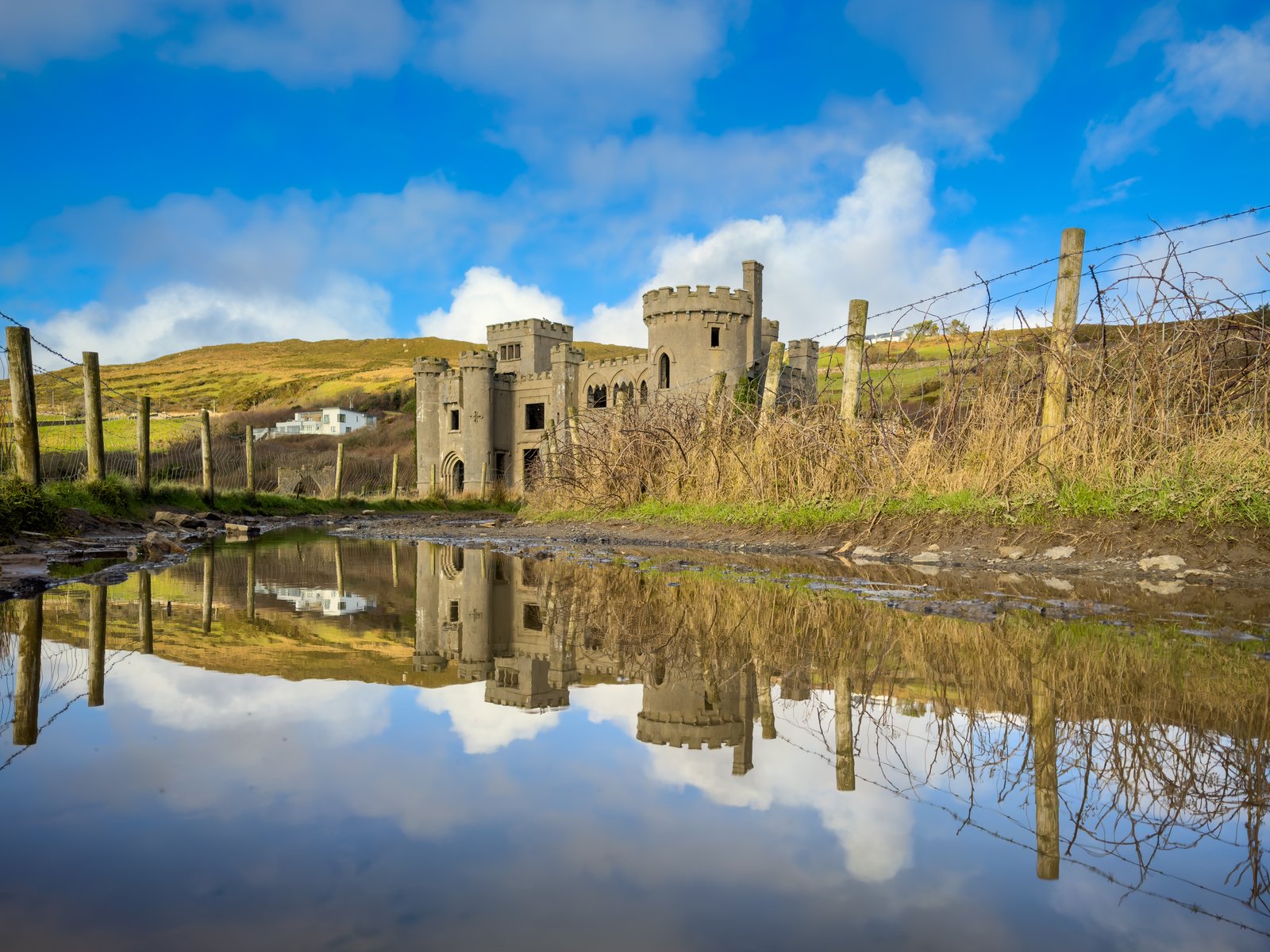
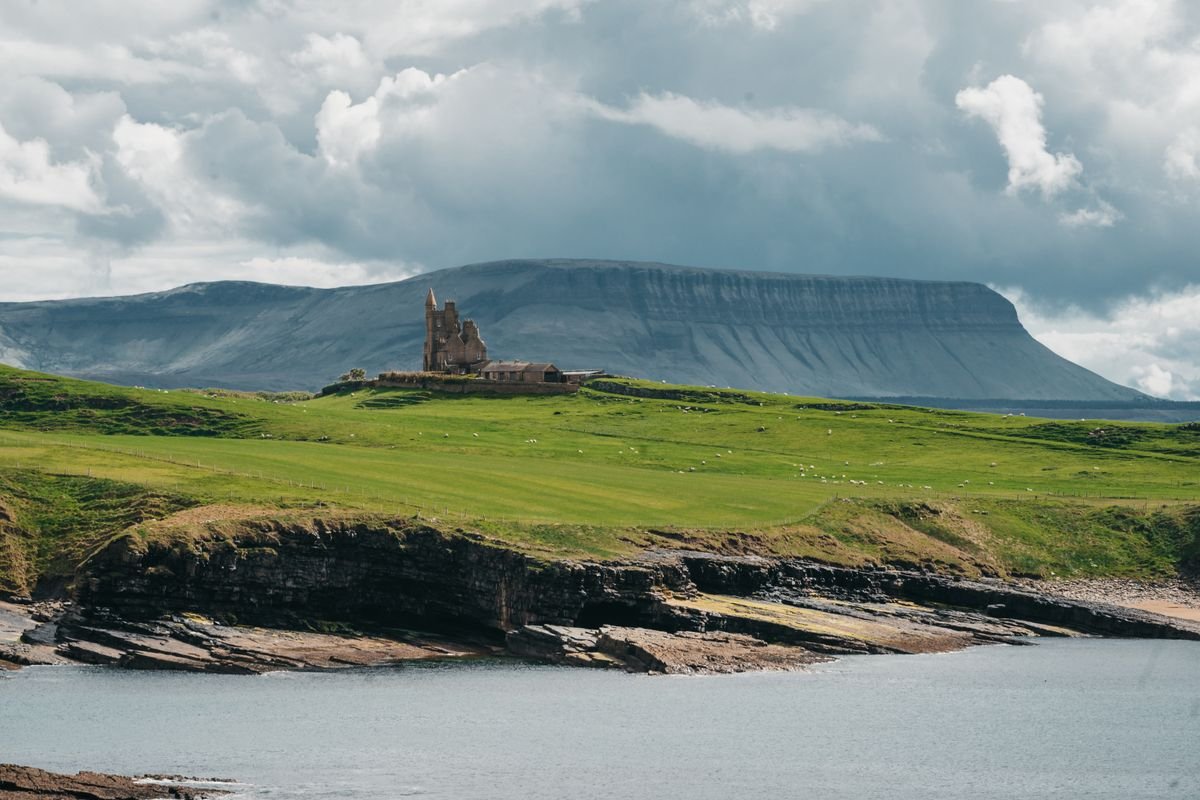
Clifden Castle is a roofless Gothic Revival manor a couple of miles outside Clifden town in Connemara, County Galway. It was built in the 1810s by John D’Arcy, the man who founded Clifden itself. After the family’s fortunes collapsed in the Famine era the house was abandoned and stripped, leaving the shell you walk up to today.
We based ourselves in Connemara on our last trip, and it’s one of the most walkable ruins on this list. You park near the old gateway and follow a track out through fields toward the coast, the Twelve Bens behind you and the sea ahead, and the castle appears turrets-first.
The walk is the point as much as the ruin. It’s on private land but access along the track has long been tolerated. Wear boots, it gets boggy.
Where to Stay near Clifden Castle (Clifden)
Menlo Castle
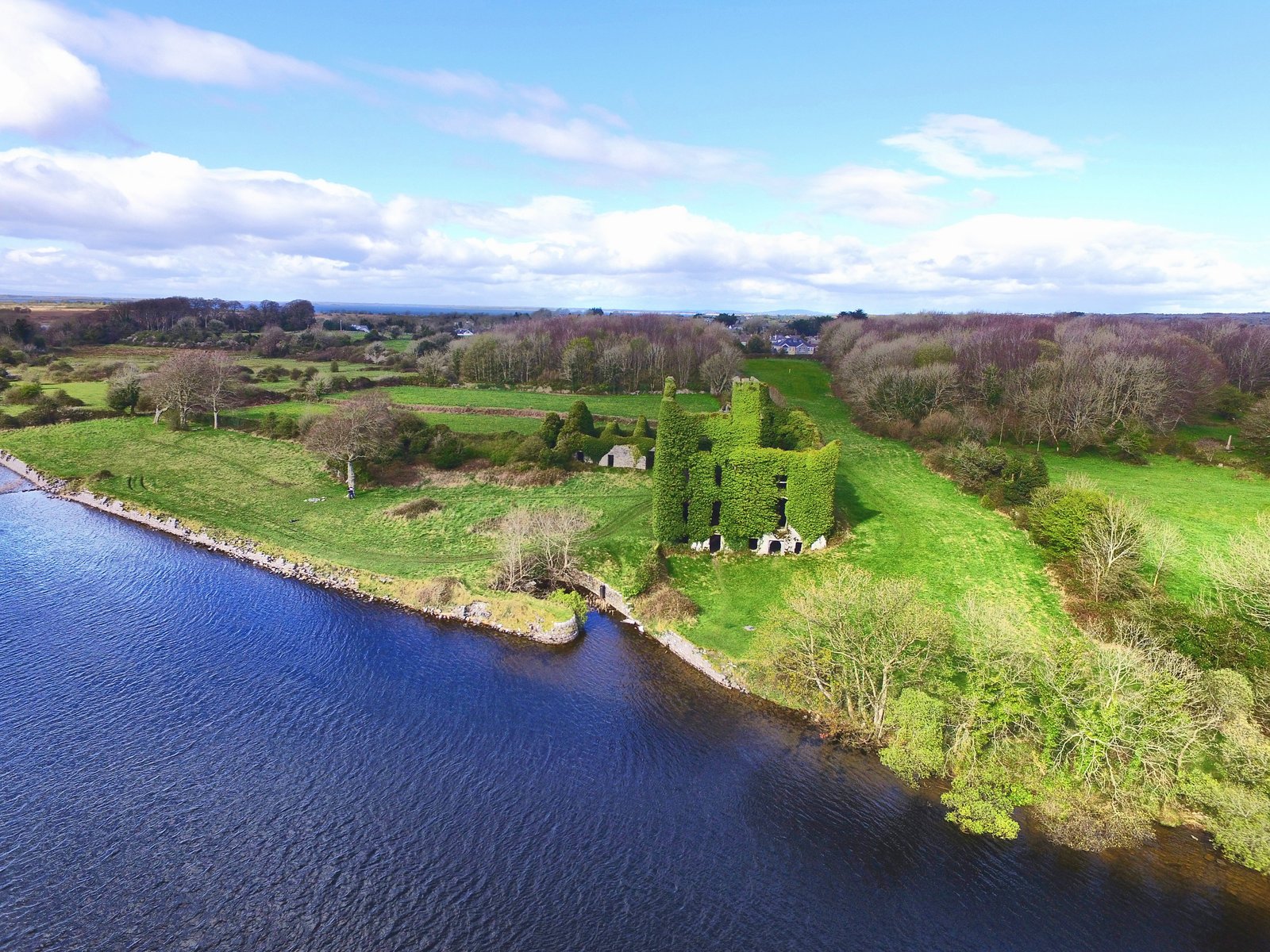
Menlo Castle is an ivy-swallowed ruin on the bank of the River Corrib, about ten minutes from Galway city center in County Galway. It was a 16th-century tower house, later extended, and home to the Blake family for generations, until a fire tore through it in 1910 and killed one of the daughters. The family never rebuilt.
What’s left is one of the more haunting sights near the city, a large house wrapped in green with the river running past. When we were in Galway it made an easy trip out from the pubs and music of the center.
You can reach it on a riverside walk from the city, and it’s free and open. The structure is fragile and fenced in parts, so admire it from the outside rather than climbing in.
Leap Castle
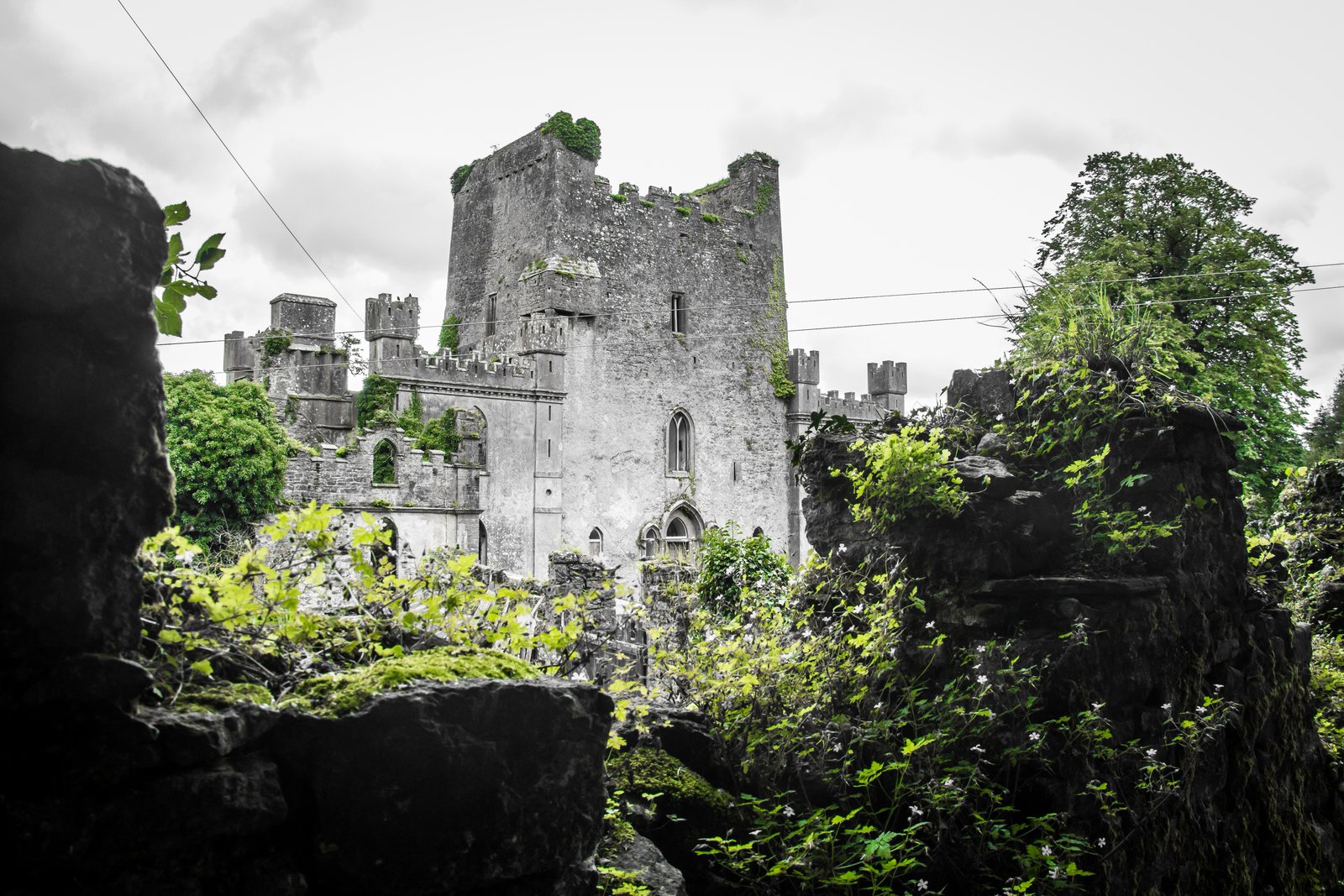
Leap Castle in County Offaly is often called the most haunted castle in Ireland, and its history earns the reputation. It was a tower house built by the O’Carroll clan, a family known for a violent streak. One story has a chieftain cutting down his own brother, a priest, mid-Mass in what’s called the Bloody Chapel.
The castle was burned in 1922 during the Civil War and stood a gutted ruin for decades. It’s partly restored now and privately owned, so it isn’t a walk-up-anytime site like the others here.
Visits happen by arrangement, and the owner has run tours in the past, so you’ll need to check ahead rather than just turning up. Whether you buy the ghost stories or not, the history alone makes it one of the most interesting ruins in the midlands.
Castle Roche
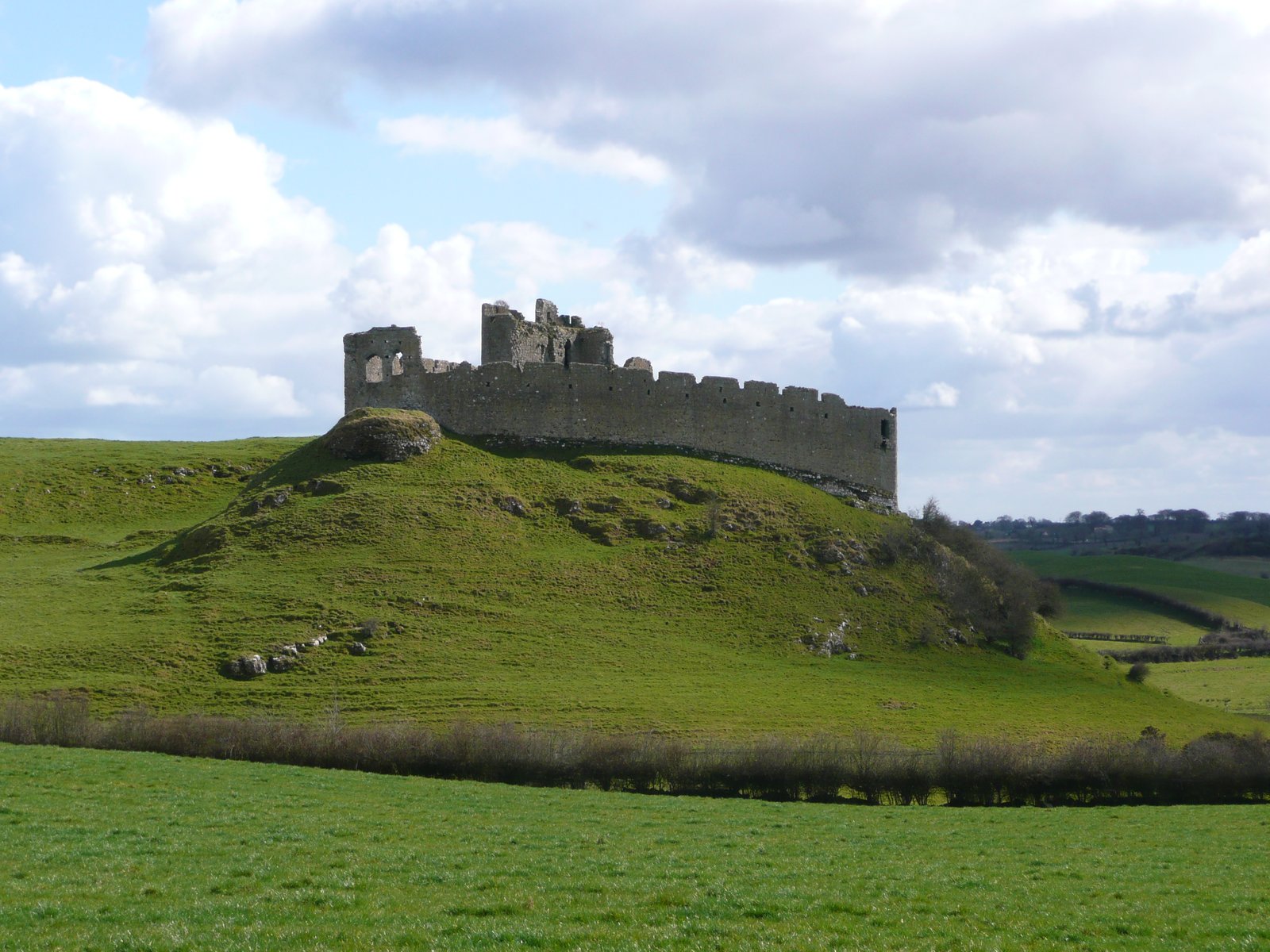
Castle Roche is a 13th-century Anglo-Norman ruin perched on a rocky crag near Dundalk in County Louth, close to the border with Northern Ireland. It was built around 1236 by Lady Rohesia de Verdun to guard the frontier of the medieval Norman territory known as the Pale, which is why it sits where it does, high and hard to approach.
The setting is the star. You get a substantial gatehouse and curtain walls on a crag with the countryside of Louth and Armagh below, and it’s dramatic in a way the more famous ruins can’t match.
It’s free and open, reached across farmland, so check access locally and mind the drops around the crag. There’s not much shelter up top, so pick a dry day if you can.
Trim Castle
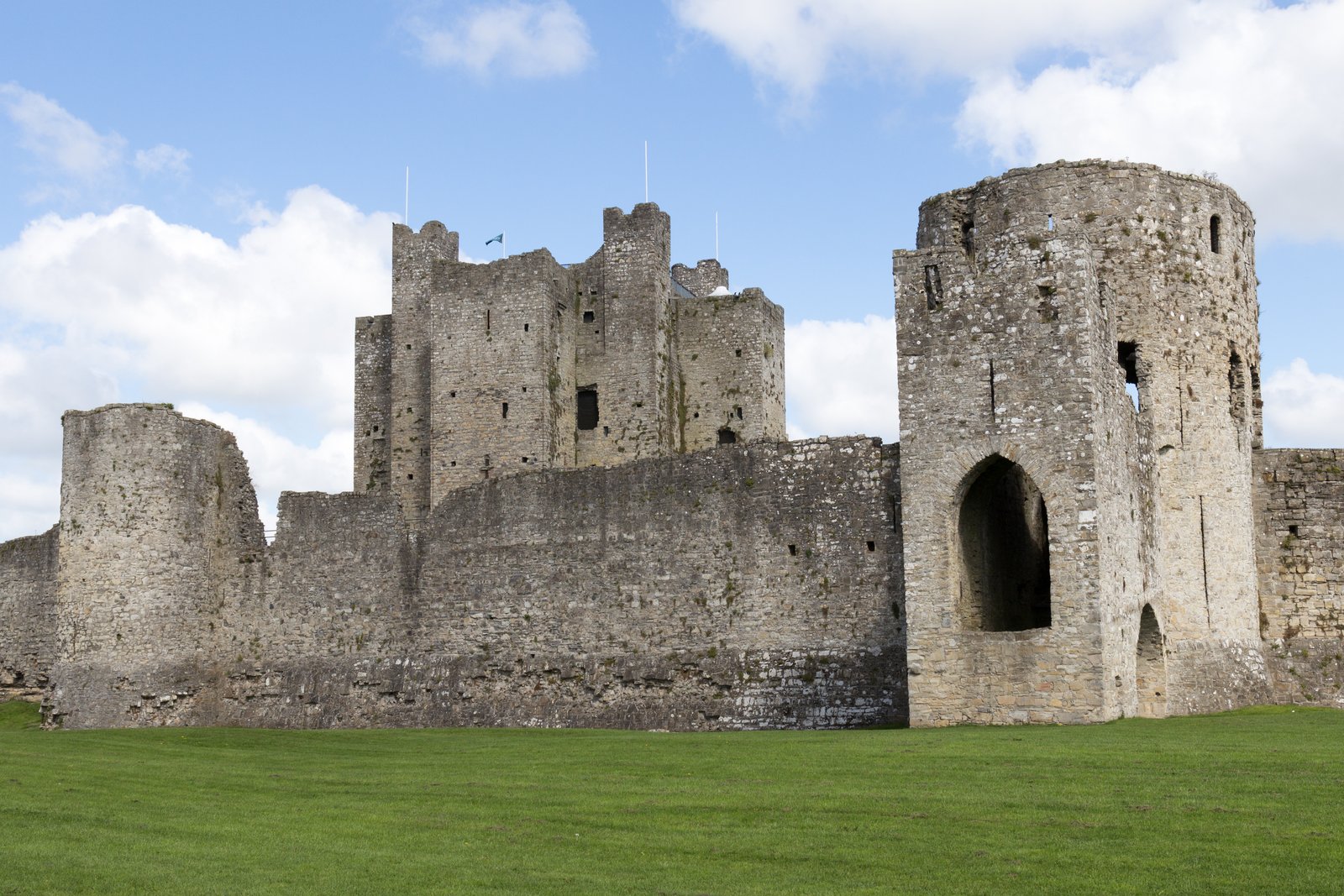
Trim Castle in County Meath is the largest Anglo-Norman castle in Ireland, and it’s a partly ruined site you can actually go inside. Construction started not long after 1172 under Hugh de Lacy, and the huge stone keep at its center took decades to build. It anchored Norman power here for centuries before falling out of use and into decay.
Film fans will know it as a filming location for Braveheart. It’s a managed site with an entry fee, and the keep is only accessible on a guided tour, worth booking because you get up onto the walls with views over the River Boyne.
The curtain walls and grounds you can wander on your own. Give it a couple of hours, and pair it with the nearby Boyne Valley sites if you have the day.
Best Time to Visit Ruined Castles in Ireland
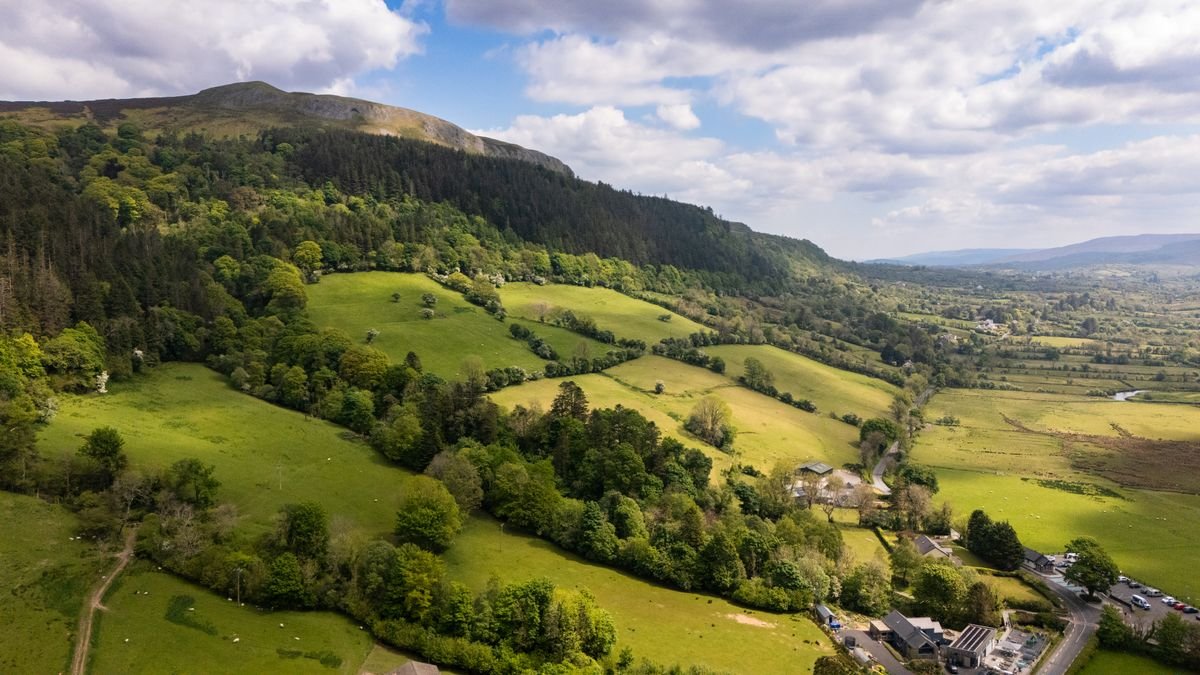
Late spring through early autumn is the sweet spot, roughly May to September. You get the longest daylight, the best odds of dry weather, and grass that isn’t a mudslide underfoot.
We drove a chunk of the country in late September, well into shoulder season, and it was ideal. Mild enough, and far fewer people at the popular ruins than you’d hit in July.
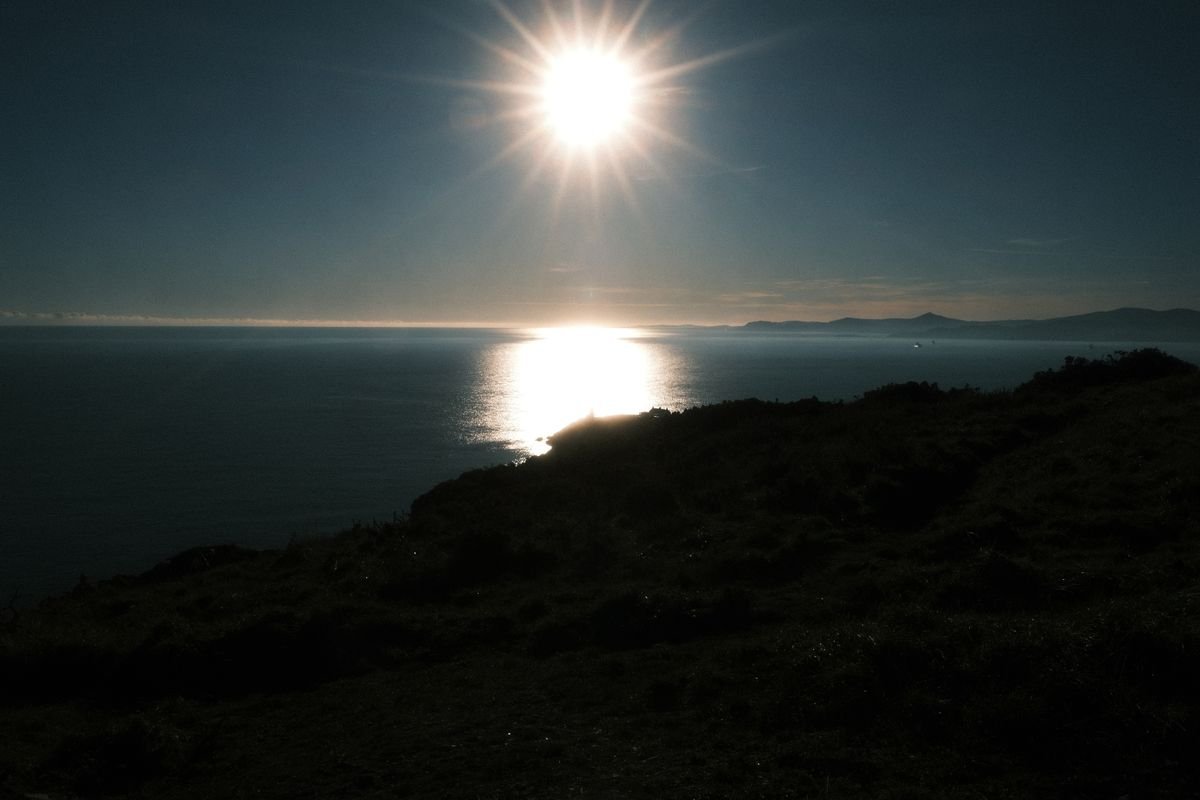
For the light, early morning and the hour before sunset are hard to beat, especially for the coastal ruins where low sun does the work no filter can. Early also gets you the managed sites like Cashel and Trim before the tour buses roll in.
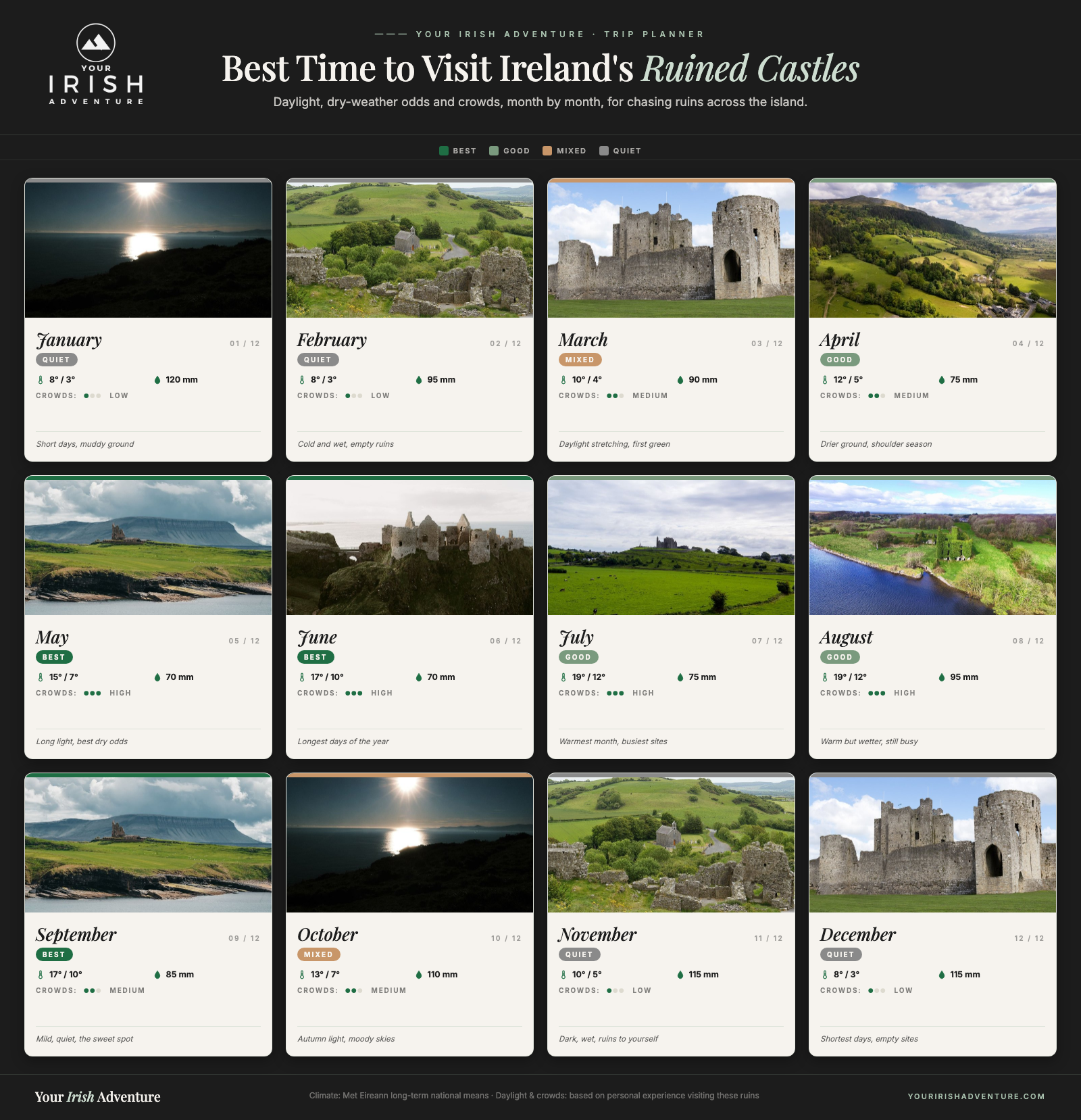
Whatever month you pick, Irish weather does what it wants, and the coastal castles get the full force of it. Bring a proper rain layer, check the forecast the morning of, and for the seaside ruins check the tide as well.
Rain isn’t a reason to cancel here. Some of these ruins look their best under a moody sky, and you’ll have them even emptier.
Where to Stay Around Ireland
- Magical Castle Hotels in Ireland You NEED To Stay in
- Wild Atlantic Way Hotels With A Touch Of Luxury
- Where to Stay in Belfast: Best Areas & Hotels
In short
- Ireland has around 30,000 castles and castle sites, most of them ruins left by centuries of war and abandonment.
- Free open ruins include the Rock of Dunamase, Kinbane, Ballinskellig, Castle Roche and Clifden Castle.
- Managed sites with an entry fee include Dunluce, the Rock of Cashel and Trim Castle.
- A rental car is the only practical way to link the ruins, as most sit down back roads with no public transport.
- Go May to September for long daylight and drier ground, and treat every unmanaged ruin as unstable.
Frequently Asked Questions About Ruined Castles in Ireland
How many castles are there in Ireland?
Estimates run to around 30,000 castles and castle sites across the island of Ireland, though most of those are ruins or fragments rather than intact buildings. The huge number comes mainly from the thousands of tower houses built between the 1400s and 1600s, one for pretty much every lord who could afford the stone.
Why are so many Irish castles in ruins?
Centuries of conflict and change. The Cromwellian campaign of the 1650s deliberately slighted many castles so they couldn’t be defended again, clan and colonial wars destroyed others, and plenty were simply abandoned when owners moved into more comfortable houses and left the old towers to the ivy.
Are Ireland’s ruined castles free to visit?
Many are free and open with no gate at all, like the Rock of Dunamase, Kinbane, and Castle Roche. The bigger managed sites charge admission, including the Rock of Cashel, Trim Castle, and Dunluce. A few, like Leap Castle, are privately owned and only open by arrangement, so check ahead.
Which is the best ruined castle in Ireland to visit?
For sheer drama it’s hard to beat Dunluce on its sea crag in Antrim. If you want the most complete ancient site, the Rock of Cashel wins. And if you want a ruin more or less to yourself, walk out to Clifden Castle in Connemara or the Rock of Dunamase in Laois.
Can you go inside the ruined castles?
It depends on the site. At managed castles like Trim you can go inside the keep on a guided tour. At most free, open ruins you can walk around and often through the remains, but the stonework is unstable, so don’t climb the walls, and treat every ruin as if a stone could come loose above you.
Final Thoughts
The single best reason to seek out Ireland’s ruined castles is that so many of them are still yours to wander alone. You can pull off a country road, walk out across a field, and have a 500-year-old tower entirely to yourself, no ticket, no crowd, no rope keeping you back.
Do the famous ones, Dunluce and Cashel earn their reputations. But leave room for a Clifden or a Castle Roche where it’s just you, the wind, and a ruin the ivy is slowly reclaiming. Those are the ones you’ll remember.
Like it? Pin it!
Save this guide for later