Most castle lists for Ireland work through Blarney, Kilkenny, and Bunratty, add a few names from a Google search, and call it done. That approach misses a lot. Ireland has somewhere between 30,000 and 45,000 castle and fortified structures depending on what you count, more per square mile than almost anywhere in Europe, and the ones worth your time are not always the ones that appear first in the results.
We have visited every castle on this list in person. That includes walking the Canal Walk approach into Kilkenny, which is one of the best free heritage 10 Luxurious Afternoon Tea Experiences in Ireland and something no amount of reading prepares you for. It also includes the lesser-known sites, Nenagh, Dunluce, Carrickfergus, where the crowds are thinner and the history is just as substantial.
What follows is twelve castles that are genuinely worth your time, with honest notes on what to expect, how to book, and what the experience is actually like when you arrive.
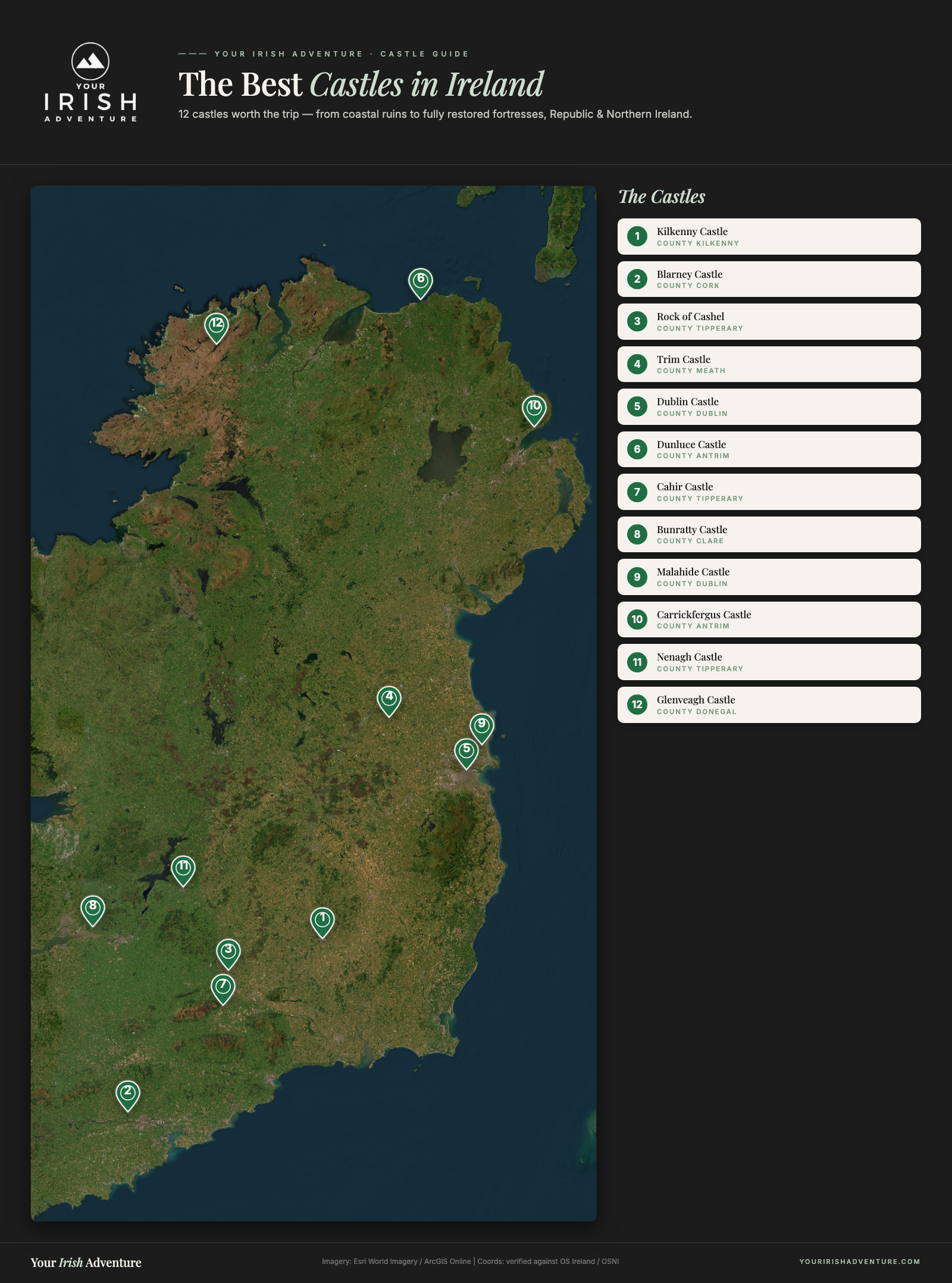
These are twelve castles that are genuinely worth your time, covering intact Victorian loch-side estates, battered Norman keeps still readable from the road, and clifftop ruins that no photograph fully prepares you for. Some are famous.
A few are not. The list mixes Republic of Ireland and castles in Northern Ireland, free entry and paid, urban and remote.
More Ireland guides:
- A Photographer’s Ireland Road Trip
- 10 Days in Ireland: The Ultimate Itinerary
- The Best Castle Hotels in Ireland
The Best Castles in Ireland
Here are twelve castles across the island that we think make for the strongest visits, ranging from free entry ruins to fully restored interiors with guided tours.
This is not a ranking of the most historically significant castles in Ireland, historians would write a different list. It is a ranking by visitor experience: what it feels like to be there, what you actually see, and whether the journey is worth it.
1. Kilkenny Castle, County Kilkenny
- Location: The Parade, Kilkenny City
- Entry: Adults €8; castle grounds free
- Hours: Mar-May & Sep-Oct 9:30am-5pm; Jun-Aug 9am-5:30pm; Nov-Feb 9:30am-4:30pm
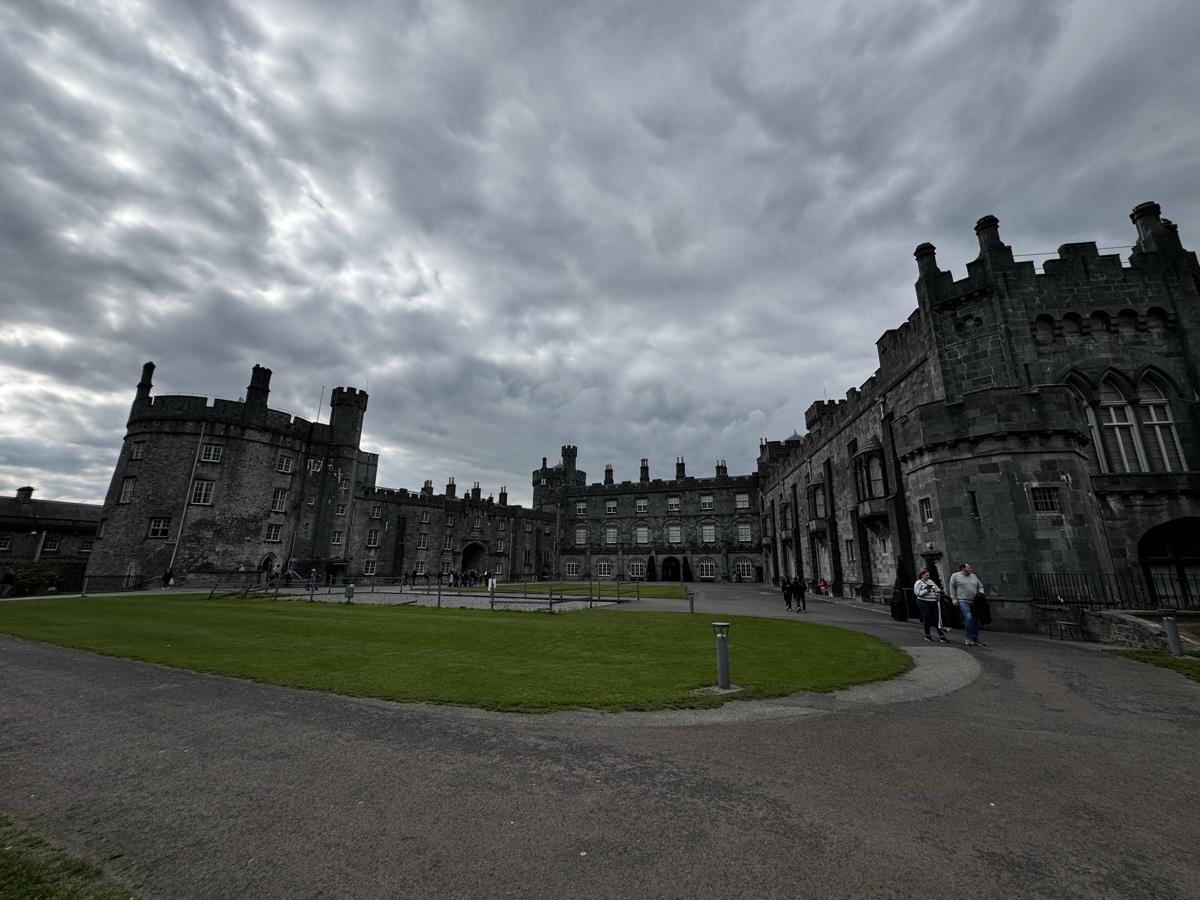
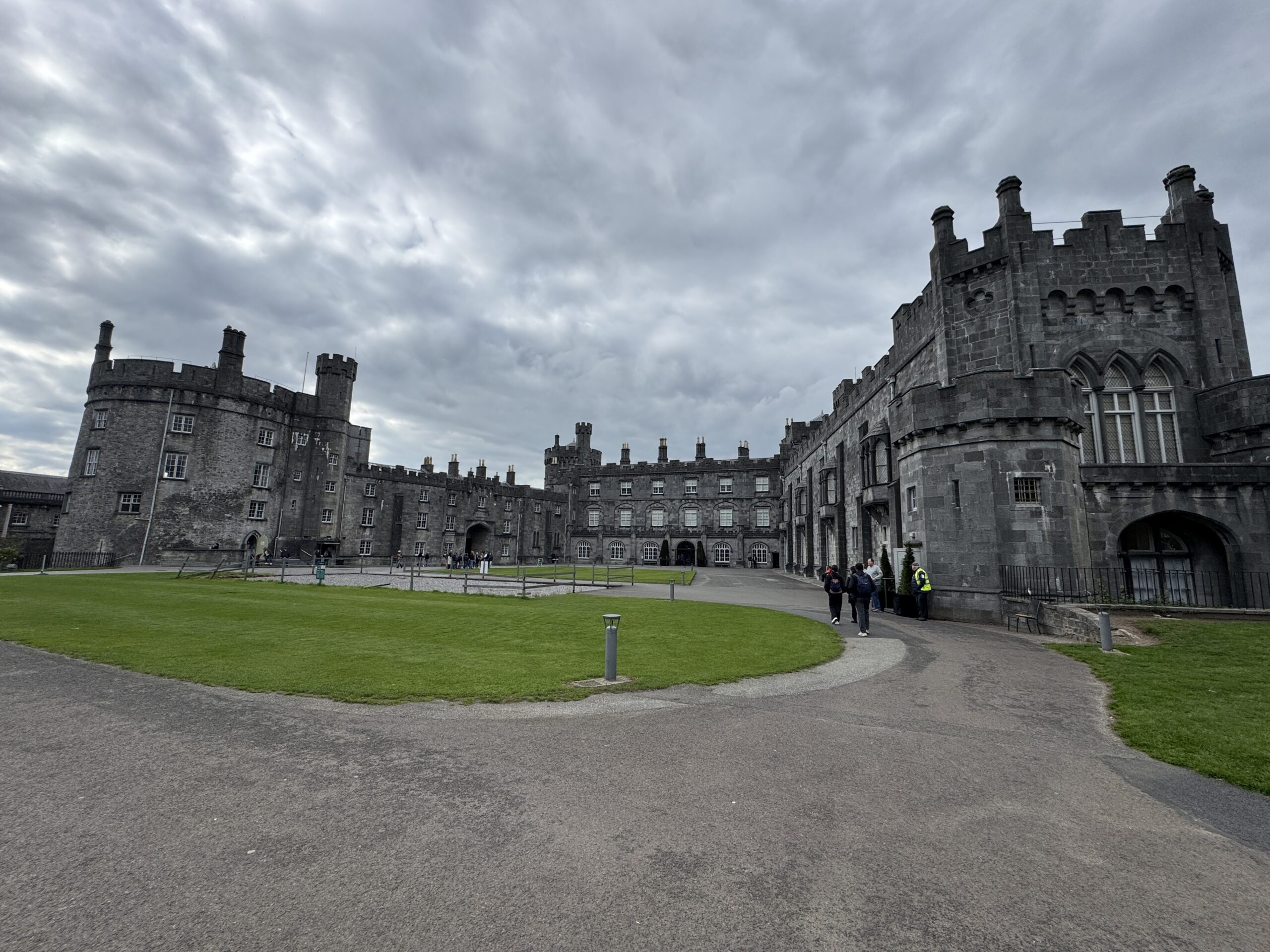
The approach along the Canal Walk before the crowds arrive is one of the better free experiences in Irish heritage tourism. The castle itself sits at the end of a broad parade, solid, three-towered, the kind of structure that has dominated its surroundings for 800 years and clearly intends to keep doing so.
Inside, the Long Gallery is the standout, a hammer-beam roof, a full run of Butler dynasty portraits, and a pair of Irish elk antlers mounted on the wall. Those antlers are genuine prehistoric specimens, and they are enormous.
I had not expected them, and they stopped me in my tracks more than any painting did. The Butler dynasty connection runs through several castles on this list, but Kilkenny is where it’s most legible.
Pre-book the interior tour in summer, it sells out. Weekday mornings can bring school groups through, which compresses the experience. The grounds are free year-round and worth walking even if you skip the tour.
For a single Irish castle day, Kilkenny is the strongest choice: the castle, the medieval city, the food scene, and the accommodation options combine into something no other castle town matches. See our guide to things to do in Kilkenny and, if you have more time, our weekend in Kilkenny itinerary.
Where to Stay Near Kilkenny Castle
Best Tour to Kilkenny Castle
2. Blarney Castle, County Cork
- Location: Blarney, County Cork
- Entry: Adults €18; includes grounds, Fern Garden, River Bank Walk, and Blarney House
- Hours: Mon-Sat 9am-6pm; Sun 9am-5:30pm (seasonal variations apply)
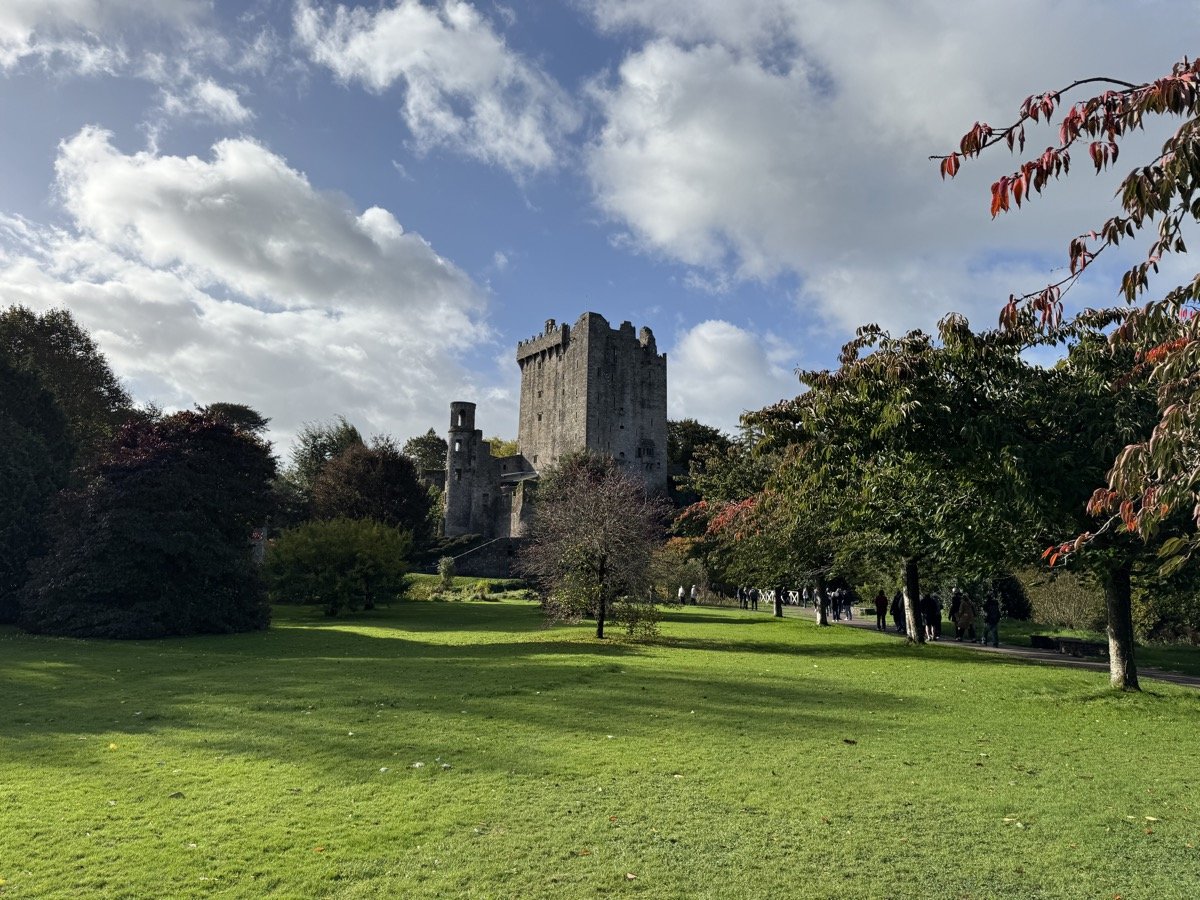
We went expecting a tourist trap and came away genuinely surprised. Dariece and I kissed the Blarney Stone, you lean back over a parapet 85 feet up, gripping iron bars, with an attendant holding your legs. It is slightly absurd, completely memorable, and yes, worth doing once.
The real find is what surrounds the tower. The Fern Garden is extraordinary, cool, deep green, completely unlike anything else in Irish castle grounds. Rock Close has a genuine Druidic stone circle, a formation called the Witch’s Kitchen, and a strange atmosphere that the main tower doesn’t have.
Budget a minimum of two hours; three is better. Most visitors rush the stone queue and leave, missing the best parts of the site.
The queue for the Blarney Stone can run 45 to 90 minutes on peak summer days. Arrive at 9am.
The €18 entry is the highest on this list, but the breadth of the estate, tower, gardens, house, riverbank, justifies it more than most castles that charge less for a single building. For more options in the county, see our guide to castles in Cork.
Where to Stay Near Blarney Castle
Best Tour to Blarney Castle
3. Rock of Cashel, County Tipperary
- Location: Cashel, County Tipperary
- Entry: Adults €8 (OPW)
- Hours: Mid-Jun to mid-Sep 9am-7pm; other seasons 9am-4:30pm or 5:30pm
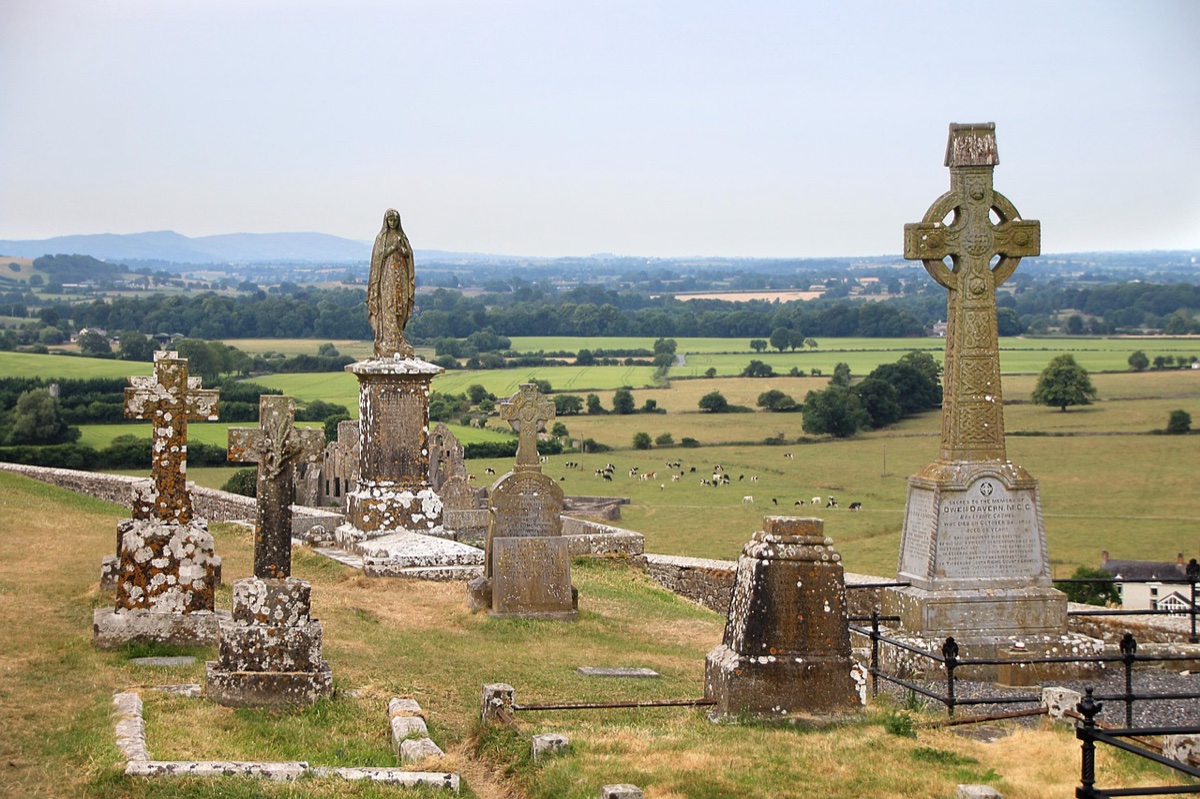
The Rock of Cashel is one of those sites that looks almost theatrical from the road, a cluster of medieval towers and a roofless cathedral sitting on top of a limestone outcrop in the middle of the Tipperary plain. Brian Boru was crowned here before the Battle of Clontarf in 1014. That context makes the site feel heavier than a lot of Irish heritage stops.
Cormac’s Chapel, built between 1127 and 1134, is the architectural high point. It is the finest Hiberno-Romanesque structure in Ireland, carved stone arches, twin towers, frescoes that survived centuries of exposure. The main cathedral lost its roof and has been open to the elements for hundreds of years, which gives the whole complex a raw, unfinished quality that works in its favour.
The site is very exposed to wind and weather, factor that into your visit. The audio guide is essential; interior signage is minimal and without context the buildings lose half their impact.
Cashel town has limited dining options, so plan ahead or stop in Cahir, 20 minutes south. For more in the region, see our guide to things to do in Tipperary.
Where to Stay Near Rock of Cashel
Best Tour to Rock of Cashel
4. Trim Castle, County Meath
- Location: Castle Street, Trim, County Meath
- Entry: Grounds free; keep tour €5 adults (OPW), Apr-Oct daily, Nov-Mar weekends only
- Hours: Apr-Oct daily 10am-5pm; Nov-Mar weekends 10am-4pm
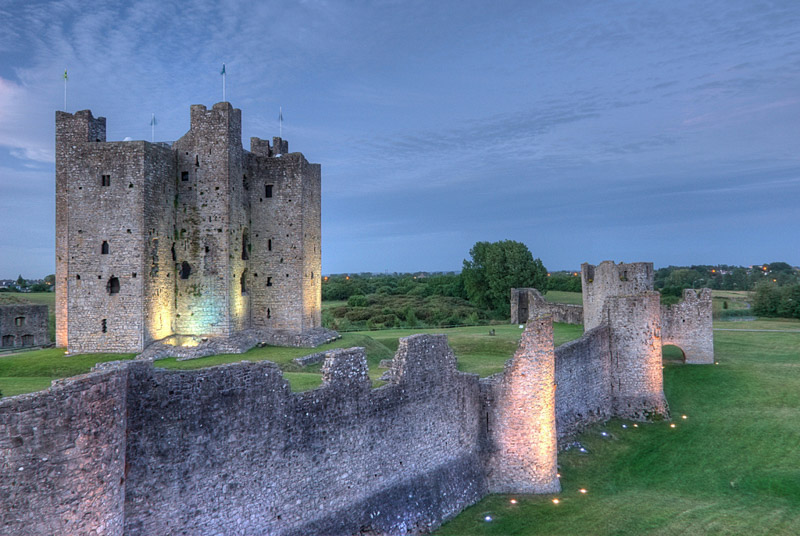
Trim is the largest Anglo-Norman castle in Ireland, and the keep has a detail that no other castle in Ireland or Britain can match, it is 20-sided, a polygonal design with no direct parallel anywhere on the islands. That alone makes it worth the detour from Dublin. The curtain walls enclose three acres, and the scale is immediately apparent when you’re standing inside them.
Braveheart was partly filmed here in 1995, which brings a certain kind of visitor, but the castle predates the film by about 800 years and doesn’t need the association. The River Boyne runs alongside the site, and the combination of water, scale, and intact stonework makes Trim one of the most photogenic castles in the country.
Keep tours have limited capacity, book ahead on summer weekends. Trim town is quiet with limited dining, so combine this with Newgrange and the Hill of Tara nearby for a fuller day in County Meath.
Where to Stay Near Trim Castle
Best Tour to Trim Castle
5. Dublin Castle, County Dublin
- Location: Dame Street, Dublin 2
- Entry: State Apartments tour €8 adults; Chester Beatty Library free
- Hours: State Apartments Mon-Sat 9:45am-5:45pm, Sun 12pm-5:45pm
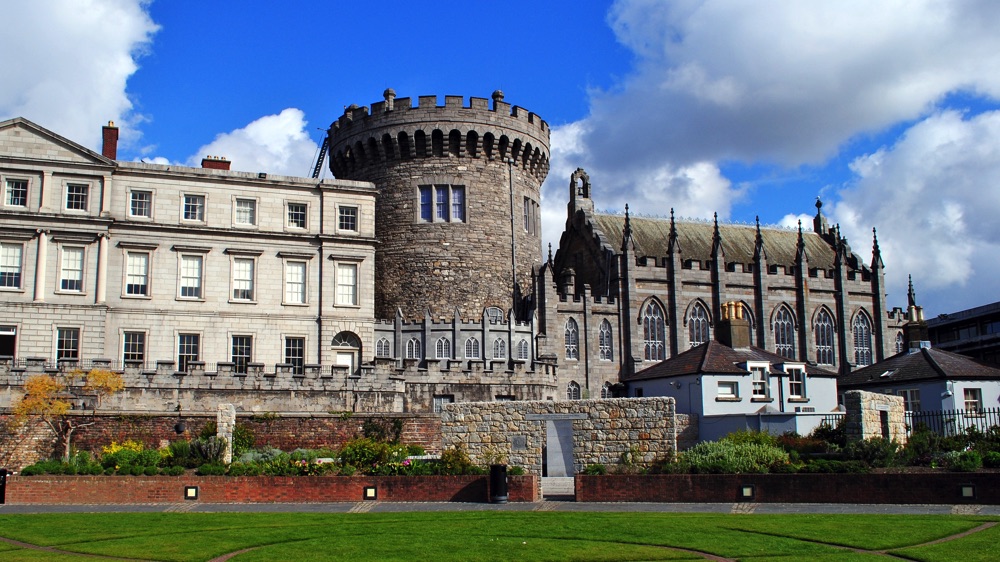
Dublin Castle is an honest disappointment from the outside. The exterior reads as Georgian government complex, brick, formal, administrative.
The Record Tower is the one visible piece of medieval fabric, and it dates to a 10th-century Viking longphort beneath the current buildings. If you arrive expecting a dramatic castle silhouette, adjust expectations before you go in.
The State Apartments are better than the exterior suggests, and 700 years of British administration ended in the formal handover ceremony here in 1922, that political weight is palpable in the rooms. But the best attraction in the complex is the Chester Beatty Library, which is free. Islamic manuscripts, East Asian scroll paintings, Western illuminated texts, it is one of Ireland’s genuinely world-class collections and most visitors walk past it to queue for the castle tour.
If time is limited, skip the State Apartments and spend it in the Chester Beatty. The library alone justifies the visit to the complex. For more on the capital’s castle options, see our round-up of castles in Dublin.
Where to Stay Near Dublin Castle
Best Tour to Dublin Castle
6. Dunluce Castle, County Antrim
- Location: 87 Dunluce Road, Bushmills, County Antrim
- Entry: Adults £5.50 (Historic Environment NI)
- Hours: Apr-Oct daily 10am-5pm; Nov-Mar Tue-Sun 10am-4pm
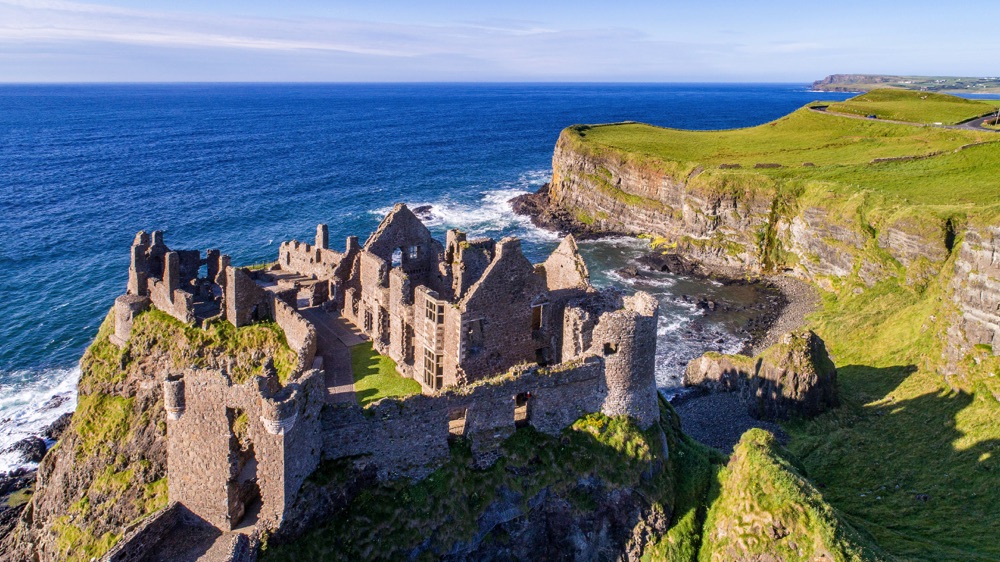
The scale, the coastal setting, the sea stack of basalt columns dropping straight to the Atlantic, Dunluce Castle is officially the most dramatically sited castle in Ireland. There is no close second. The ruin sits on a detached promontory connected to the mainland by a narrow bridge, and the view from the road before you even enter is one of those sights that requires no effort to appreciate.
The castle has a genuinely strange piece of history: in 1639, the kitchen collapsed into the sea during a dinner party. Only a kitchen boy survived, having fallen asleep in a corner.
The MacDonnells abandoned the castle not long after. That story captures something true about Dunluce, it is a place where the ground itself is unreliable, and the ruin reflects that.
It is a ruin with limited interior interpretation. Treat it as a scenic stop rather than a deep heritage experience; 45 to 60 minutes is usually enough. Combine with the Giant’s Causeway and Bushmills Distillery nearby.
The area also features prominently in our guide to Game of Thrones filming locations in Northern Ireland. Visit in clear weather, the site is exposed and the views are the main event.
Where to Stay Near Dunluce Castle
Best Tour to Dunluce Castle
7. Cahir Castle, County Tipperary
- Location: Castle Street, Cahir, County Tipperary
- Entry: Adults €5 (OPW)
- Hours: Mid-Jun to mid-Sep 9am-6:30pm; other seasons 9am-4:30pm or 5:30pm
Cahir Castle sits on a rocky island in the River Suir, and the water defence is still immediately readable, you can see exactly how the site worked, which is not always true of medieval castles. It has been barely modified since the 15th century, which makes it one of the most coherent medieval interiors in Ireland.
The cannon damage in the outer walls from Robert Devereux’s 1599 siege is still visible. That kind of specific, dateable damage is rare, most castles have been repaired or consolidated to the point where the history is told to you rather than read off the walls.
At Cahir, you can actually see it. The entry fee is the lowest of any castle on this list.
The audio tour is essential here, interior signage is limited. Cahir town has few dining options. The logical pairing is Rock of Cashel, 20 minutes north, which makes for a very strong half-day of Tipperary heritage on a single route.
Where to Stay Near Cahir Castle
Best Tour to Cahir Castle
8. Bunratty Castle, County Clare
- Location: Bunratty, County Clare
- Entry: Adults €17.95 (Castle & Folk Park)
- Hours: Daily 9am-5:30pm
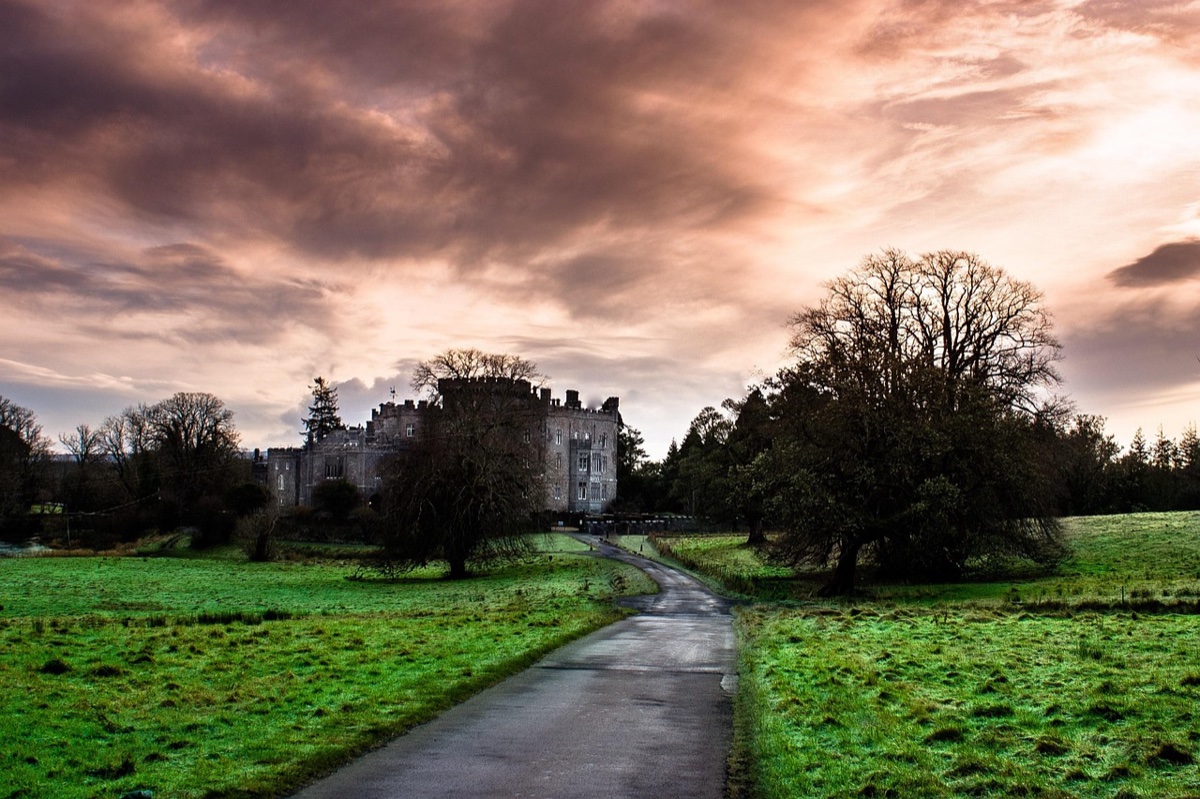
Bunratty is the most completely restored medieval tower house in Ireland. Built in 1425, the interior contains genuine 15th to 17th-century furniture and tapestries, not reproductions, not approximations. The restoration is meticulous enough that the rooms feel inhabited rather than staged, which is a difficult thing to pull off and Bunratty pulls it off.
The medieval banquet evenings have been running since 1963, making them the longest-running in Ireland. They are overtly touristy and clearly proud of it.
That is either a selling point or a reason to avoid the evening programme, depending on what you are looking for. The daytime visit is the stronger option.
Expect tour groups, the location between Shannon Airport and Limerick means Bunratty catches a lot of transit visitors. The folk park alongside the castle is worth the time and tends to be less crowded than the tower itself.
At nearly €18 the combined admission is not cheap, but the breadth of the site justifies it. For more options in the county, see our guide to castles in Clare.
Where to Stay Near Bunratty Castle
Best Tour to Bunratty Castle
9. Malahide Castle, County Dublin
- Location: Malahide Demesne, Malahide, County Dublin
- Entry: Adults €15
- Hours: Mon-Sat 9:30am-5:30pm, Sun 11am-5pm
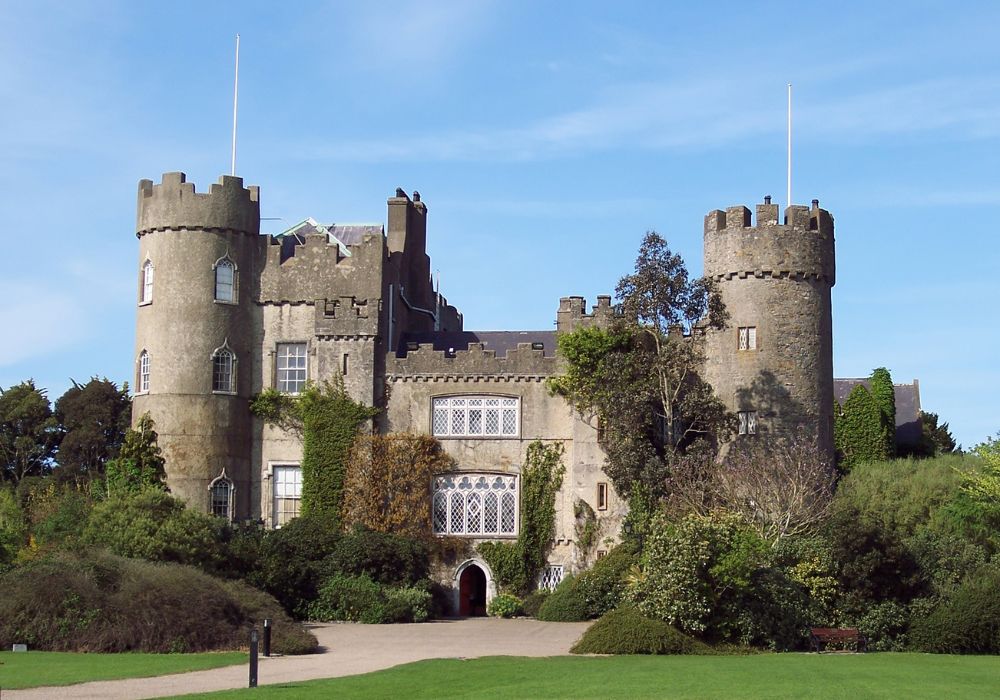
The Talbot family lived at Malahide Castle from 1185 to 1973, nearly 800 years of continuous occupation by one family. That extraordinary run ended when the last direct heir died and the estate passed to Dublin County Council. The house reflects that long inhabitation: it is not a museum dressed to look like a home, it is a home that became a museum, which reads very differently.
On the morning of the Battle of the Boyne in 1690, fourteen members of the Talbot family breakfasted together in the castle. None of them returned.
That detail stops most visitors when they hear it, and the guide usually pauses after it. The story holds the weight of the whole visit.
The guided tour is the only option, quality varies by guide, and some are significantly better than others. The demesne parkland and walled garden are free and worth visiting regardless. Malahide is accessible by DART from Dublin city centre, which makes it one of the more practical half-day trips from the capital.
10. Carrickfergus Castle, County Antrim
- Location: Marine Highway, Carrickfergus, County Antrim
- Entry: Adults £5.50 (Historic Environment NI)
- Hours: Apr-Oct Mon-Sat 10am-5pm, Sun 12pm-5pm; Nov-Mar Tue-Sat 10am-4pm
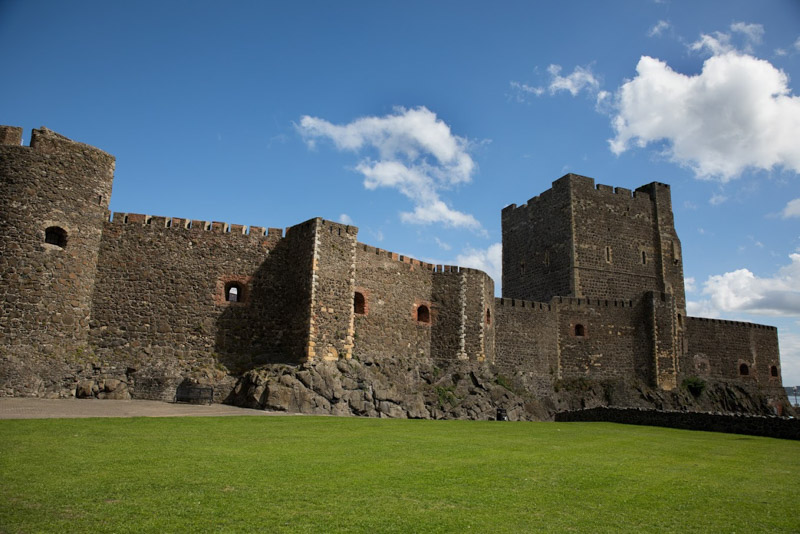
Carrickfergus is the best-preserved Norman castle in Ireland, and the claim holds up when you’re standing in it. Built from 1177, it was in continuous military use until 1928, a span of over 750 years. Very few buildings anywhere have been in active service for that long, let alone a 12th-century castle.
William III, William of Orange, landed here in June 1690 before marching to the Battle of the Boyne. The waterfront setting on Belfast Lough gives the castle a different visual character to any other on this list: it reads as a working fortification placed to control a harbour, not as a hilltop statement or a seat of aristocratic power. The function is still visible in the form.
The urban waterfront setting is not dramatic countryside, expect Belfast day-trippers and a fairly functional rather than exceptional museum inside. This is a strong choice for people interested in Norman architecture or Ulster history, and a reasonable addition to a Belfast day, see our guide to things to do in Belfast or our round-up of day trips from Belfast for planning context.
Where to Stay Near Carrickfergus Castle
Best Tour to Carrickfergus Castle
11. Nenagh Castle, County Tipperary
- Location: Banba Square, Nenagh, County Tipperary
- Entry: Free (exterior always accessible; interior seasonal, call ahead)
- Hours: Typically summer Tue-Sun; access can be limited; call to confirm
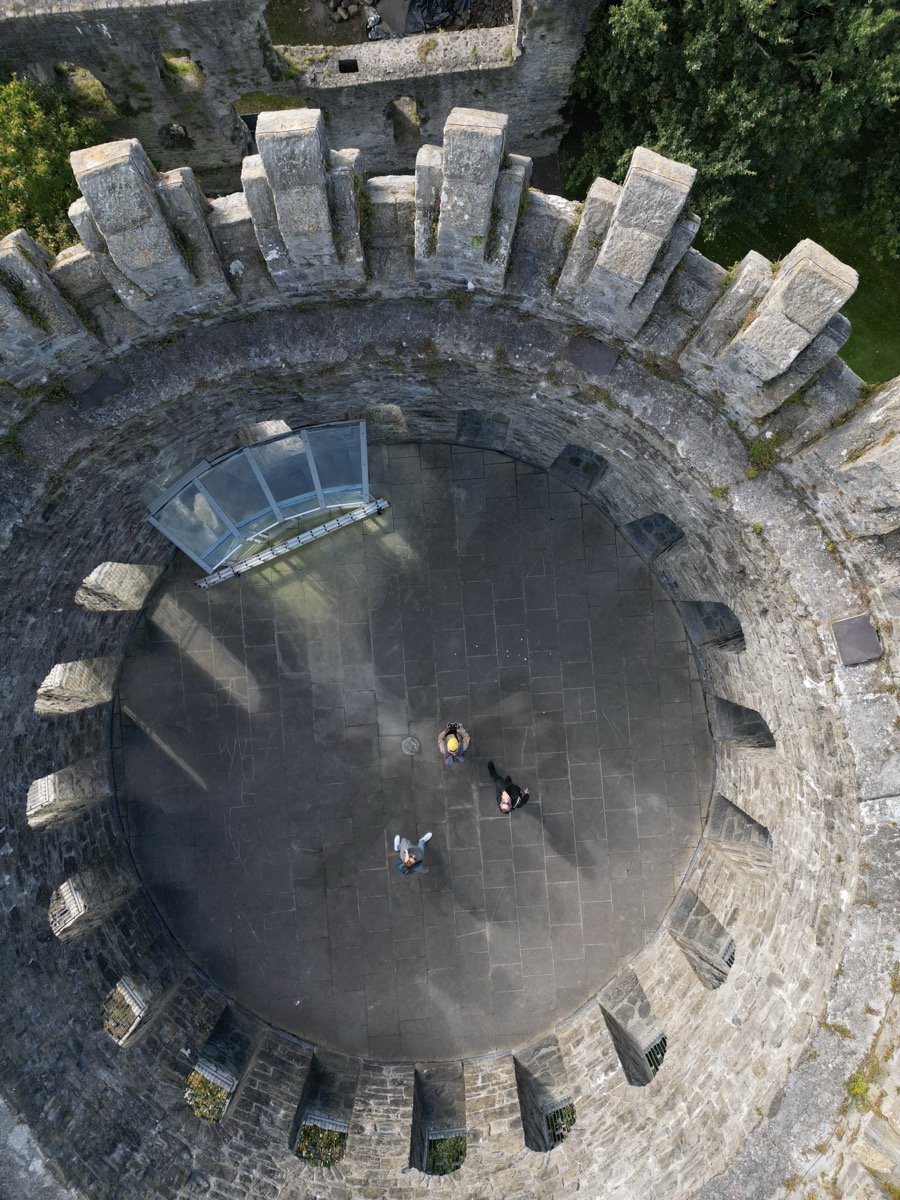
Nenagh Castle is one of only a handful of fully circular Norman keeps in Ireland, 100 feet tall, around 15 metres in diameter, a near-perfect drum of stone rising above the town centre. The same Butler dynasty connection runs through Kilkenny and Cahir, but here the geometry is the thing. From the air, it is one of the most striking castles in the country.
I climbed the wooden spiral staircase and stood in the stone window alcoves near the top, looking out over Nenagh. Through one of the arched windows, the church spire frames perfectly against the sky, the kind of composition that makes you stop moving and just look. I flew my DJI drone from the grounds for aerial shots of the circular keep and the geometry only becomes more impressive from above.
Interior access is inconsistent, call ahead before building it into a fixed itinerary. Most Ireland itineraries skip Nenagh entirely, which is their loss.
After visiting, we had what was genuinely the best fish and chips of our entire Ireland trip at the Hibernian Inn, a short walk from the castle. That alone would make it worth a stop.
Where to Stay Near Nenagh Castle
12. Glenveagh Castle, County Donegal
- Location: Glenveagh National Park, Churchill, County Donegal
- Entry: Castle tour Adults €6 (OPW); National Park free; shuttle bus included
- Hours: Apr-Oct daily 9am-6pm; Nov-Mar limited hours
Glenveagh is unlike anything else on this list. A Victorian Scottish Baronial castle on the shore of a mountain lough, inside 16,000 hectares of national park in the wilds of Donegal.
The setting alone is extraordinary, dark water, steep hillsides, nothing else for miles in any direction. It does not look or feel like any other Irish castle.
The history is darker than the gardens suggest. John George Adair cleared 244 tenants off the estate in 1861 to create his deer park. The castle was built on that clearance.
After 1937, Henry McIlhenny, the Tabasco heir, developed the gardens into their current form: an Italian garden, a walled garden, a pleasure ground that contrasts with the raw landscape around it. That contrast between the manicured and the wild is the most interesting thing about Glenveagh.
It is very remote, 25 kilometres from Letterkenny on narrow roads, and private vehicles cannot reach the castle (a shuttle bus runs from the visitor centre, included in admission). Donegal weather can be severe even in summer. Book castle tours in advance in the summer months.
This is a full half-day commitment at minimum, and it rewards that commitment. For more on the wider area, see our guide to things to do in Donegal.
Where to Stay Near Glenveagh Castle
Best Tour to Glenveagh Castle
Tips for Visiting Irish Castles
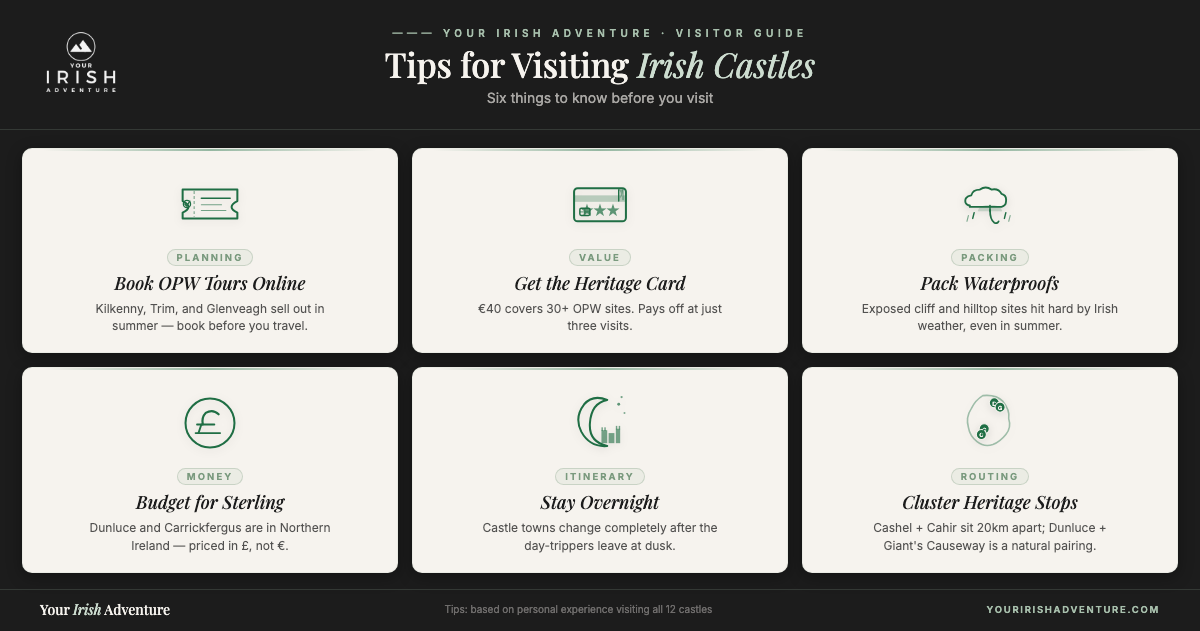
Book OPW sites online before you go. Kilkenny, Trim, and Glenveagh all run timed tours in summer and they sell out, arriving without a booking can mean missing the interior entirely.
The Heritage Card pays for itself at three or more OPW sites. At €40 for adults and €90 for families, it covers over 30 monuments across the Republic, if your itinerary includes Kilkenny, Rock of Cashel, and Trim, you are already close to break-even.
Northern Ireland castles, Dunluce and Carrickfergus, are priced in sterling, not euro. Budget separately for those two sites if you are crossing the border.
At several castles on this list, the grounds are free while the interior is ticketed. Kilkenny’s grounds, Trim’s curtain wall circuit, and Malahide’s demesne park are all accessible without paying entry. Worth knowing if the budget is tight.
Weather matters more for castle visits than almost any other heritage category. Rock of Cashel sits exposed on a limestone outcrop in the middle of the Tipperary plain. Dunluce is a clifftop ruin above the Atlantic.
Glenveagh can be soaked in cloud on a day when Donegal town is bright. Always carry waterproofs.
Castle towns like Kilkenny and Cashel change character once the day-trippers leave. The medieval laneways in Kilkenny are quieter in the evening, the restaurants fill with people who are actually staying, and the castle grounds have a completely different atmosphere at dusk. Staying overnight is worth considering for both.
Cluster your heritage stops to avoid wasted driving. Rock of Cashel and Cahir are 20 minutes apart and make a natural pairing. Trim, Newgrange, and the Hill of Tara form a strong full day in County Meath.
In the north, Dunluce, the Giant’s Causeway, and Bushmills Distillery sit on the same coastal road. An Ireland road trip is the most practical way to combine several castles in a single visit.
Also worth reading:
- The Best Castles in Northern Ireland
- The Best Castles in Dublin
- Castles in Cork
Getting to Ireland’s Castles
The castles on this list span the full length of the island, from Donegal to Cork, and several are in locations with limited or no public transport. A hire car is the most practical way to cover multiple sites in one trip.
Compare Ireland car hire deals here →
FAQs About Ireland’s Ancient Castles
What is the most famous castle in Ireland?
Internationally, Blarney Castle has the highest name recognition, the Blarney Stone draws visitors from around the world and has been doing so for well over a century. For architectural integrity and overall visitor experience, though, Kilkenny Castle makes a stronger case for the title. It is more completely preserved, the setting in a medieval city gives it more context, and the Long Gallery interior is finer than anything Blarney’s tower contains.
What is the best-preserved medieval castle in Ireland?
Carrickfergus Castle in County Antrim holds that claim most convincingly, it was in continuous military use from 1177 to 1928, over 750 years, which is an extraordinary span for any building. Cahir Castle in County Tipperary is another strong contender: barely modified since the 15th century, with original defensive features still clearly readable. Bunratty is the most completely restored, but restoration is different from preservation.
Which castle should I visit if I only have time for one?
Kilkenny. The castle itself is the strongest intact interior on this list, the Canal Walk approach is one of the best free experiences in Irish heritage, and Kilkenny city offers medieval laneways, excellent food, and good accommodation. No other castle on this list sits inside a medieval city that is genuinely worth a full day. If you are choosing one, Kilkenny is the strongest single answer.
Can you stay overnight in an Irish castle?
Yes, there are castle hotels in Ireland ranging from genuine luxury to surprisingly affordable. Several historic castle properties have been converted into accommodation, from large estate hotels to smaller tower houses with rooms. For a full guide to staying in Irish castle hotels, see our dedicated post on the subject.
How many castles are in Ireland?
The answer depends on what you count. Estimates range from 30,000 to 45,000 structures across the island when you include tower houses, ringforts with later construction, fortified manor houses, and ruined fragments. Ireland has a higher density of castle and fortified structures per square mile than almost anywhere in Europe, a legacy of centuries of competing dynasties and colonial plantation. For a fuller breakdown of the numbers, see our guide to how many castles are in Ireland.
What is the largest castle in Ireland?
Trim Castle in County Meath is the largest Anglo-Norman castle in Ireland. The curtain walls enclose three acres, and the 20-sided polygonal keep is the largest of its kind in Ireland or Britain. The scale is immediately apparent when you are standing inside the curtain walls, it is substantially bigger than most visitors expect from a town the size of Trim.
Are Irish castles accessible year-round?
Most OPW sites in the Republic operate year-round with reduced hours from November to February. The main exception on this list is Nenagh Castle, where interior access is seasonal and inconsistent, call ahead before visiting in winter. Northern Ireland sites (Dunluce, Carrickfergus) also reduce their hours in winter. Glenveagh’s castle tours are limited outside the April to October season, though the national park itself remains open.
Do I need to book Irish castle visits in advance?
For Kilkenny, Trim, and Glenveagh, yes, book online in advance during summer. Timed tours have limited capacity and sell out, particularly on weekends. For Blarney and Bunratty, advance booking is less critical but arriving at opening time is the better strategy to avoid the Stone queue and midday crowds. For Dunluce, Cahir, and Carrickfergus, walk-up entry is generally fine year-round.
Final Thoughts
This list suits travellers who want to actually understand what they are looking at, not just photograph a ruin from a car park and move on. The castles here range from free entry towers in small Tipperary towns to Victorian estates accessible only by shuttle bus through a national park. That range is deliberate, because Ireland’s castle stock is genuinely diverse, and the most interesting examples are not always the most famous.
If forced to choose the single most rewarding experience on this list, it is Kilkenny, the combination of castle and city is unmatched. The most underrated is Nenagh, which almost no itinerary includes and which rewards the detour.
The most visually arresting, for a short stop, is Dunluce. And if you are covering the north and south in one trip, the contrast between Carrickfergus’s functional Norman harbour fort and Glenveagh’s remote Victorian baronial castle illustrates just how wide the definition of “Irish castle” actually runs.
The island has more of these sites than you will ever visit in a single trip. The twelve here are a reliable starting point, specific enough to be useful, varied enough to suit different kinds of travellers and different parts of the country. If you are planning a longer journey, our 10 days in Ireland itinerary gives a strong framework for fitting several of these into a single trip.
Like it? Pin it!
Save this guide for later