Ten days in Ireland is enough time to do it properly, covering Dublin, the south coast, the Ring of Kerry, and Galway without feeling like you’re just ticking boxes from a moving car.
We spent 13 days on a roadtrip in Ireland at the end of September into October – which was a great amount of time. But, 10 days would be sufficient as well, and you’ll really be able to cover a lot!
Of course, there are still so many places we missed! I can’t wait to return to Ireland.
This itinerary maps out exactly how to use those ten days, with a logical route that cuts down on backtracking and leaves room for the unexpected stops that end up being the best part of any Ireland trip.
More guides for your Ireland trip:
- A Weekend in Dublin, Ireland: The Perfect 2 Day Itinerary
- Weekend in Killarney: The Perfect 2 Day Itinerary
- 10 Best Meals in Ireland (What to Eat and Drink)
- 10 Best Places To Stay in Bray, Ireland
- 10 Best Airbnbs in Galway, Ireland
- Weekend in Galway: The Perfect 2 Day Itinerary
- 10 Luxurious Afternoon Tea Experiences in Ireland
- 10 Best Pubs In Galway, Ireland
- 10 Best Bars In Belfast, Northern Ireland
- Weekend in Cork: The Perfect 2 Day Itinerary
Is 10 Days Enough for Ireland?
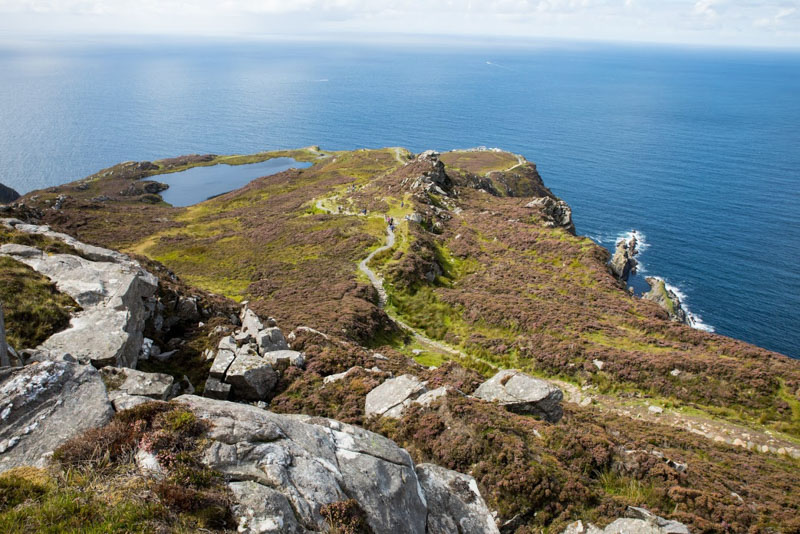
Yes, ten days is a solid amount of time for Ireland.
You can cover Dublin, the south coast, the Ring of Kerry, and Galway without it turning into a blur of motorway driving and rushed sightseeing.
What you will have to leave out: Northern Ireland, the Aran Islands, and any real depth in Connemara. If you have a couple of extra days, I recommend adding on Connemara – it’s a beautiful area.
Ten days hits a sweet spot: enough time to slow down occasionally, take the scenic roads, and not feel like you’re just ticking counties off a list.
How to Get Around Ireland
For this itinerary, renting a car is not optional.
It is the only practical way to do it.
The Ring of Kerry, the Dingle Peninsula, and the Cliffs of Moher are all accessible by tour bus if you’re based in a city, but public transport to these places on any flexible schedule simply does not exist.
A car puts you in control. You stop when you want, take the back roads, and don’t have to reverse-engineer your day around a bus timetable.
Book through DiscoverCars to compare rates across multiple companies.
Weekly rentals typically run €200 – €400 depending on the season and car class, and booking in advance almost always gets you a better deal.
If you are not used to driving a manual on the left, pay the extra for an automatic. It is worth every cent, especially on the narrow country roads in Kerry and Clare.
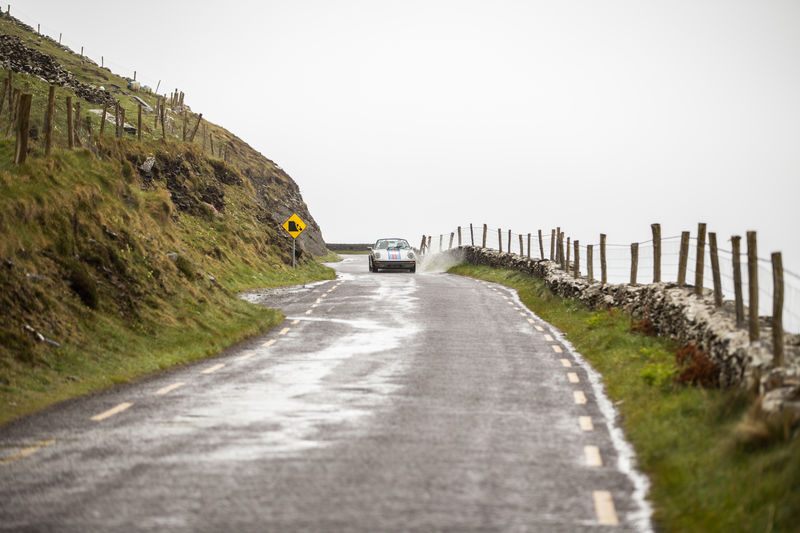
Roads outside the cities can be extremely tight, sometimes barely wide enough for one car, with stone walls on both sides and a tractor coming the other way.
For a full breakdown of what to expect behind the wheel, the Definitive Guide to Driving in Ireland for Tourists covers everything from roundabout rules to parking.
Fuel costs roughly €1.70 – €1.90 per litre.
If you pass through Dublin on the M50 ring road, there is an electronic toll of around €3.10 that you pay online within 24 hours of travel.
Your rental company will handle it if you forget, but they charge an admin fee for doing so.
This route runs clockwise from Dublin, looping through Kilkenny, Cork, the Ring of Kerry, Killarney, Dingle, and Galway before heading back to Dublin, covering roughly 1,000 kilometres in total.
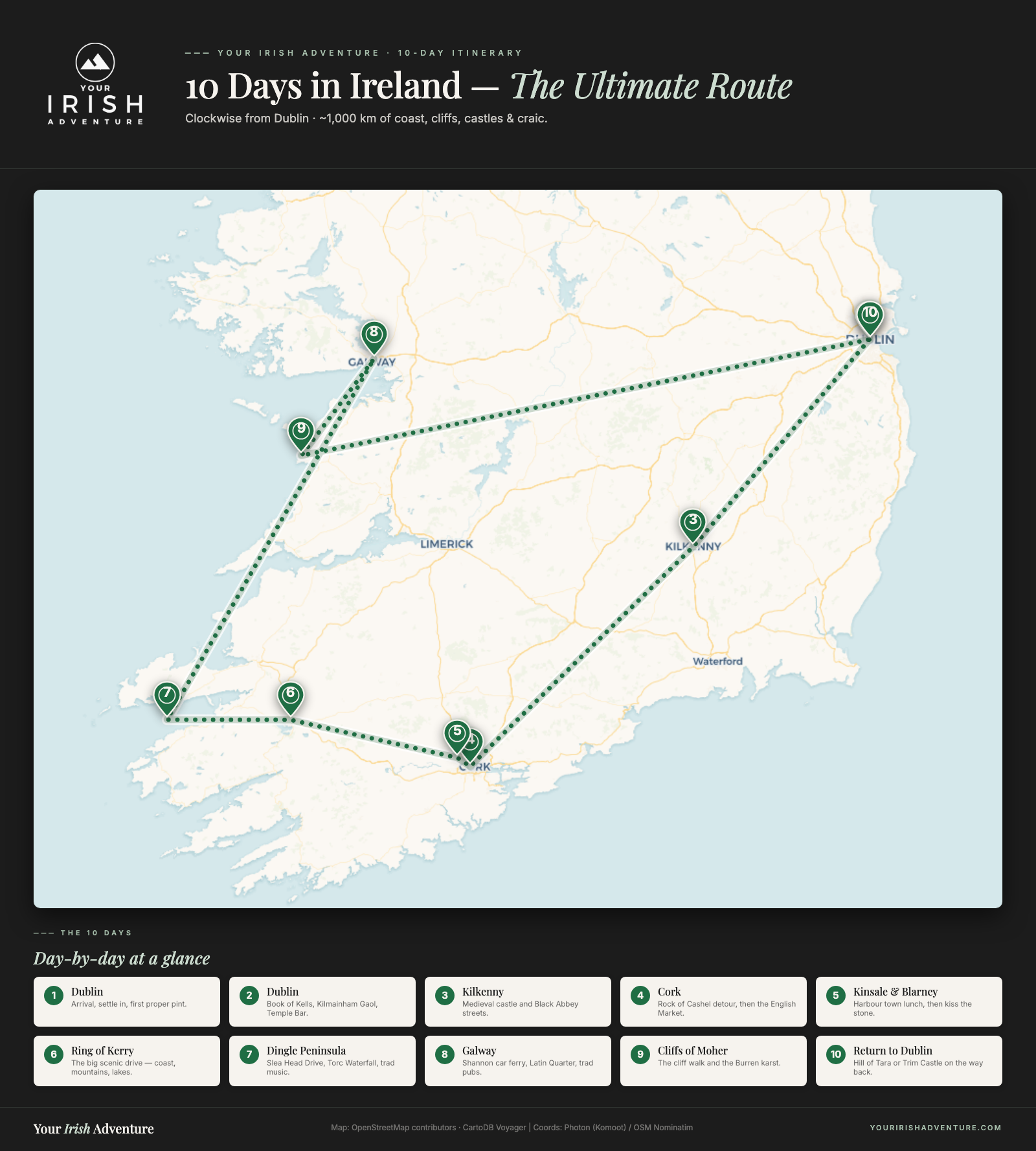
Clockwise makes sense here because it puts the southwest’s narrow roads in front of you while you’re fresh.
It also leaves the more straightforward drive back from Galway to Dublin for the final day when you’re tired and just want to get home.
The Perfect 10-Day Itinerary
After driving around Ireland, I’m excited to share our itinerary – one I think makes for a perfect 10 day trip to Ireland!
Day 1 – Arrive in Dublin
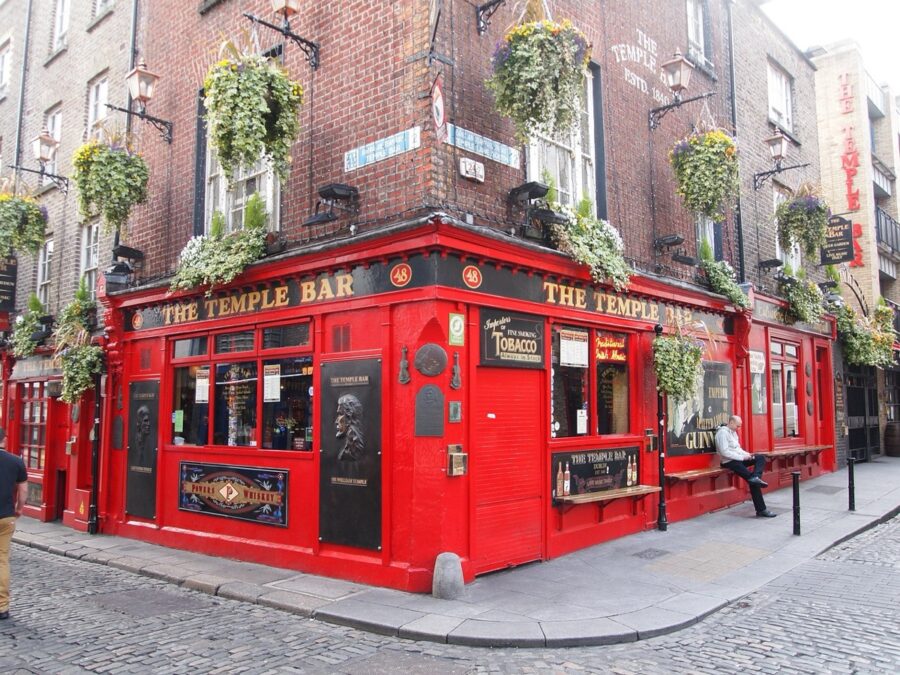
If you’re flying into Dublin Airport, keep things simple on arrival day. This is not the day to race for the countryside.
My advice: skip the rental car for now.
Pick it up on Day 3 when you’re leaving Dublin, which saves you parking fees in the city and the stress of driving on the lefthand side before you’ve had your first pint.
Getting into the city from the airport is straightforward.
The Aircoach runs directly to the city centre for around €8, or you can grab a taxi for about €25-30.
For the full breakdown of your options, the guide on getting from Dublin Airport to Dublin City Centre covers everything.
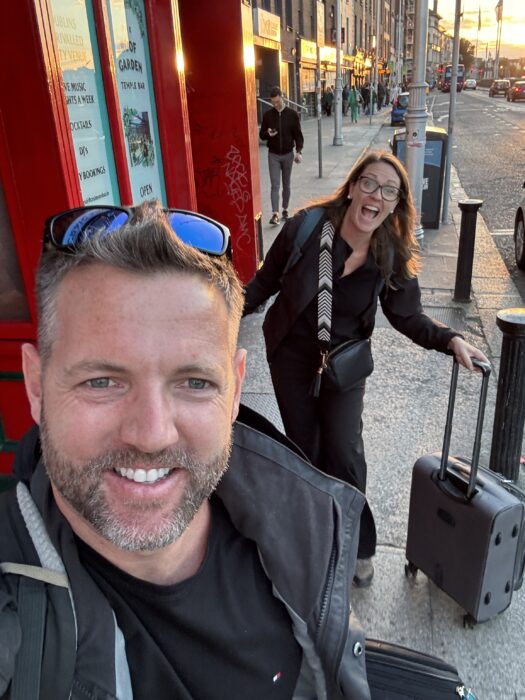
For accommodation, I’d point you toward the Liberties or the Northside rather than the tourist-heavy streets around Temple Bar.
Both neighbourhoods have more character, better value, and you’re still within easy walking or tram distance of everything.
A solid mid-range pick in this part of the city is the The Moxy Dublin City, which comes in at around €120-150 per night and puts you close to the Luas and a short walk from Smithfield Square.
For more options across the city, the Where To Stay in Dublin guide breaks it all down by neighbourhood.
In the evening, head to around the Temple Bar area, or Stoneybatter or the streets around Smithfield for your first proper Irish pub experience. We loved the vibe, food and drinks at Darkey Kelly’s.
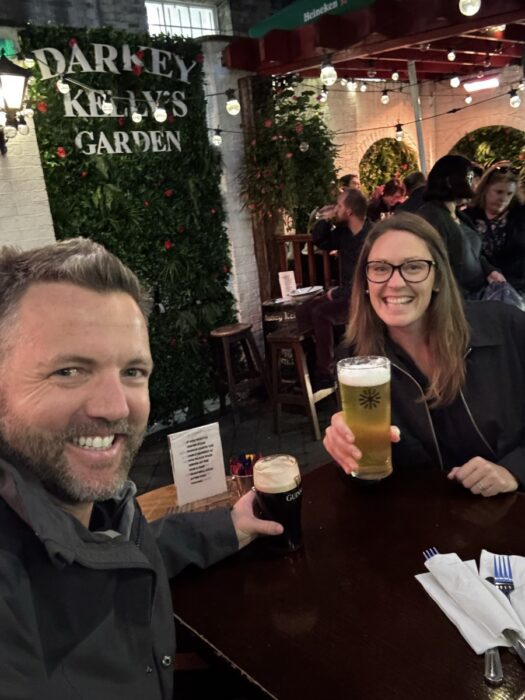
These parts of the city has a good spread of local pubs with live music on most nights, without the inflated prices and tourist crowds you’ll find closer to the river.
Grab a pint, order something from the bar menu if you’re hungry, and don’t overthink it. Day 2 is where the real sightseeing begins.
Day 2 – Explore Dublin
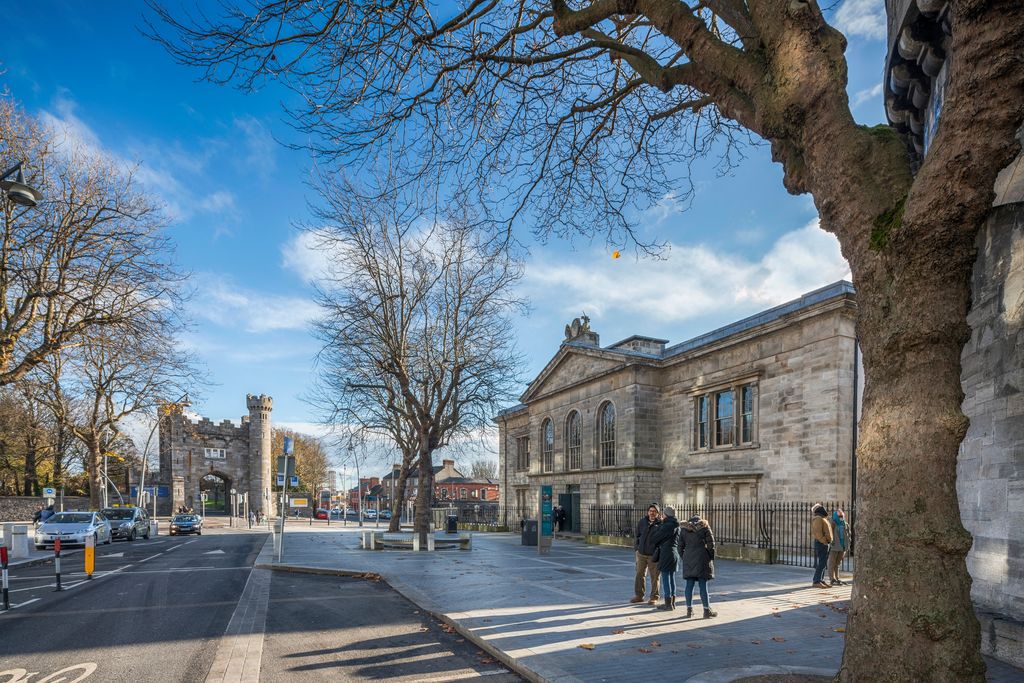
If you decided to rent a car from the airport, leave it car parked today.
Dublin city centre is very walkable, and parking is an expensive headache you don’t need.
Start the morning at Trinity College to see the Book of Kells. Book your entry ticket online before you go, because the queues without one can eat up an hour of your morning. Unfortunately, we made that mistake and weren’t able to see the Book of Kells before it closed!! But, we still enjoyed wandering around Trinity College.
From Trinity, walk west through Temple Bar and keep going into the Liberties. It’s one of the oldest parts of the city and feels noticeably different from the more polished streets around Grafton Street.
In the afternoon, head to Kilmainham Gaol, and make sure to book this one in advance too. The guided tour takes about an hour and covers the 1916 Rising executions in real detail, and it’s one of the best history experiences in the country.
Another more interesting tour that includes the Gaol is this dark adventure aboard the Gravedigger Ghost Bus Tour. This immersive experience starts at Trinity College, where the guides, dressed for the occasion, transport you 600 years back into the heart of old Dublin, marked by plague and terrifying legends. Click here to learn more about this highly-rated, spooky trip.
One thing to keep in mind: Dublin is not cheap.

Budget €20 – 40 per attraction and factor that in before you go, especially if you’re planning on adding the Guinness Storehouse or the Jameson Distillery to the mix – and you should! I did the “Secret Whiskey Tasting” at Jameson and it was fantastic, highly recommend it.
If you want to stretch this into a longer Dublin stay, the 3 Days in Ireland: The Perfect Itinerary is worth a read.
If you’d rather hand the logistics to someone who knows the city well, this Dublin skip-the-line highlights tour covers the main sights with a local guide and is one of the highest-rated options out there.
Day 3 – Dublin to Kilkenny
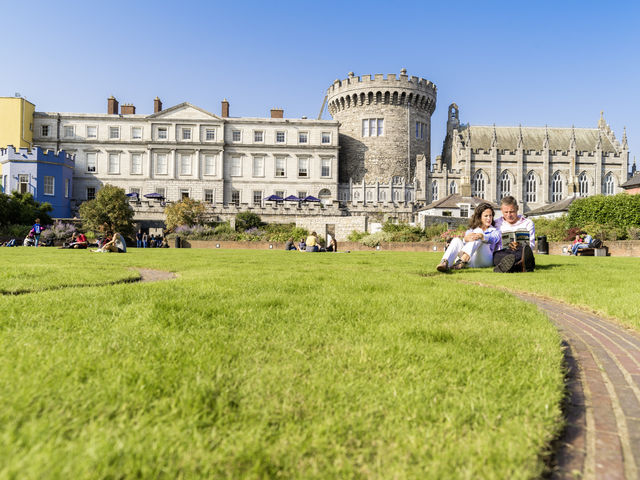
Pick up your rental car this morning and head south on the M9.
Kilkenny is about 1.5 hours from Dublin city centre, and the motorway driving is straightforward even if you’re not used to driving on the left.
If you haven’t driven in Ireland before, it’s worth reading up on the basics before you set off. The Definitive Guide to Driving in Ireland for Tourists covers everything you need to know.
Once you’re in Kilkenny, head straight to the Kilkenny Castle – just behind the castle, there’s a beautiful park and walking area as well.
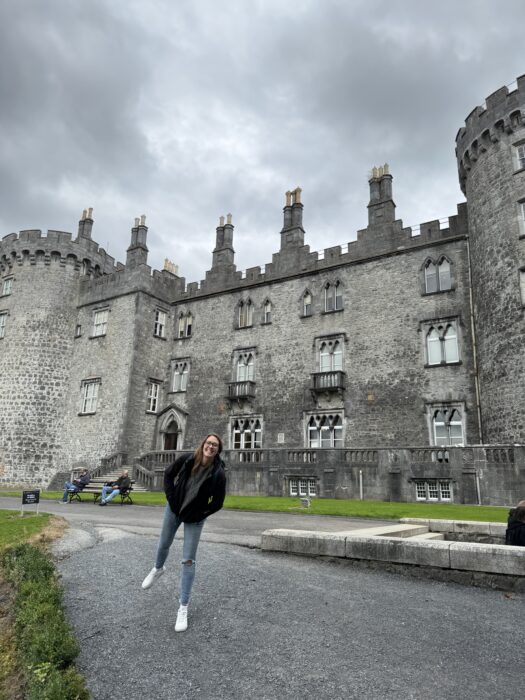
After the castle, the Medieval Mile is right on your doorstep. It’s a walking route through the heart of the old city that takes in the cathedral, the Black Abbey, and some of the best-preserved medieval streetscapes in Ireland.
Grab lunch at one of the cafés on High Street, then take the afternoon at a slower pace. One thing worth noting is that Kilkenny is compact, and half a day covers the highlights comfortably.
That’s exactly why it works so well as an overnight stop on a longer trip rather than a two-night base.
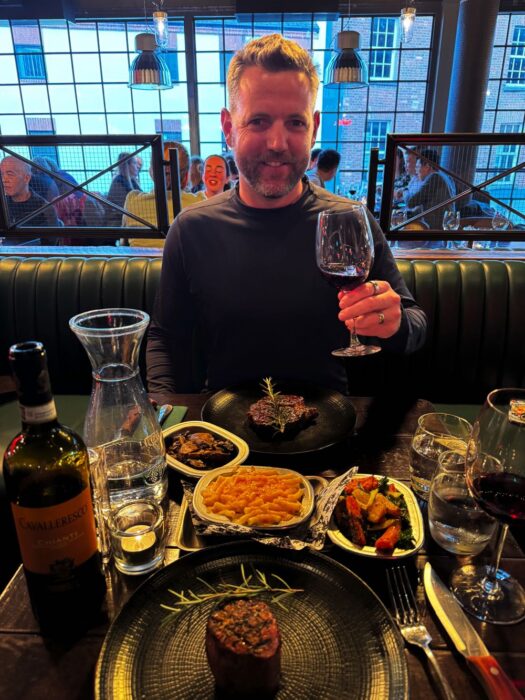
For the evening, grab dinner at the Butcher – the steaks and side dishes are sooo good! Kilkenny also has a pub scene that’s worth checking out in the evening.
Parliament Street and John Street are where most of the action is, with traditional music sessions most nights.
For accommodation, The Kilkenny River Court Hotel sits right on the Nore River with views of the castle from some rooms.
Expect to pay around €120-160 per night depending on the season.
Day 4 – Kilkenny to Cork
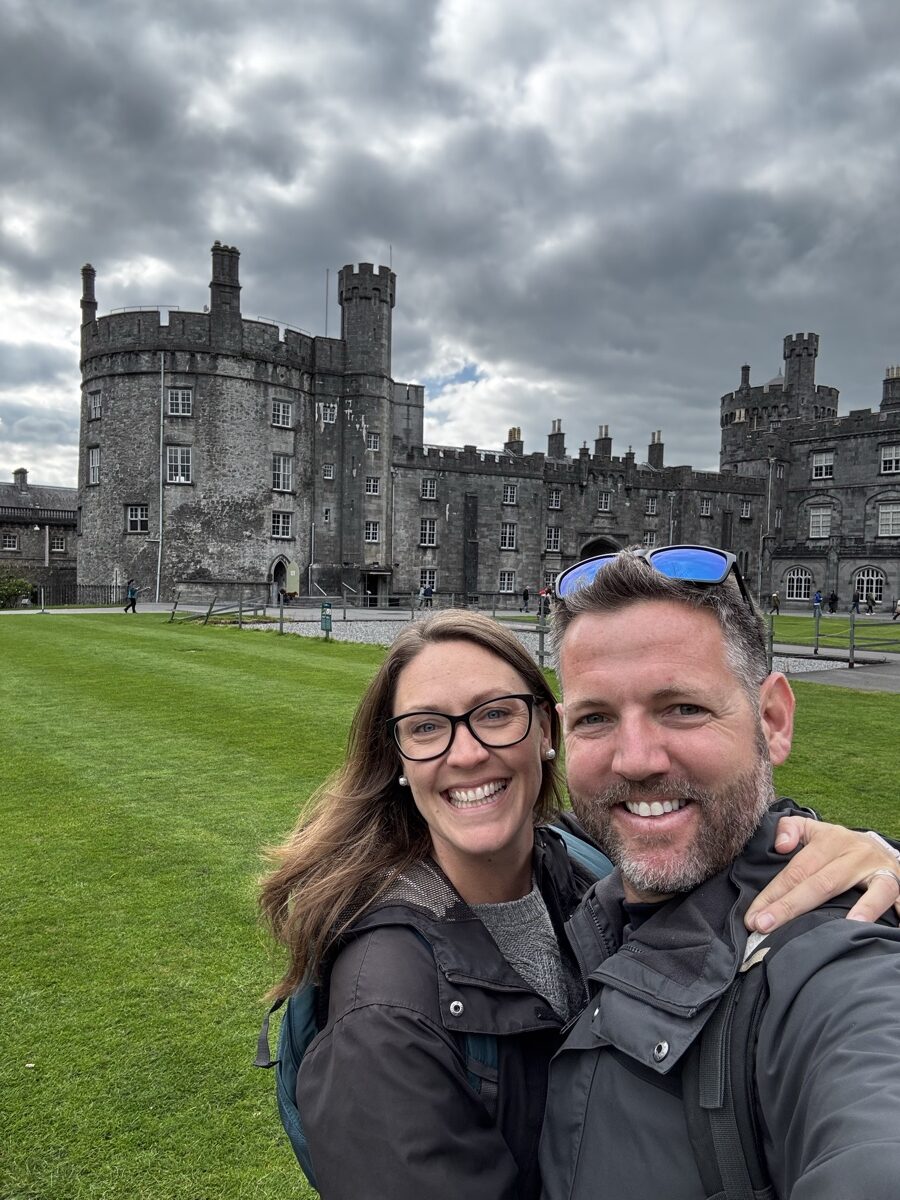
The drive from Kilkenny to Cork takes around 1.5 to 2 hours, but there’s one stop along the way that’s worth slowing down for.
The Rock of Cashel sits about halfway between the two cities, and even a 30-minute stop is enough to justify pulling off the N8.
It’s one of those places that stops you in your tracks – a cluster of medieval towers and a cathedral perched on a limestone outcrop in the middle of flat Tipperary farmland.
If you want more time in that part of the country, Cahir Castle is only 20 minutes further south and one of the best-preserved Norman castles in Ireland, so it pairs well if you’re not in a rush.
Aim to be in Cork by midday, which gives you a solid afternoon in the city.
First stop should be the English Market – it’s free to walk through, it’s been trading since 1788, and it’s one of those places that actually lives up to the reputation.
After that, the Victorian Quarter is worth a wander, and Oliver Plunkett Street has good coffee shops if you need a sit-down after the drive.
Cork gets overlooked because it sits in Dublin’s shadow, but most people who spend time here come away impressed. It has real character, a strong food scene, and a relaxed pace.
If you want to get your bearings and pick up some local history, a Cork city walking tour is a solid use of a couple of hours in the afternoon – click here to book a highly-rated Cork city walking tour.
For more ideas on how to fill your time, our guide to the best things to do in Cork covers both the city and day trips.
For a place to stay, Cork city centre hotels on Booking.com range from around €90 per night for a solid mid-range option up to €180-220 for something more comfortable.
Our guide to where to stay in Cork breaks down the best neighbourhoods if you want help narrowing it down.
Day 5 – Cork, Kinsale, and Blarney

Day five keeps you based in Cork but gets you out of the city for most of it.
Start the morning with the drive to Kinsale, about 45 minutes south of Cork.
It’s a small harbour town with colourful shopfronts, fishing boats, and a food scene that’s earned it a genuine reputation as one of the best places to eat in Ireland.
Walk the waterfront, grab a coffee, and spend an hour or two exploring before heading back north to Blarney Castle.
Entry is €18 – 20, and in summer you’ll want to book ahead because the queues for the Blarney Stone can be long! Yes, kissing the stone means leaning backwards over a parapet while someone holds your legs, and yes, it’s one of the most touristy things you can do in Ireland.
But, we did it anyways! If nothing else, the views from the top of the castle are incredible. And, I was actually grossed out at the thought of thousands of people’s lips being on that stone…but, after each kiss, I watched them disinfect it.
Even if you skip the stone, the castle grounds alone are worth the entry fee, with gardens, woodland walks, and the castle ruins themselves to explore. Click here for a 2 hour guided trip around the gardens, castle and stone.
For more on what to see in the area, our guide to the top castles to visit in Cork is worth a look before you go.
Back in Cork for the evening, don’t underestimate the city’s restaurant scene. The English Market area and the streets around Princes Street have a concentration of good independent restaurants, in particular, don’t miss Market Lane.
If you’re still putting together your Cork plans, our guide to the best things to do in Cork and our Cork weekend itinerary cover plenty more options for the evening.
Day 6 – Cork to the Ring of Kerry
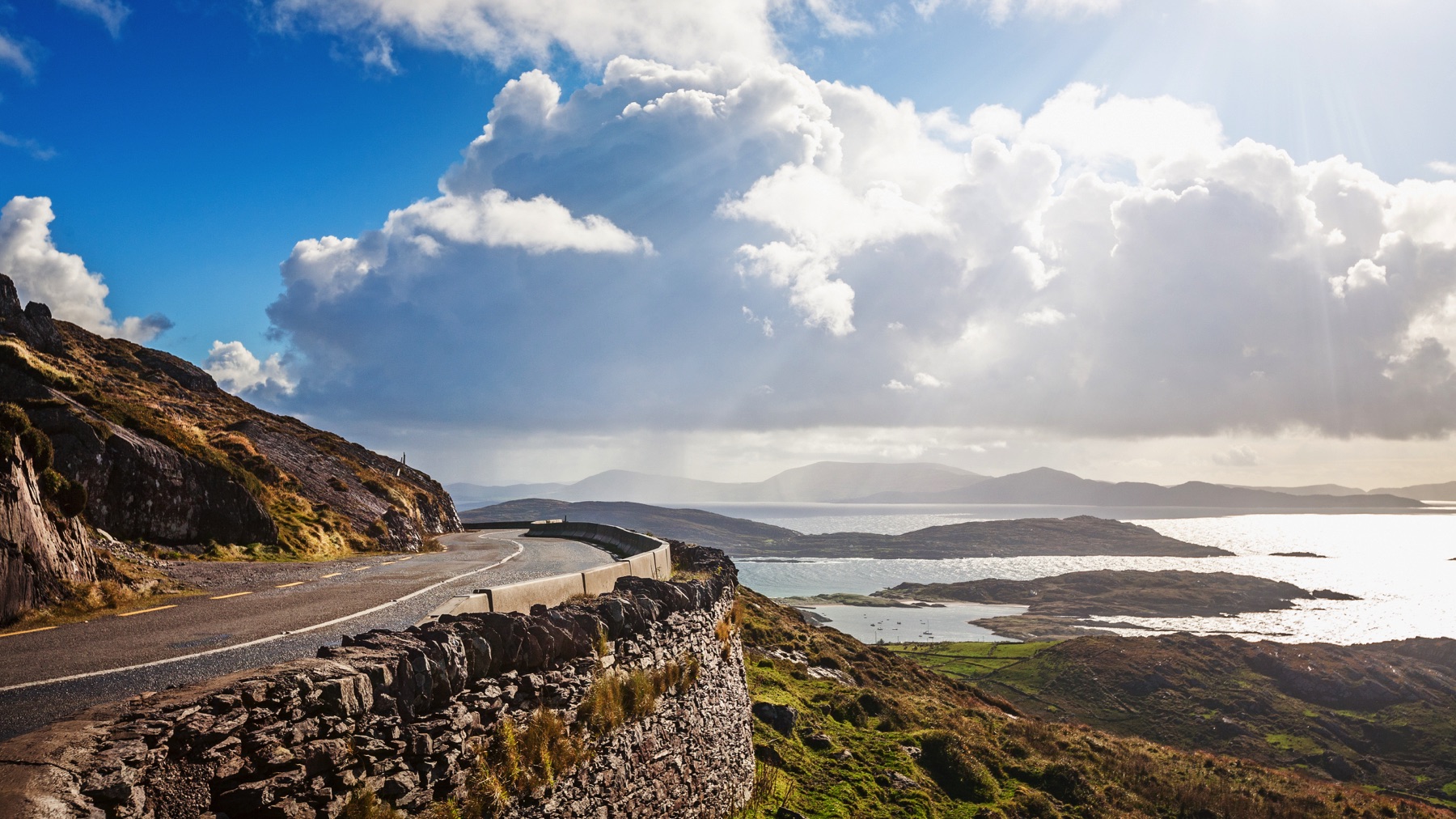
Day 6 is the big scenic drive, and it delivers.
Head out of Cork early and make the 1.5-hour drive to Killarney, drop your bags at the hotel, then loop the Ring of Kerry for the rest of the day.
The loop is roughly 180km and takes 4-5 hours with stops, so an early start matters more than you’d think.
For Killarney accommodation, there are some excellent options on Booking.com across all budgets, and our guide to where to stay in Killarney breaks down the best areas if you want a more detailed look.
Drive the loop anti-clockwise.
The tour buses all go clockwise, so driving the opposite direction means you’re not stuck behind a convoy of coaches on narrow roads, and passing is a lot easier.
Leave Killarney before 9am if you can, especially in July and August. The route runs through Killorglin, Cahersiveen, Waterville, and Sneem before looping back through Molls Gap.
Don’t skip Ladies View on the return leg. The panorama over the Upper Lake is one of the best on the whole route.
If you have an extra hour, the Gap of Dunloe is worth a detour before or after the main loop. It’s a narrow mountain pass just west of Killarney, and the scenery there is different from the coastal section of the Ring.
One caveat: in peak summer, the Ring of Kerry can feel overwhelming with traffic.
Starting early and driving anti-clockwise takes the edge off, but if self-driving isn’t your thing, a guided day tour is a solid option and takes all the navigation stress out of it.
Click here to book a highly-rated Ring of Kerry tour.
For more on planning the drive in detail, our Ring of Kerry drive guide covers every stop, viewpoint, and practical tip you’ll need.
In the evening, you’re spoiled for choice when it comes to restaurants and pubs. Killarney had our favourite music scene of the whole trip. The “trad” sessions were incredible.
One of the best musicians we saw were a couple of brothers who performed at the Killarney Grand, and another great spot is O’Connors Traditional Pub – the way the band worked the crowd was so much fun!
And if you want more to fill the days around this, our guide to things to do in Kerry and the Killarney weekend itinerary are both worth reading before you go.
Day 7 – Killarney and the Dingle Peninsula
Start the morning in Killarney National Park before the crowds arrive. It’s free to enter, and a walk to Torc Waterfall or a loop around Ross Castle takes around two hours.
That sets you up nicely for the drive ahead.
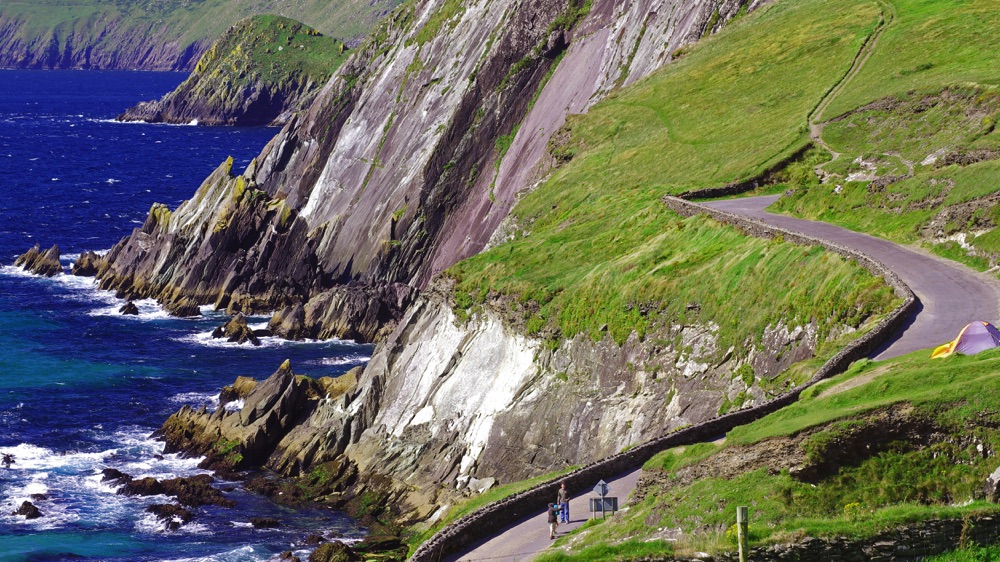
From Killarney, it’s about an hour to Dingle town, and from there the Slea Head Drive is one of the most dramatic coastal loops in the country. Give yourself around 2.5 hours with stops.
The Slea Head viewpoint, Dunbeg Fort, and the ancient beehive huts are the highlights, and the clifftop views over the Blasket Islands on a clear day are hard to beat.
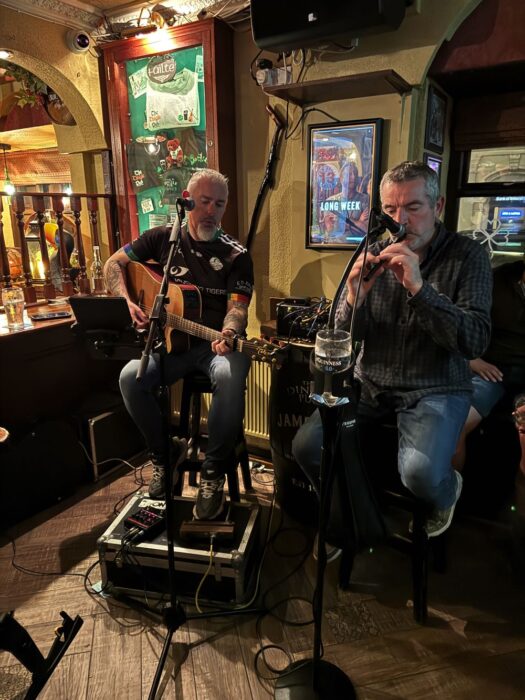
Dingle town itself is small but lively, with an awesome pub scene! Our favourites were The Dingle Pub and Foxy John’s (which is actually a hardware store by day, pub by night!)
Our full guide to things to do in Dingle is worth a read before you arrive, and if you need help picking where to sleep, our guide to the best places to stay in Dingle covers the top options across all budgets.
For a solid mid-range pick, check current availability and rates in Dingle on Booking.com.
More guides for your Ireland trip:
- 10 Best Golf Courses in Ireland
- 10 Best Castles in Dublin, Ireland
- 10 Best Golf Resorts In Ireland
- The Most Haunted Places In Ireland
- Ireland Packing List for April: Spring Is In The Air
- Finn Lough Resort – Sleeping With The Stars in Northern Ireland
- Whiskey in Ireland: Here Are The Ones You May Not Have Heard Of
- The Most Beautiful Seaside Towns in Northern Ireland
- Is This The Best Bed and Breakfast In Northern Ireland?
- The Most Beautiful Towns In Ireland You Need To Visit
Day 8 – Dingle to Galway
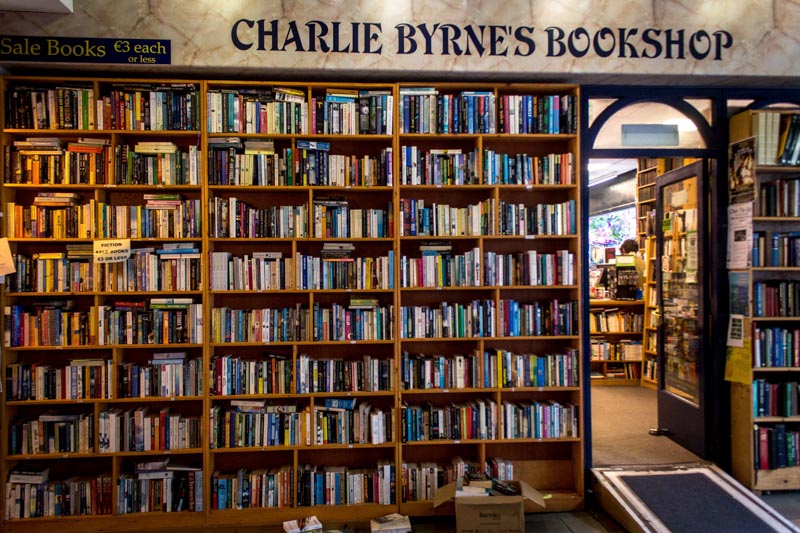
The drive from Dingle to Galway is around 2.5 to 3 hours direct, but there’s a smarter way to do it.
Head north to Tarbert and take the car ferry across the Shannon Estuary to Killimer.
It costs around €25 per car and saves you roughly 90 minutes compared to going inland through Limerick. That’s not a small saving on a long drive day, and the ferry crossing itself is a nice change of pace.
On the north side of the Shannon, consider stopping in Ennis for lunch. It’s a proper market town with good food and a relaxed atmosphere, and it barely gets a mention on most Ireland itineraries.
You’ll want to aim to reach Galway by mid-afternoon so you have time to explore before dinner.
Walk Shop Street and Quay Street, Latin Quarter, catch whoever’s playing on the street corners, and get a feel for why so many people end up extending their stay here.
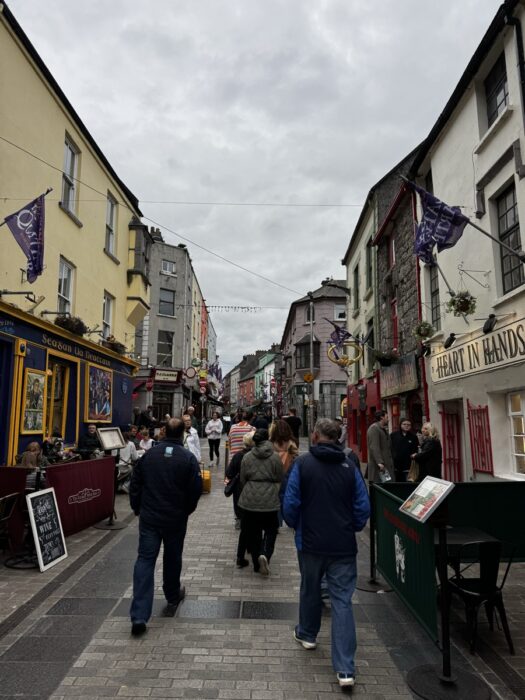
Our guide to the best things to do in Galway will help you make the most of your time, and if you’re planning a full evening out, check our pick of the best pubs in Galway before you head out. We had a couple of great nights here with busy pubs, super fun vibes, and excellent trad music. Check out Tig Coili, Salt House, and Taaffes Bar for a fun night out.
For where to sleep, our guide to the best places to stay in Galway covers all the neighbourhoods and price ranges.
Or check current availability and rates in Galway on Booking.com.
Click here to book a highly-rated Galway city walking tour to get your bearings on arrival.
Day 9 – Galway and the Cliffs of Moher
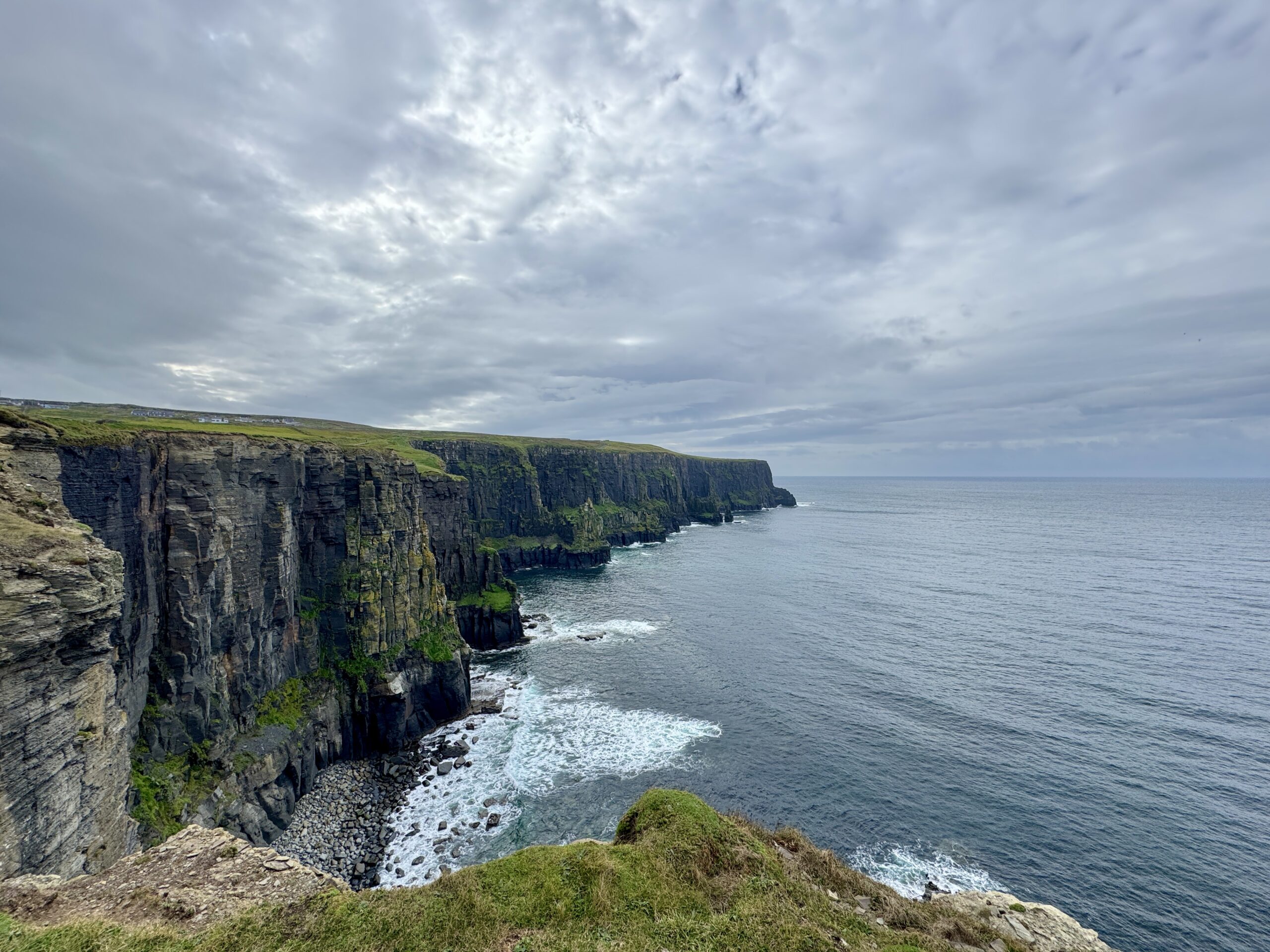
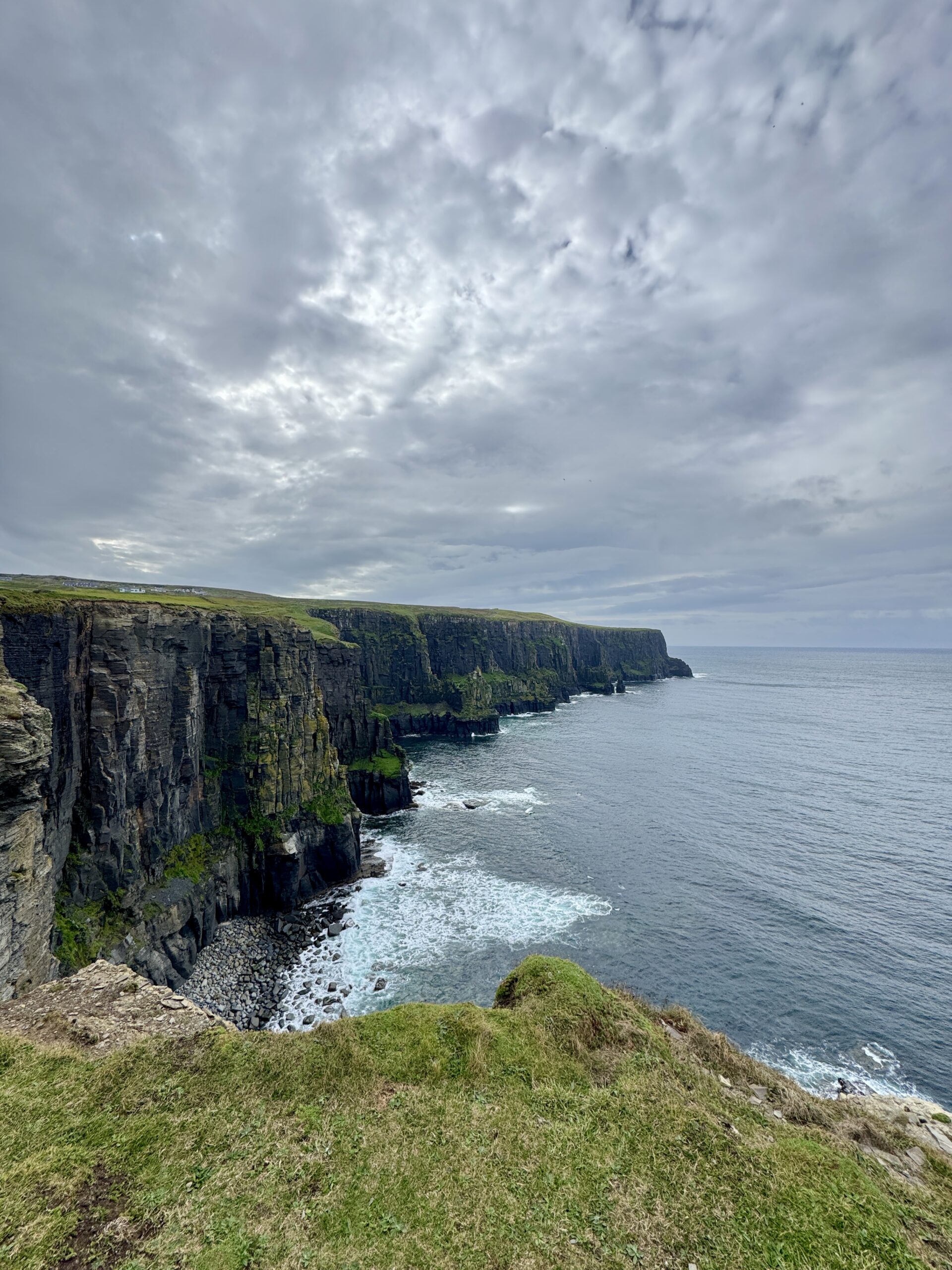
The Cliffs of Moher are about an hour’s drive south of Galway, and they deserve a full morning.
Entry costs €8 – 10 per person, and the walk along the cliff edge is roughly 1km in each direction, with views that live up to the hype.
Ireland isn’t exactly known for it’s sunny weather, so just keep that in mind when visiting the Cliffs of Moher – you’ll probably have clouds, you might even have rain, and there could be fog.
Check the weather before heading out, but also know that the weather can change quickly. It might be foggy when you arrive, but clear up after 30 minutes. We were “lucky” and had overcast skies when we visited!
On the way back, pull over for the Burren, a strange, flat limestone karst landscape that most people drive straight through without stopping. It’s one of the more odd-looking places in Ireland.
Back in Galway for the evening, a second night gives you more time to explore the pub scene properly rather than just scratching the surface.
If you’d rather skip the driving, have a look at this highly-rated full day tour from Galway, or this half day tour from Galway, both takes care of the logistics for you so you can just enjoy the view!
Day 10 – Return to Dublin
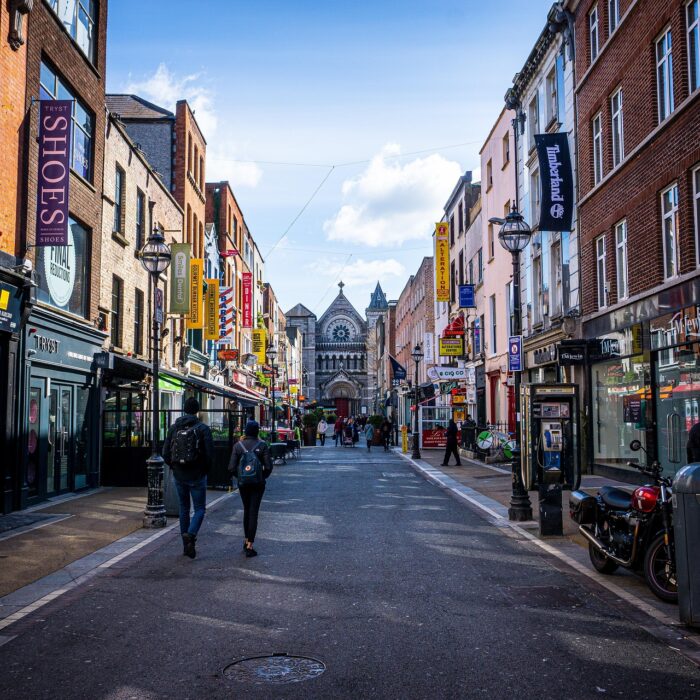
The drive from Galway back to Dublin takes around 2 to 2.5 hours on the M6, which actually leaves a solid window for one more stop if your flight is in the afternoon.
County Meath sits right on the M4/M6 corridor and it’s worth a detour for either the Hill of Tara or Trim Castle.
Both are interesting stops and neither will eat more than an hour or two of your time.
After that, it’s back on the road to return the rental car at Dublin Airport and wrap up the trip.
Ten days goes fast, and most people finish this itinerary already thinking about what they didn’t get to see.
If you have an evening flight or a night to spare in Dublin before you head home, it’s worth booking an Irish Whiskey Museum tasting tour – a pretty fitting way to close out the trip.
10-Day Ireland Itinerary: What It Will Cost
Ireland is not a cheap destination.
It regularly ranks among the more expensive countries in Western Europe for travellers, and if you go in without a budget in mind, costs can creep up fast. Having spent almost 2 weeks in Ireland, I can say…it’s worth every euro!
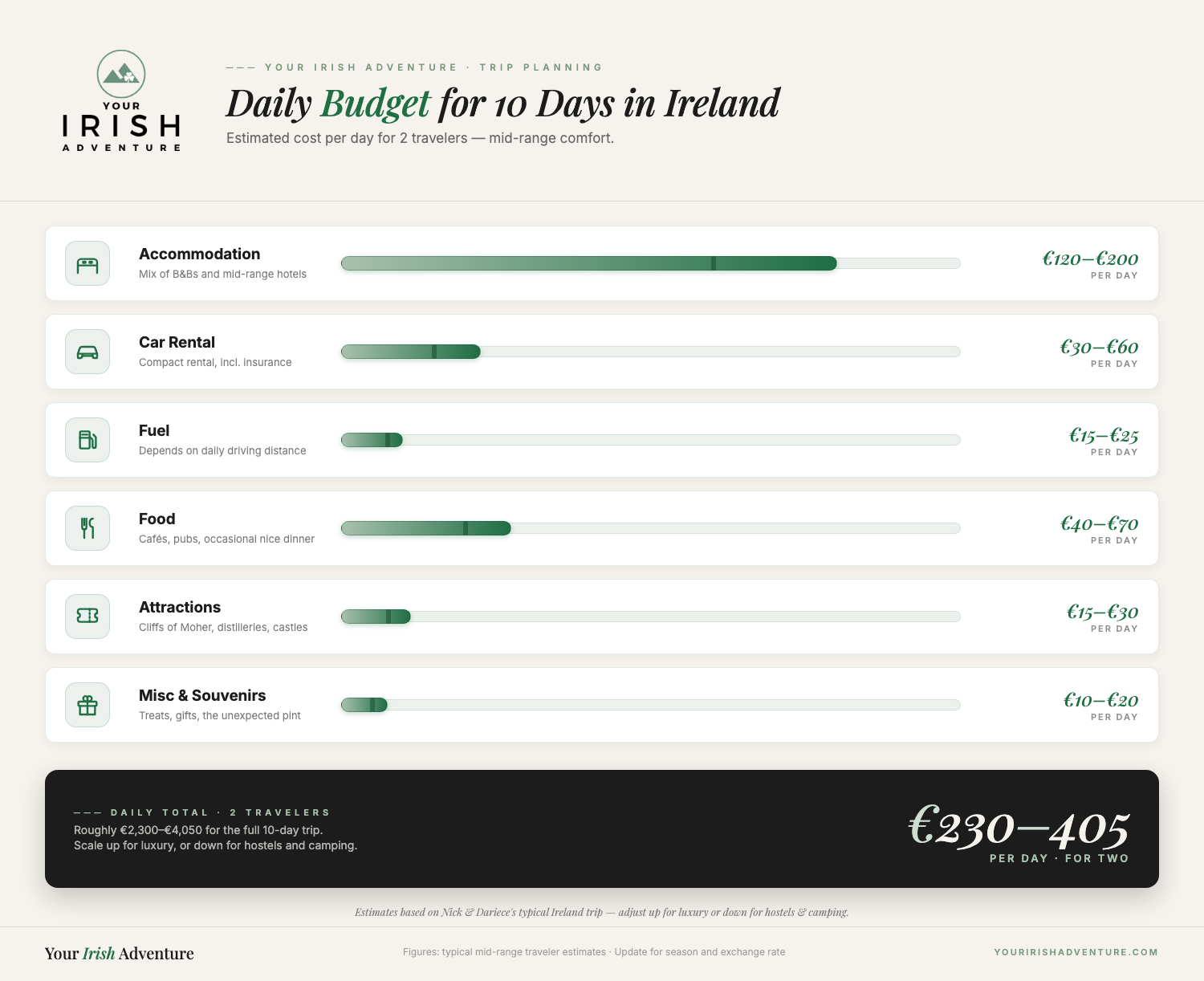
Here’s a breakdown of what to expect across three budget tiers, per person per day.
| Category | Budget (€80-110/day) | Mid-Range (€150-200/day) | Comfortable (€250+/day) |
|---|---|---|---|
| Accommodation | €25-35 (hostel dorm) | €60-90 (B&B / 3-star) | €120-180 (4-star hotel) |
| Food & Drink | €20-30 | €40-55 | €70-90 |
| Car Rental (amortised) | €20-25 | €20-25 | €25-35 |
| Fuel | €8-12 | €8-12 | €10-15 |
| Attraction Entry | €5-10 | €15-20 | €25-35 |
For a 10-day trip, that puts your rough total at around €800-1,100 on a tight budget, €1,500-2,000 mid-range, or €2,500+ if you’re travelling comfortably and not watching every euro.
A couple of things worth knowing:
Car rental is split across two people in these figures.
Solo travellers will pay more per day once you factor in fuel and the full rental cost on your own.
For food, pub lunches are consistently better value than sit-down restaurants.
A bowl of chowder and brown bread at a pub will run you €10-13.
The same meal dressed up in a tourist-area restaurant can be €18-22.
Check out our guide to the best meals in Ireland if you want to eat well without overspending.
Itinerary Variations
This itinerary is built around a Dublin arrival, but it’s easy to reshape depending on where you’re flying in or how much time you have.
Flying into Shannon instead of Dublin?
Start in Galway, work your way down through the Burren and the Ring of Kerry, then head east to Kilkenny and Dublin for your final days.
The route flows just as well in reverse.
Want to add Northern Ireland?
Swap the Days 9-10 Galway extension for Belfast and the Causeway Coast instead.
It’s a different kind of trip, but one of the best additions you can make.
Our weekend in Belfast guide is a good starting point for planning those days.
Short on time?
Ten days is the sweet spot, but Ireland rewards even a quick visit.
Practical Tips for Your Ireland Trip
A few things are worth knowing before you land, so you’re not figuring them out on the fly.
Pack Layers and a Waterproof Jacket
It doesn’t matter what month you’re visiting, bring a waterproof jacket and something warm. It’s best to wear layers – light long sleeve, a fleece, a rain jacket. Bring a winter hat, waterproof shoes, and comfortable clothing that you can hike, walk, and sit in the car with.
Ireland’s weather changes fast, and even a July afternoon can turn cold and wet with very little warning.
Check out our full Ireland packing list if you want a proper breakdown by season.
Book Kilmainham Gaol, the Book of Kells, and the Cliffs of Moher Early
These three sell out weeks ahead in summer, sometimes months for Kilmainham. Don’t leave them until you arrive and hope for the best.
Book slots as soon as your dates are confirmed. The Cliffs of Moher guide has everything you need on timing and tickets.
Tipping Is Not Expected
Ireland isn’t a tipping culture the way the US is.
Around 10% is a fair way to say thanks if the service was good at a sitdown restaurant, tips aren’t expected at a bar or casual pub. Nobody will look at you sideways for skipping it.
Pick Up an Irish SIM Card

An Irish SIM is cheap, easy to find, and makes the whole trip smoother.
Coverage is generally solid in cities and on main roads, though it can get patchy in very remote areas along the west coast.
Three and Vodafone Ireland are the most reliable options and you’ll find them in any airport or convenience store.
Driving Tips: Stay Left and Watch the Roads
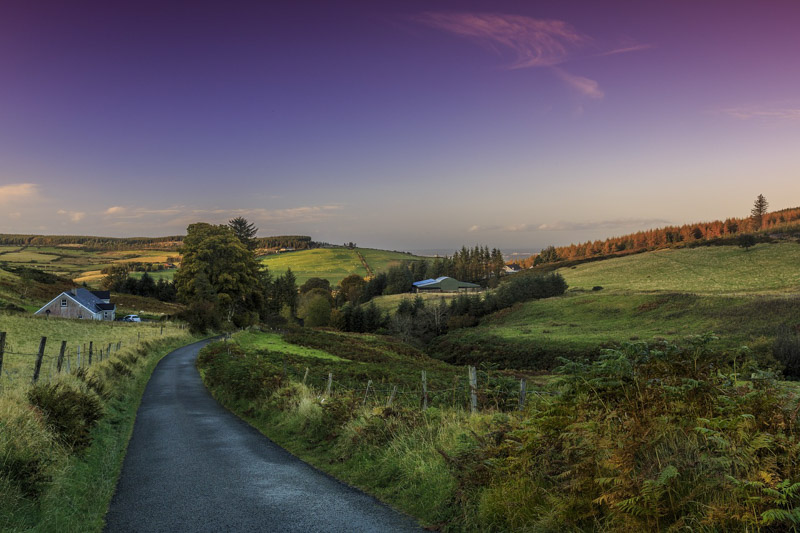
If you’re renting a car, the left-hand driving becomes second nature quickly, but the roads themselves are a different story. Rural lanes in Connemara, Kerry, and Clare can be incredibly narrow, with passing challenging in many places.
Go slow, be patient with oncoming traffic, and don’t underestimate drive times. Our complete guide to driving in Ireland covers everything worth knowing before you get behind the wheel.
Card vs. Cash

The vast majority of restaurants, shops, and attractions in Ireland are card-friendly.
That said, some rural pubs, farmers’ markets, and roadside car parks still run cash only, so it’s worth keeping €20-30 on you at all times.
Frequently Asked Questions
Here are the questions I see most often about planning a 10-day Ireland trip.
Is 10 days enough to see Ireland?
Ten days is a solid amount of time to cover the highlights, but you won’t see everything, and that’s fine. The key is to pick a route and commit to it rather than trying to zigzag the whole island.
Do I need a car for a 10-day Ireland itinerary?
For any itinerary that takes you outside Dublin, a car makes a huge difference.
Galway, Cork and the Cliffs of Moher area are all manageable without one, but you’ll be dependent on tours and limited bus schedules, which cuts your flexibility significantly.
What is the best time of year for 10 days in Ireland?
May, June, and September are the sweet spots: longer daylight hours, fewer crowds than July and August, and better odds of dry weather.
Ireland is visitable year-round. Our guide to the best time to visit Ireland breaks it down month by month if you want the full picture.
How much does a 10-day Ireland trip cost?
Budget roughly €100-130 per person per day for mid-range travel, covering accommodation, food, fuel, and a few paid attractions.
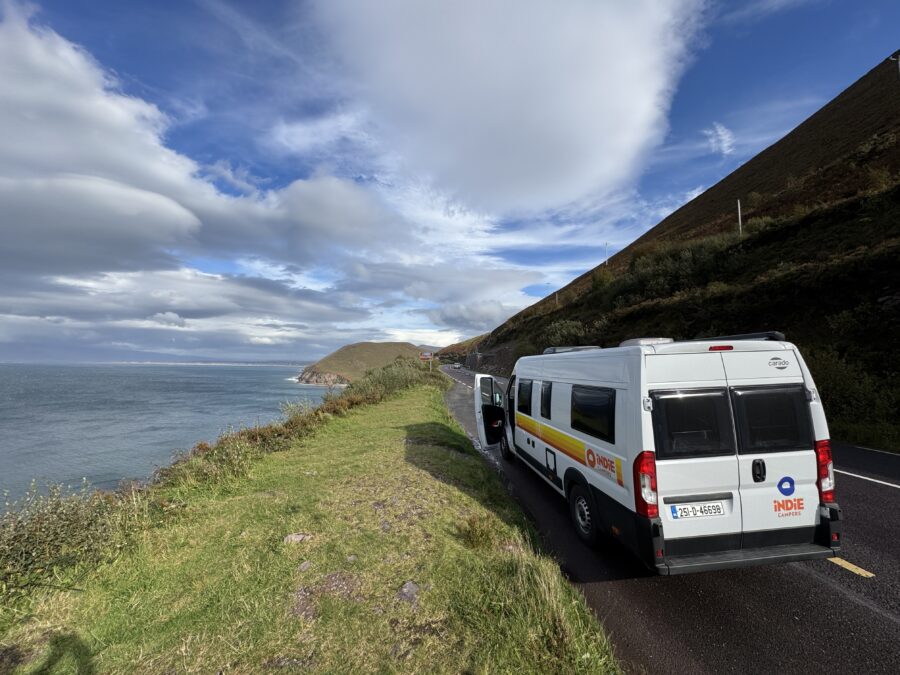
You can trim that down by self-catering, Tips For Camping In Ireland And What To Bring, renting a campervan, and skipping the pricier tours, or push it up considerably if you’re staying in country house hotels and eating out every night.
Can I do this itinerary without visiting Northern Ireland?
Absolutely. The Republic alone has more than enough to fill 10 days comfortably.
Is this itinerary suitable for first-time visitors?
Yes, and it’s probably ideal for first-timers. It hits the places that are top of every tourist’s travel list: Dublin, the Wild Atlantic Way, Killarney, Galway.
If you’ve already ticked those off, consider a route focused on Ireland’s smaller towns for something less obvious.
Final Thoughts
Ten days is the perfect amount of time in Ireland, and this itinerary uses it well.
You get Dublin without rushing it, the Wild Atlantic Way at a pace that actually lets you stop and look around, and enough time in Killarney and Galway to feel like you’ve been somewhere rather than just passed through.
What it doesn’t cover: the north coast, Belfast, the Causeway Coast, Connemara, and most of the smaller towns. Make sure to book your rental car early, especially for summer travel when availability drops fast.
Figure out your Dublin accommodation before anything else, since the city gets expensive quickly when options are limited. And, build at least one loose day into the itinerary, somewhere in the west, where you’re not trying to tick anything off.
Like it? Pin it!
Save this guide for later